
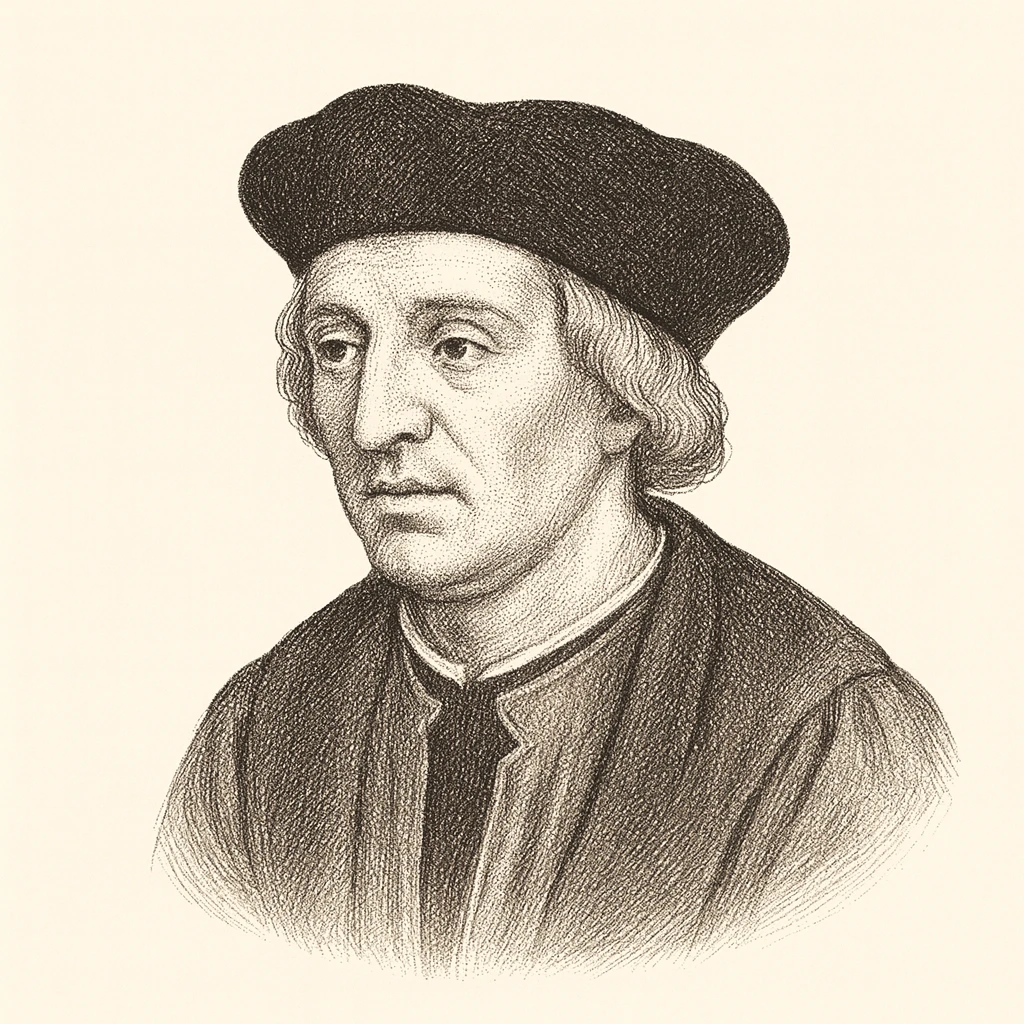
John of Salisbury studied at Paris under Abelard, served two archbishops of Canterbury as secretary, stood beside Thomas Becket in the quarrel with Henry II, was present in the cathedral when Becket was murdered, and ended as Bishop of Chartres. He was also the best Latinist of his century and knew more classical literature than almost anyone between the fall of Rome and Petrarch.
The Policraticus, finished in 1159, is the first substantial treatise on politics written in the medieval West, and it is organized around a metaphor that would govern European political language for four hundred years. The commonwealth is a body: the prince is the head, the senate the heart, judges and governors the eyes and ears, soldiers the hands, financial officers the stomach, and the peasantry the feet, which touch the soil and must be protected because the whole body falls if they give way. The image gave political argument a vocabulary of function, proportion and mutual dependence in which harm to one part is injury to all.
Its most consequential claim concerns the ruler who fails that function. John distinguishes the prince, who governs according to law and serves the commonwealth, from the tyrant, who oppresses it by force and treats public power as private property. The prince is the image of the divine; the tyrant is an image of its opposite. And because the tyrant has broken the bond that made obedience owed, John concludes that it is not merely permitted but just to kill him. He hedges the doctrine with conditions — no poison, no violation of an oath of fealty — but the doctrine is there, stated plainly, three centuries before anyone else in the Latin west would go so far. It was quarried by every later writer on resistance, by conciliarists, by the Huguenot monarchomachs after 1572, and by the defenders of the English regicide.
The Metalogicon, written the same year, is a defense of the liberal arts against those who thought logic and grammar a waste of a clerical career. It contains the sentence, attributed to his teacher Bernard of Chartres, about standing on the shoulders of giants.
Wondering where you land? Take the 4-minute assessment