
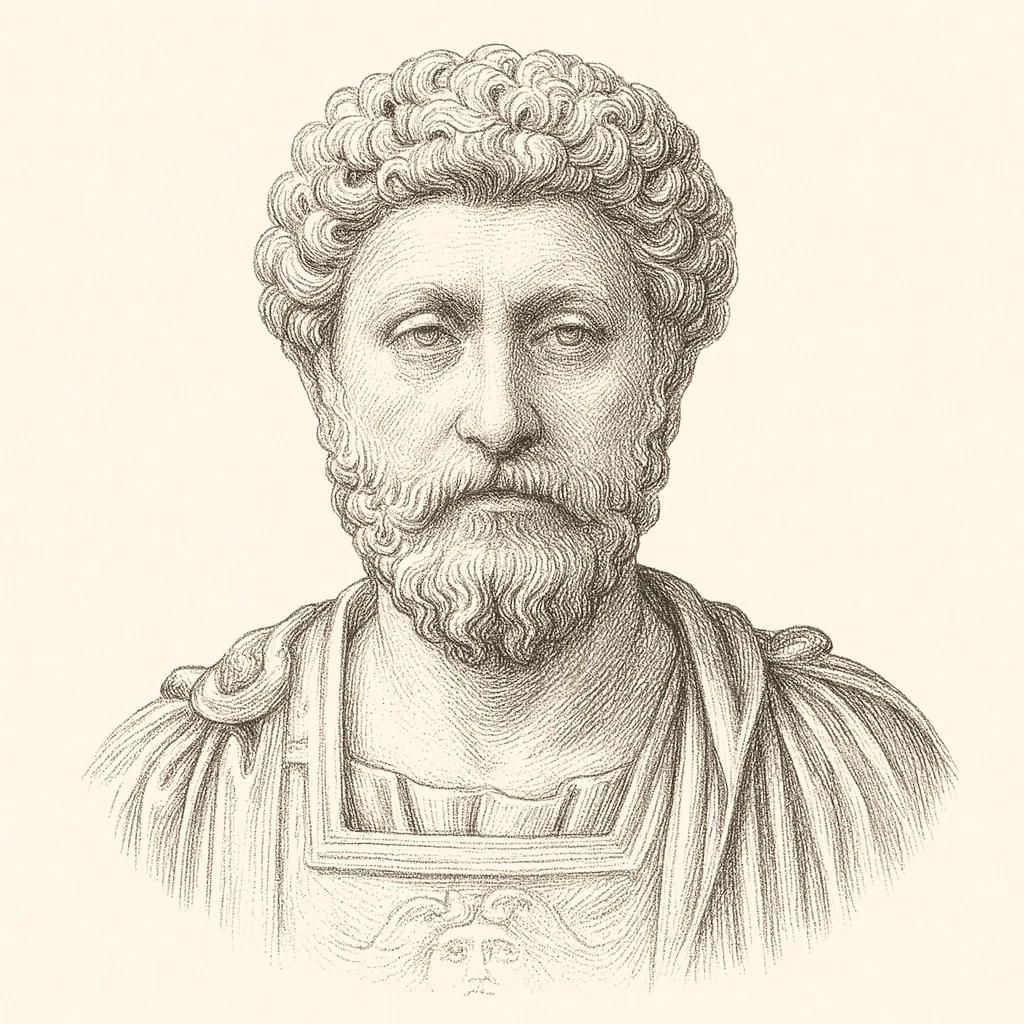
Marcus Aurelius Antoninus was born in 121 AD in Rome, into a family of Spanish origin that had risen to senatorial rank, and was adopted at the age of seventeen by the Emperor Antoninus Pius at the request of the Emperor Hadrian, who had identified Marcus as a young man of exceptional character. The adoption placed him in the direct line of imperial succession and committed him to a philosophical education under the finest teachers available in Rome -- Fronto, the great rhetorician, for Latin literature; Herodes Atticus and Aelius Aristides for Greek; and, most importantly, a series of Stoic philosophers, above all Quintus Junius Rusticus, who introduced him to the works of Epictetus and shaped the philosophical outlook that would organize his inner life for the next four decades.
He became emperor in 161 AD at the age of thirty-nine, jointly with his adoptive brother Lucius Verus, and ruled until his death in 180. The reign was not peaceful. The Antonine period that preceded him had been the era that Edward Gibbon would later identify as the high point of human happiness, when the Roman world was governed by a sequence of wise and capable emperors. Marcus's reign was beset by war: the Parthians in the east, the Germanic tribes across the Danube in the north, and -- most devastating -- the Antonine Plague, a pandemic that swept through the empire beginning in 165 and killed millions over the following decades. He spent much of his reign on campaign, commanding armies in the field, administering an empire under conditions of almost continuous crisis.
The Meditations -- which he called simply "To Myself" and which he almost certainly never intended to publish -- were written during these years on campaign, in Greek, in spare moments between military operations and imperial administration. They were a series of short entries, sometimes a sentence, sometimes several paragraphs, organized not by subject but by the rhythm of daily reflection: reminders to himself of the Stoic principles he was trying to live by, reproaches for his failures, arguments against the temptations that power and comfort offered. They were, as Gibbon described them, "a work of the most genuine and noble virtue," and they have been continuously read and cited from their composition to the present day -- by Descartes, by Frederick the Great, by John Stuart Mill, by Matthew Arnold, by Wen Jiabao, by the stoicism revival of the early twenty-first century.
The Stoic framework within which the Meditations operated was not Marcus's invention but the culmination of a philosophical tradition that ran from Zeno of Citium through Chrysippus, Panaetius, Posidonius, Cicero, Seneca, and Epictetus. Its central claims were: that virtue was the only genuine good; that external things -- wealth, reputation, pleasure, health, even life itself -- were "preferred indifferents," things that it was reasonable to prefer but that should not determine one's fundamental orientation toward the world; that rational self-governance, the alignment of one's will with reason and with the natural order, was the foundation of genuine human happiness; and that all human beings shared in the universal reason (logos) that governed the cosmos, and were therefore members of a single cosmopolitan community whose claims could not be overridden by local loyalty.
The political implications were significant. Marcus's Stoicism committed him to a conception of human dignity that transcended social position: the slave had the same rational nature as the emperor, and the emperor's obligations to the slave were not merely legal but moral. His cosmopolitanism committed him to a conception of justice that transcended Roman citizenship: the good of humanity as a whole was the appropriate end of political action, not the good of Rome in particular. His insistence on the life of reason as the only genuine good committed him to a modesty about his own achievements and a skepticism about the political importance of military victory, territorial expansion, and imperial glory that was remarkable in someone with the power to pursue all three.
He was also, at his worst, capable of persecuting Christians with a consistency that his Stoic philosophy should have restrained. The persecutions under his reign were not as savage as those of Nero or Diocletian, but they were systematic, and Marcus apparently found the Christians' ostentatious willingness to die for their beliefs more contemptible than admirable -- a theatrical stubbornness that contrasted unfavorably with the rational equanimity that genuine Stoic indifference to death should have produced. This tension between the cosmopolitan implications of his philosophy and his administration's treatment of religious minorities who refused assimilation is the most uncomfortable element of his legacy.
He died on campaign in Vindobona -- modern Vienna -- in 180, possibly of the plague. The succession passed to his son Commodus, whose reign was a catastrophe that Marcus's philosophical preparation could not have predicted and his administrative arrangements did nothing to prevent. The Meditations were preserved, circulated, and eventually printed, becoming one of the most widely read texts in the subsequent history of Western civilization -- a private journal by a man who commanded armies and administered an empire, devoted to the question of how to live well under conditions that made living well almost impossibly difficult.
Marcus Aurelius is associated with Pragmatic Centrist. See the archetype