
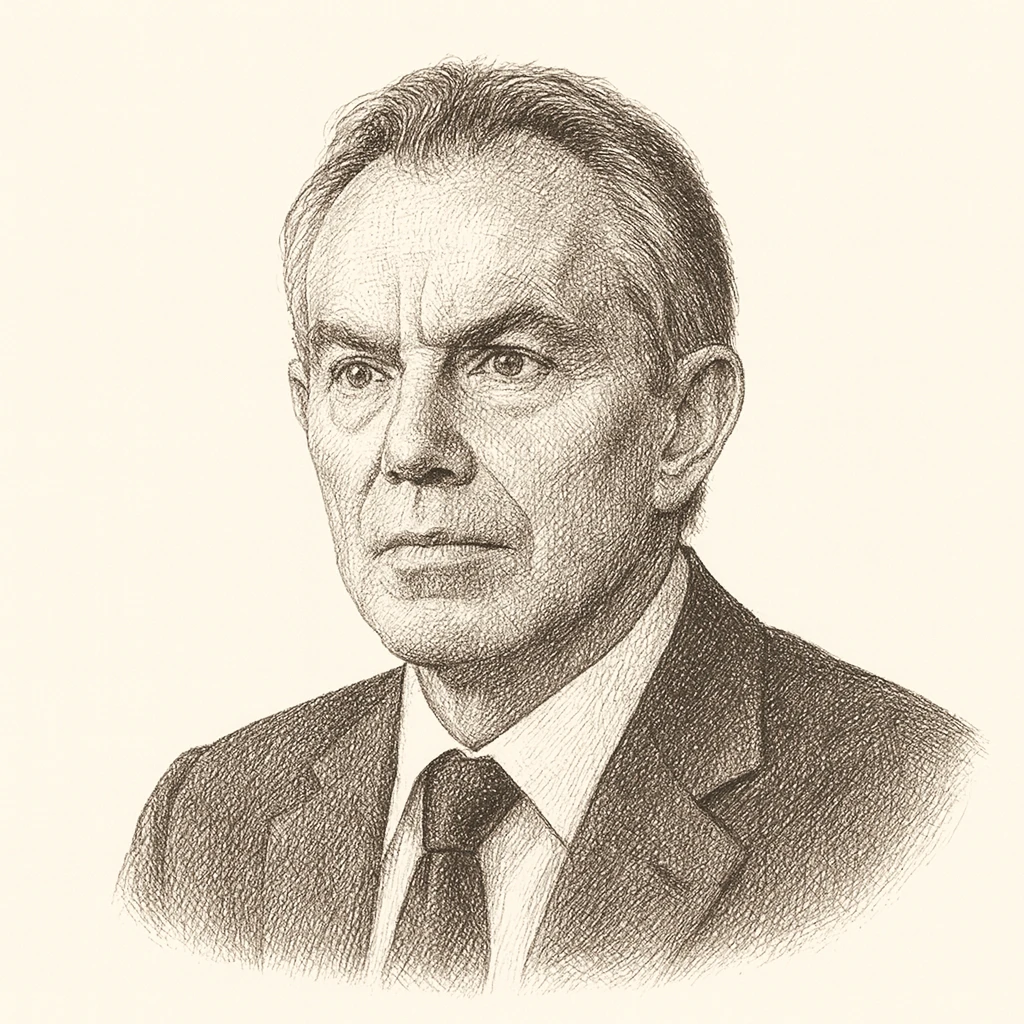
Tony Blair is the political figure most closely associated with the "New Labour" project and the broader "Third Way" current that reshaped social-democratic parties in the 1990s. As leader of the British Labour Party from 1994 and Prime Minister from 1997 to 2007, he argued that the left had to abandon its historic commitment to state ownership and class-based politics in order to win and govern in an era of globalized markets. The symbolic centerpiece of this repositioning was the rewriting of Clause IV of Labour's constitution, which had committed the party to common ownership of the means of production. Blair recast Labour as a party comfortable with private enterprise, aspiration, and fiscal discipline while retaining a commitment to public services and social investment.
Intellectually, Blairism drew on the idea, developed in dialogue with sociologist Anthony Giddens, that traditional divisions between left and right had been overtaken by economic and social change. The Third Way sought to combine market efficiency and wealth creation with social justice, arguing that opportunity, responsibility, and community should replace older redistributive language. In practice this meant accepting much of the Thatcherite economic settlement while directing its proceeds toward health, education, and anti-poverty measures. Critics on the left saw this as a capitulation to neoliberalism; defenders saw a pragmatic modernization that made progressive government electable and durable.
Blair's political thought is equally defined by his approach to foreign policy, often described as liberal interventionism. He advanced the view that the international community could be justified in intervening, including militarily, to prevent humanitarian catastrophe or confront threats, framing this as a moral rather than purely strategic duty. This outlook shaped Britain's involvement in interventions during the 1990s and, most consequentially, its participation in the 2003 invasion of Iraq alongside the United States. Iraq became the defining controversy of his premiership, sharply dividing opinion and permanently complicating assessments of his legacy.
Blair's influence extends well beyond Britain. He became an international reference point for centrist and center-left leaders seeking to reconcile social democracy with market globalization, and "Blairism" entered political vocabulary as a shorthand for that synthesis. His record continues to structure debates within the Labour Party and among European progressives about whether electoral success requires moving toward the center or reasserting a more distinctly left program.
Tony Blair is associated with Cosmopolitan. See the archetype