
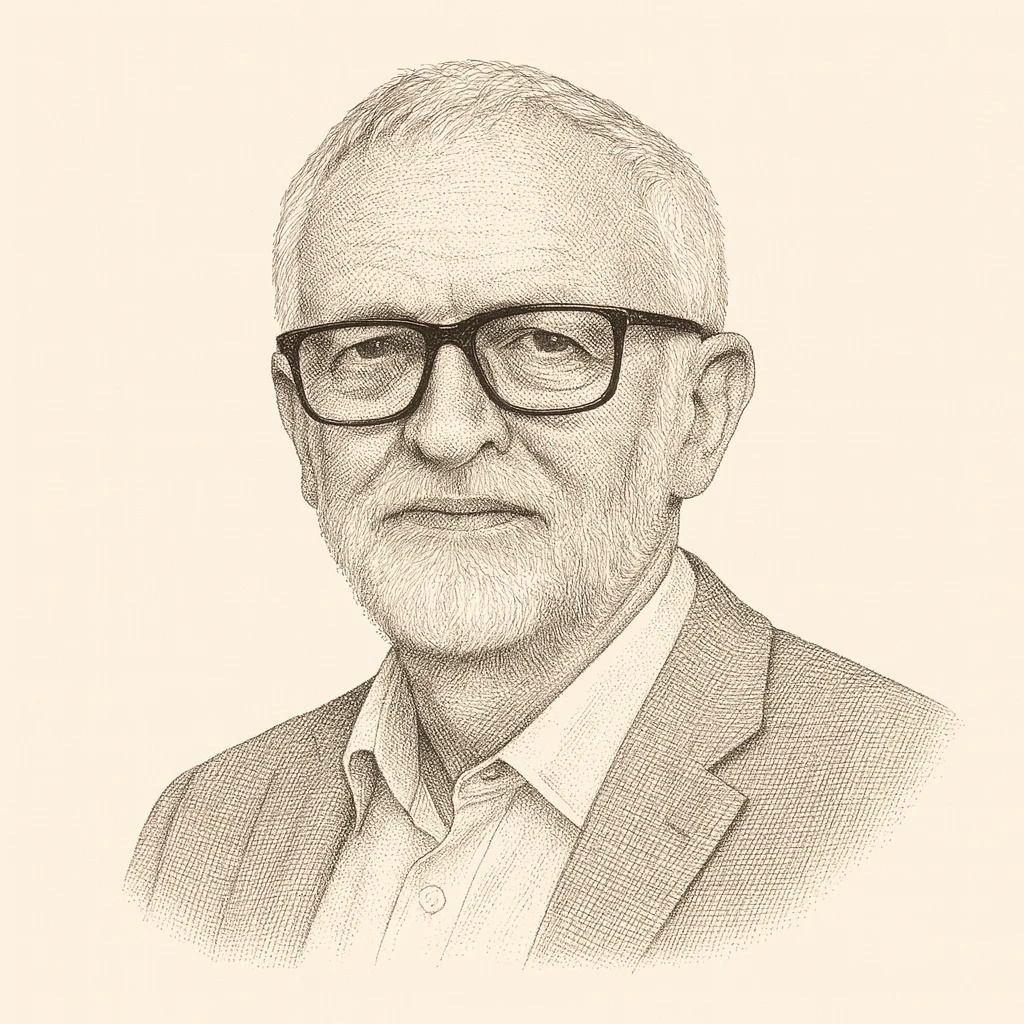
Jeremy Corbyn's political thought sits squarely within the British democratic-socialist and Bennite tradition, named for Tony Benn, with whom Corbyn was closely allied during decades on Labour's backbenches. For most of his career he was a persistent parliamentary dissenter, associated with causes on the party's left: nationalization of key utilities and services, redistribution through progressive taxation, opposition to nuclear weapons, and skepticism of military intervention. His outlook combined a belief in an active, interventionist state as an instrument of economic justice with a grassroots, movement-oriented conception of politics that prized mass membership and participation over centralized managerial leadership.
Corbyn's improbable election as Labour leader in 2015, riding a wave of enthusiasm among younger and newly enrolled members, marked a decisive break from the New Labour centrism of the preceding two decades. Under his leadership Labour advanced an unambiguously anti-austerity platform, arguing that public spending, investment, and reversing privatization offered an alternative to the fiscal consolidation pursued after the 2008 financial crisis. The 2017 general election, in which Labour gained seats on a radical manifesto, was read by supporters as evidence that a frankly socialist program could command broad appeal, while the party's heavy defeat in 2019 became a focal point for arguments about the limits of that project.
His tenure was seriously contested. The period saw sustained controversy over the handling of antisemitism within the party, culminating in a critical report by the Equality and Human Rights Commission; Corbyn was subsequently suspended from the Parliamentary Labour Party, and his response to the report proved a lasting point of division. Critics also attacked his foreign-policy positions and past associations as evidence of a reflexive anti-Western instinct, while supporters defended them as principled anti-imperialism.
Beyond his own electoral record, Corbyn matters as a symbol of the enduring appeal—and the internal contradictions—of a socialism that refuses to accommodate itself to market orthodoxy. For a generation drawn into politics through his campaigns, he embodied the idea that the Labour Party could again be a vehicle for transformative rather than merely ameliorative change, reviving debates about ownership, class, and the purpose of the state that mainstream British politics had treated as settled.
Jeremy Corbyn is associated with Trad Socialist. See the archetype