
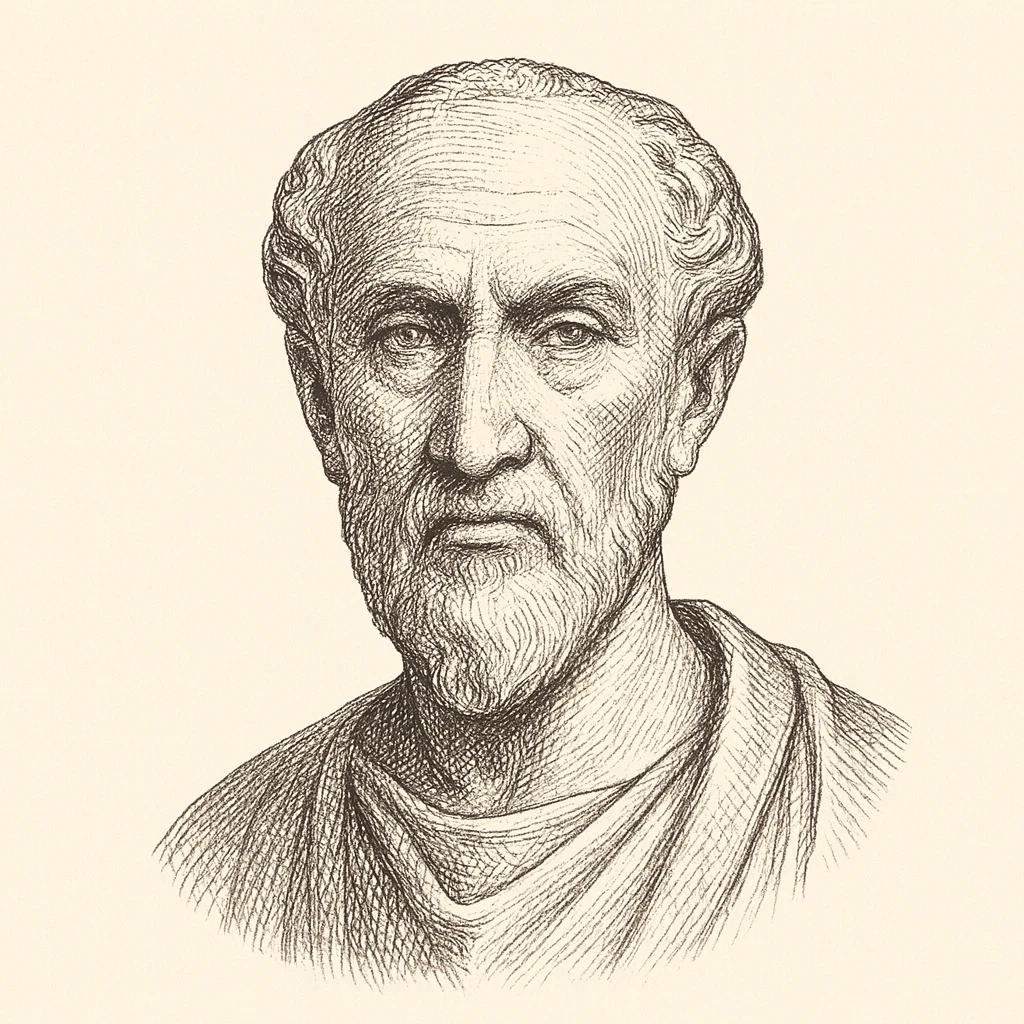
Plotinus was born in Egypt, studied in Alexandria for eleven years under Ammonius Saccas, joined a Roman expedition to Persia in the hope of meeting Indian and Persian philosophers, escaped when it collapsed, and settled in Rome as a teacher. His pupil Porphyry collected his writings after his death, arranged them into six groups of nine, and gave them the name they still carry: the Enneads.
He regarded himself as an interpreter of Plato, and what he produced was a system Plato would not have recognized. Reality descends from a first principle he calls the One, which is beyond being and beyond description — not a thing that exists but the source of there being anything. From the One proceeds Intellect, in which all forms are thought together; from Intellect proceeds Soul, which is the principle of life and motion; and at the far edge of the procession is matter, which is not a rival power but the point at which reality thins out into near-nothing. Evil is not a substance but a privation, a distance from the source.
The corresponding movement is upward. Since the soul retains a connection to what it came from, the philosophical life is a return: a turning away from the dispersion of sense towards the unity from which everything descends, ending in a union with the One that is not knowledge, because knowledge requires a knower and something known. Porphyry records that Plotinus reached it four times in the years they were together.
The political content is thin, and that is itself the point — this is a philosophy of withdrawal at a moment when the empire was disintegrating. Its influence, however, is difficult to overstate. Augustine read Plotinus in translation shortly before his conversion and said the books of the Platonists taught him to look for an incorporeal reality; the account of evil as privation, which allowed Christianity a reply to the Manichees, comes straight from the Enneads. Through the Arabic tradition — where a paraphrase circulated under Aristotle's name — Plotinus shaped al-Farabi and Avicenna. Through Pseudo-Dionysius he shaped medieval mysticism; through Ficino he shaped the Renaissance. Almost every European account of a reality ordered in degrees, with the divine at the top and matter at the bottom, descends from him.
Wondering where you land? Take the 4-minute assessment