
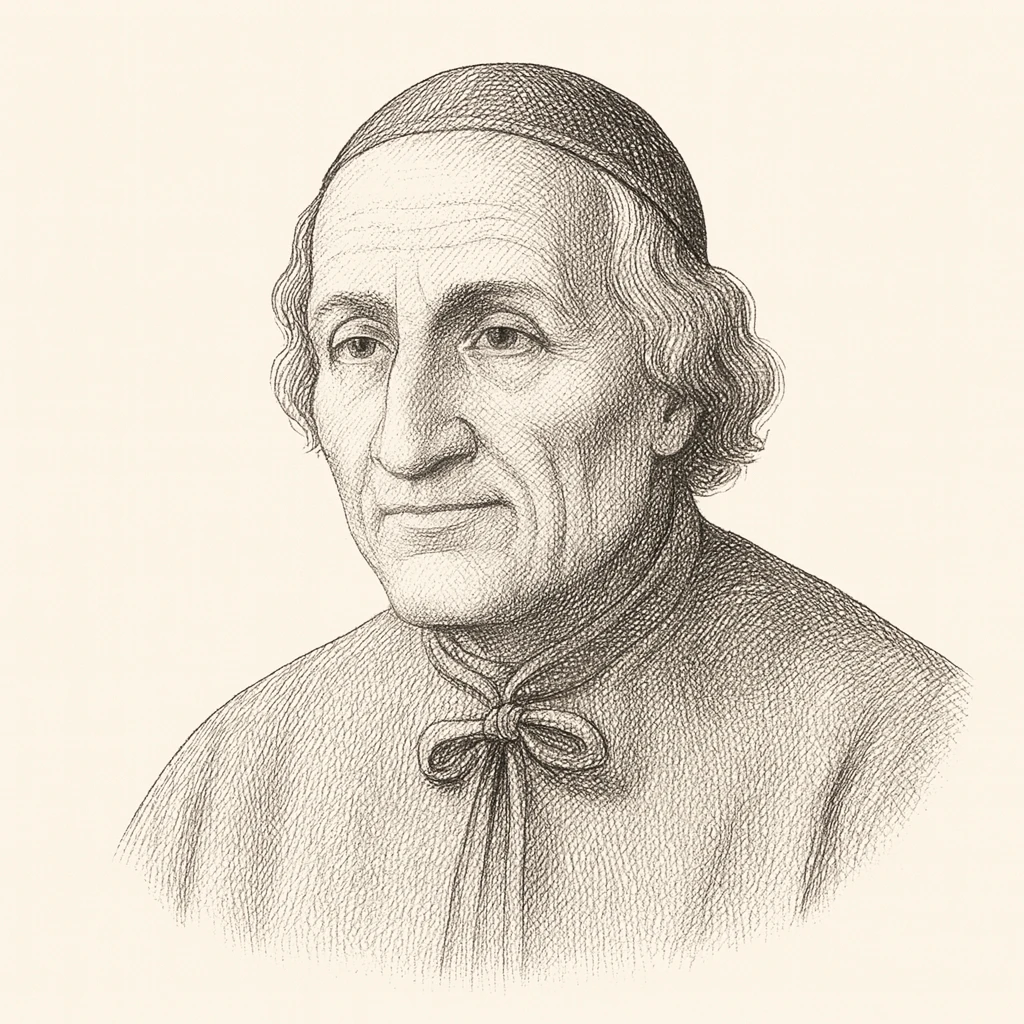
Marsilio Ficino was installed by Cosimo de' Medici in a villa at Careggi with a commission: to translate Plato. He completed the whole corpus by 1469 — the first complete Latin Plato in the West — and then translated Plotinus, Porphyry, Iamblichus and the Hermetic writings besides. Whatever else the Renaissance did, this is the moment at which Plato became directly available to European readers rather than known by report through Aristotle's criticisms.
Ficino was not a neutral translator. His Platonic Theology argues for the immortality of the soul as the pivot of a system in which reality descends from God through angelic mind, soul, quality and body, and the human soul occupies the middle rank, able to move in either direction. The soul is the knot binding the universe, and its dignity consists in that mobility. The framework is Plotinus adapted to Christianity, and Ficino, who was ordained in 1473, saw no conflict: he believed a single ancient theology ran from Hermes and Zoroaster through Plato to the Gospels, and that recovering it would return philosophy and religion to the unity they had lost.
His theory of love had the widest reach. In the commentary on the Symposium he describes a love that ascends from the beauty of a particular body to the beauty of soul and thence to the divine, and coins the phrase amor platonicus for a bond between two people that is spiritual rather than physical. Platonic love in the modern sense begins here, though Ficino meant something considerably more strenuous than the phrase now suggests.
He also practiced astrological medicine and wrote a book on regulating the life of scholars by planetary influences, which the church viewed with suspicion and which his defenders have always found awkward. It is of a piece with the rest: a universe of graded correspondences in which the human soul can act on the cosmos as well as be acted on. That vision — hierarchy, correspondence, the dignity of the soul at the center — is the intellectual scaffolding behind a great deal of Renaissance painting, poetry and magic alike.
Wondering where you land? Take the 4-minute assessment