
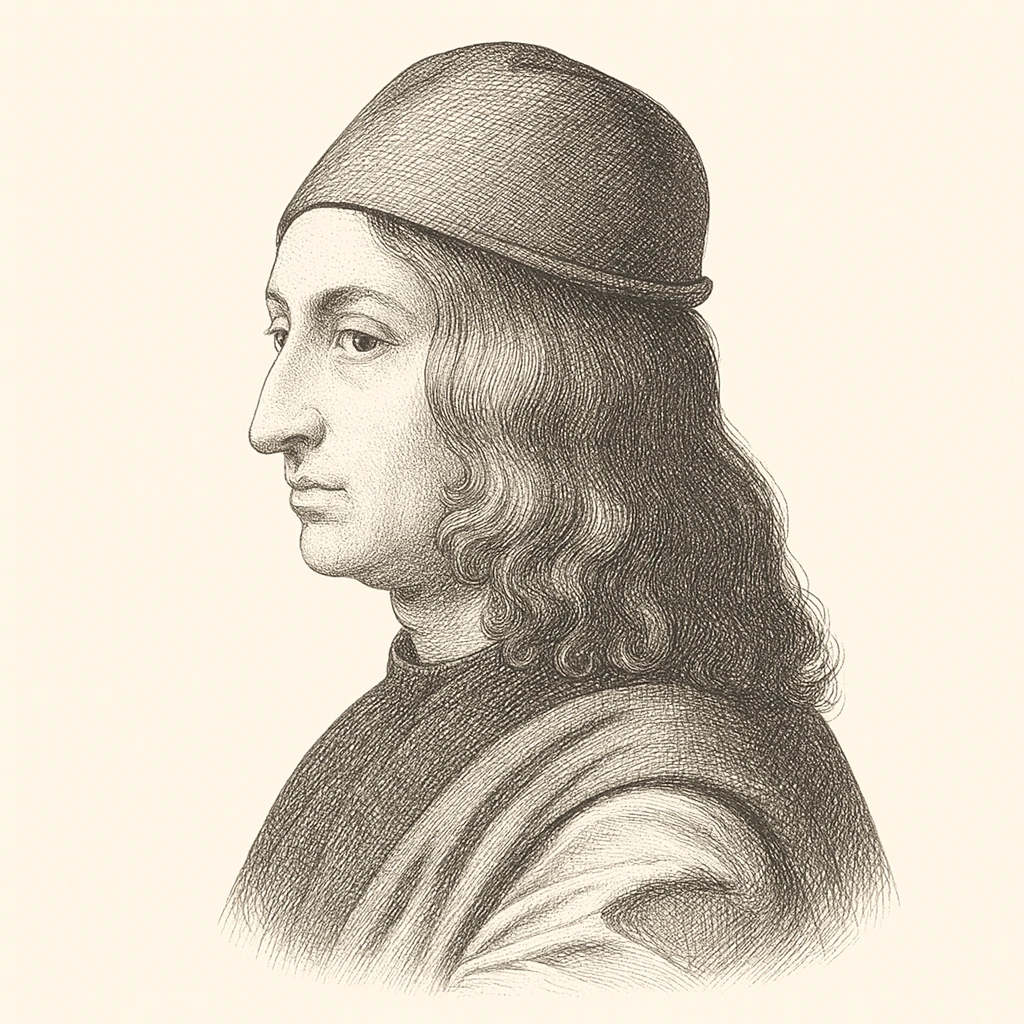
Pico della Mirandola was a count who could read Latin, Greek, Hebrew, Arabic and Aramaic, and who at twenty-three published nine hundred theses drawn from every philosophical and religious tradition he could reach, offering to defend them against all comers in Rome at his own expense. The disputation never happened. A papal commission condemned thirteen of the theses, Pico published a defense, Innocent VIII condemned all nine hundred, and he fled to France and was arrested. He was pardoned by Alexander VI in 1493 and died the following year at thirty-one, probably poisoned by his secretary.
The Oration written to introduce the disputation was not published in his lifetime and is now the most anthologized text of the Italian Renaissance. Its argument is that God gave every other creature a determinate nature and gave man none: placed at the center of the world, with no fixed seat, no proper form and no gift peculiar to him, man may sink to the level of the beasts or be reborn into the divine, according to what he wills. Dignity consists precisely in the absence of a given essence. The passage has been read as the charter of Renaissance individualism, as an anticipation of existentialist self-creation, and — by scholars who have read the rest of the Oration — as a much more conventional Neoplatonic account of ascent through purification, since the freedom Pico describes is freedom to climb a ladder whose rungs are fixed.
The nine hundred theses matter as much as the Oration. Pico's premise was that Plato and Aristotle agree, that the Arabic and Jewish philosophers are worth quarrying, and above all that the Kabbalah confirms Christianity — he was the first Christian to take Hebrew mystical texts seriously as philosophy, and Christian Kabbalah begins with him. His Disputations Against Astrology, written at the end of his life, attacks the astrological determinism his friend Ficino had embraced, on the ground that it contradicts the freedom the Oration had asserted; Kepler took the arguments seriously.
Wondering where you land? Take the 4-minute assessment