
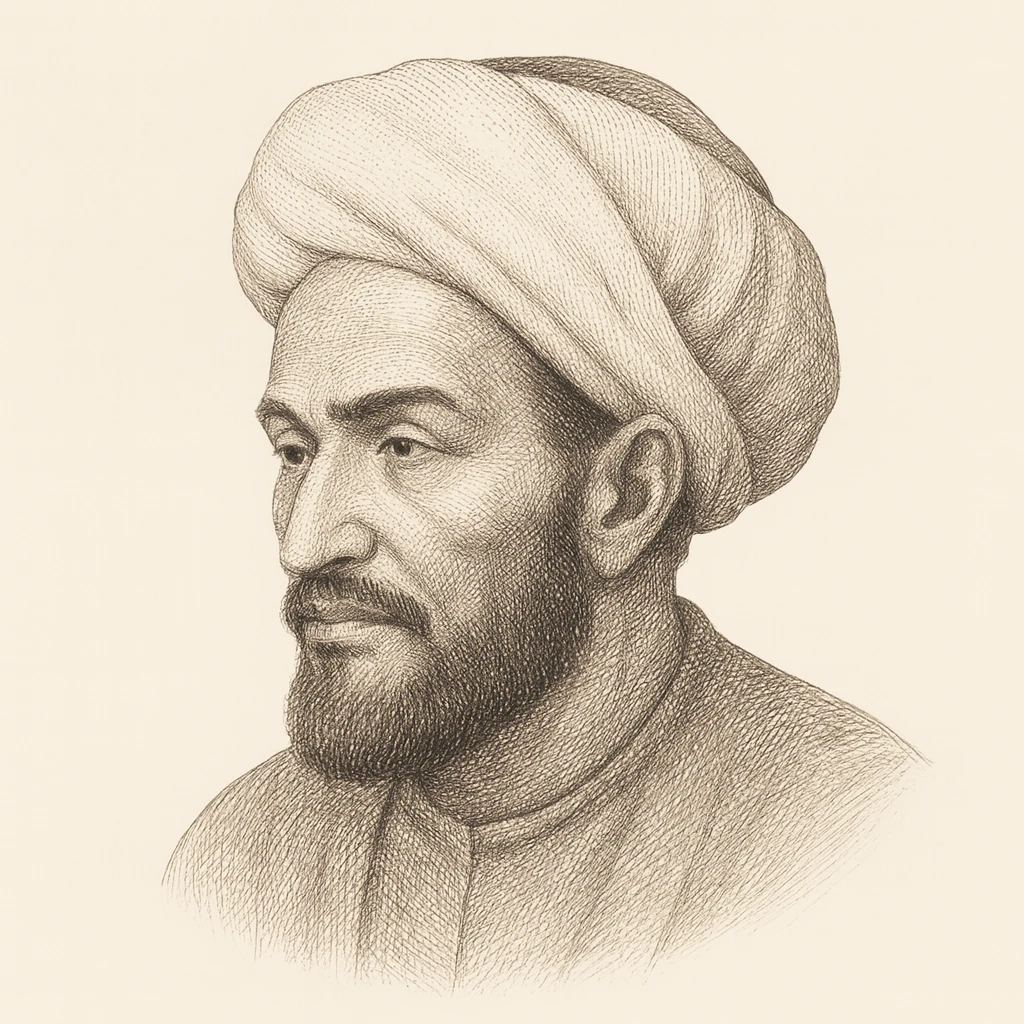
Al-Farabi was born in Transoxiana, taught in Baghdad when it was the intellectual center of the world, and died in Damascus. He was called the Second Teacher — Aristotle being the first — and the title records what his successors thought he had done: made the Greek philosophical inheritance usable in a culture organized around revealed law.
His logical and metaphysical work was the foundation on which Avicenna built, and Avicenna records that he understood Aristotle's Metaphysics only after reading al-Farabi's commentary on it. But the distinctive achievement is political, and it is Platonic rather than Aristotelian. Where the Latin west would receive its politics through Aristotle, al-Farabi had the Republic and the Laws, and he used them to think about prophecy. The Virtuous City describes a community ordered towards genuine human perfection, arranged in a hierarchy that mirrors the descent of being from the First Cause, and governed by a ruler who unites in one person what Plato had assigned to the philosopher-king and Islam to the prophet.
The mechanism is his account of the imagination. Philosophical truth is grasped by demonstration and is available to few; the same truths can be received in images and symbols by a powerful imaginative faculty and communicated to everyone. Prophecy, on this account, is not a rival to philosophy but its popular presentation — religion is philosophy in symbols, suited to the multitude. He classifies the defective cities that result when a community aims at wealth, honor, domination or pleasure instead, in a taxonomy that reads as a Platonic diagnosis of actually existing politics.
The consequences were long. Avicenna took over the framework and made it the standard metaphysics of the Islamic east. Maimonides, who told his translator that al-Farabi's works were all excellent and worth study, built the account of prophecy in the Guide of the Perplexed on it, and through the Guide it entered Latin scholasticism. Averroes read him closely. Aquinas engaged the whole tradition al-Farabi began. And the claim that the philosopher must speak differently to the many than to the few made him, in the twentieth century, central to Leo Strauss's argument about the necessity of esoteric writing.
Wondering where you land? Take the 4-minute assessment