
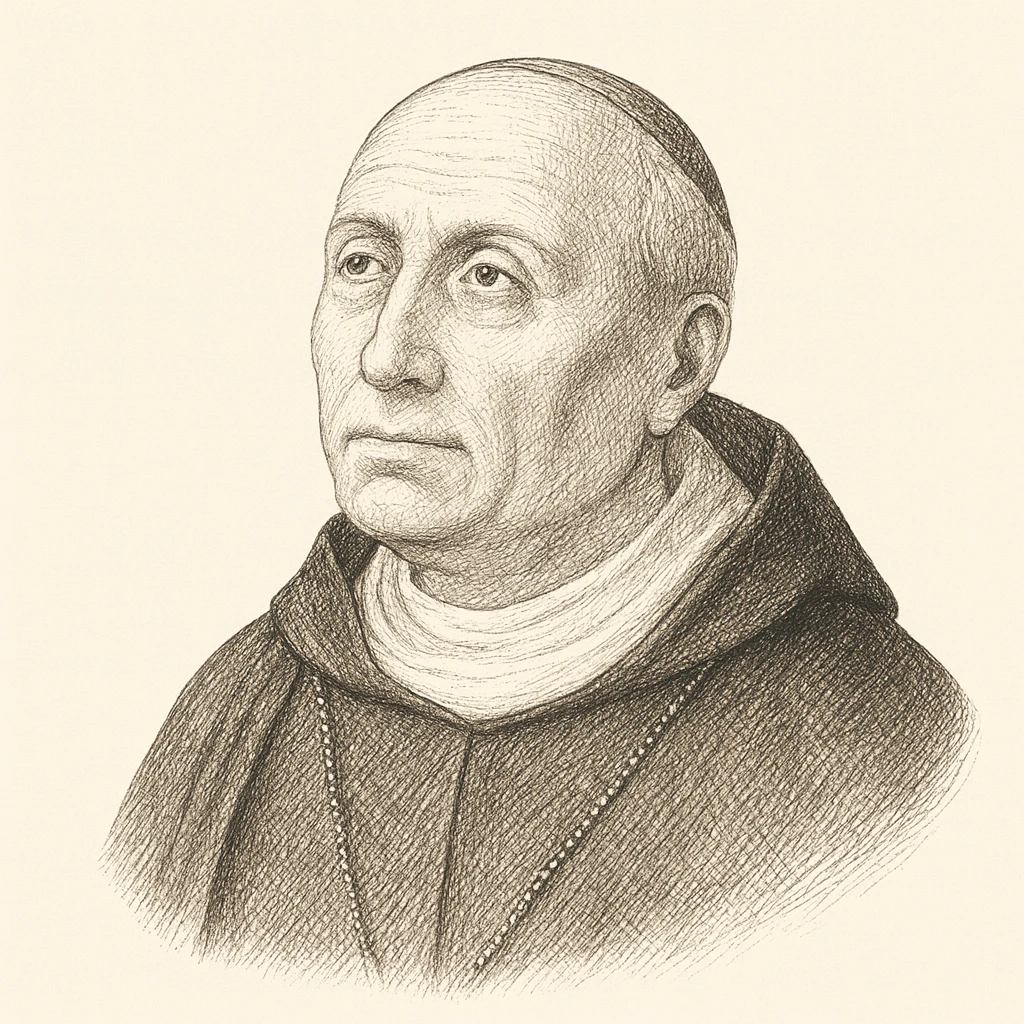
Nicholas of Cusa was a boatman's son from the Moselle who became a cardinal, a papal legate, and one of the last figures able to stand with a foot in the medieval and the modern world at once. He collected manuscripts, corrected the calendar, argued that the earth moves and that the universe has no circumference, and wrote the most original metaphysics of the fifteenth century.
De Concordantia Catholica, written for the Council of Basel in 1433 when he was still a conciliarist, contains the political argument. All legitimate authority, he holds, rests on consent, because all men are by nature equally free and no one may rule another without agreement; rulership therefore arises from the elective concurrence of those subject to it, and a law binds because it has been consented to. He applies this to church and empire alike, proposing regular councils, an elective structure, and a harmony in which each level of authority is constituted from below while remaining ordered to a unity above. Few medieval texts state the consensual basis of government so flatly, and none combine it with so elaborate an account of hierarchy.
He then changed sides. When Basel overreached and elected an antipope, Cusa went over to Eugenius IV and spent the rest of his career as a papal servant, which his critics never let him forget.
De Docta Ignorantia, finished in 1440, is the philosophical work. Its premise is that the infinite is not reachable by proportion: since knowing is comparing, and the infinite exceeds every ratio to the finite, God cannot be known as objects are known. What is available is learned ignorance — an exact grasp of why the thing exceeds us. In God opposites coincide, as in an infinite circle the curve and the straight line become one; the images are geometrical because he thought mathematics the least misleading route to what cannot be said. From the same premises he denied that the universe has a fixed center or a bounding sphere, a century before Copernicus and without a telescope.
He also wrote De Pace Fidei after the fall of Constantinople in 1453 — a dialogue in which representatives of every religion discover a single faith beneath the variety of rites. It is among the earliest European arguments for religious peace on principle rather than exhaustion.
Wondering where you land? Take the 4-minute assessment