
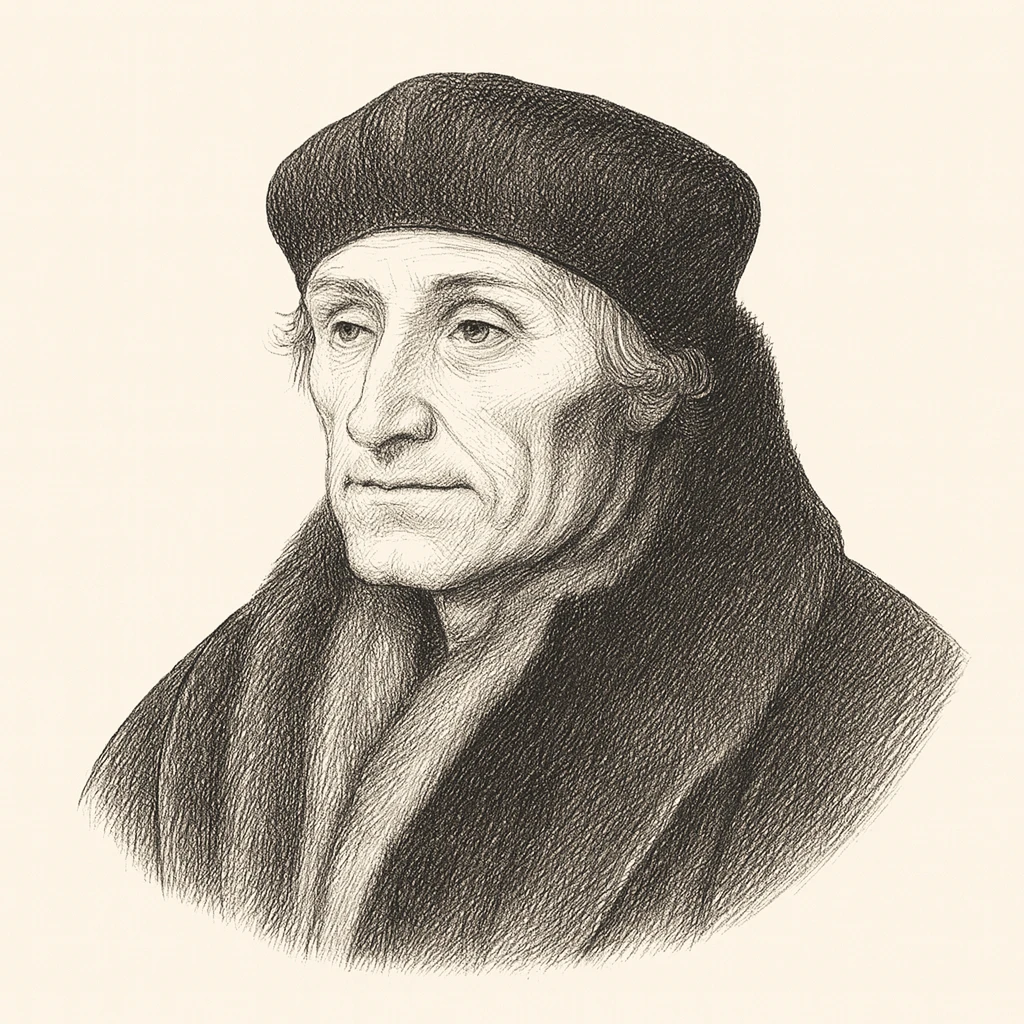
Erasmus was the illegitimate son of a priest, an unwilling Augustinian canon, and by the 1510s the most famous living writer in Europe, corresponding with popes, kings and reformers and belonging to none of their parties. He wrote in Latin of exceptional grace, edited the Church Fathers, and produced in the Adages a collection of classical proverbs that functioned as the common cultural currency of educated Europe.
His decisive work is the Novum Instrumentum of 1516, the first published Greek New Testament, printed with his own Latin translation alongside and notes justifying his departures from the Vulgate. The implication was radical whatever his intentions: the church's authorized text was a translation, translations can be wrong, and the original could be consulted. Luther translated from Erasmus's Greek. Tyndale used it. The reformers' appeal to scripture over tradition rested on the assumption Erasmus had made practical.
His own program was the philosophia Christi — a Christianity of inward disposition and imitation rather than of ceremony, scholastic subtlety or ecclesiastical machinery. The Praise of Folly satirizes monks, theologians and popes with a lightness that made it enormously popular and enormously resented. The Education of a Christian Prince, written for the future Charles V, argues that a ruler exists for his subjects, that war is almost never justified, and that a prince who taxes his people to fund glory is a thief — a mirror for princes as different from Machiavelli's Prince, published in manuscript three years later, as two books on one subject can be.
When the break came he refused it. The dispute with Luther over free will in 1524-25 is the pivot: Erasmus argued that scripture is obscure on the question, that humility about what cannot be settled is the proper posture, and that some human cooperation in salvation must be preserved or moral effort becomes meaningless. Luther replied with contempt, insisting that assertion is the mark of a Christian. Erasmus was thereafter attacked from both sides, and the label affixed to him — that he laid the egg Luther hatched — was meant as an accusation.
Wondering where you land? Take the 4-minute assessment