
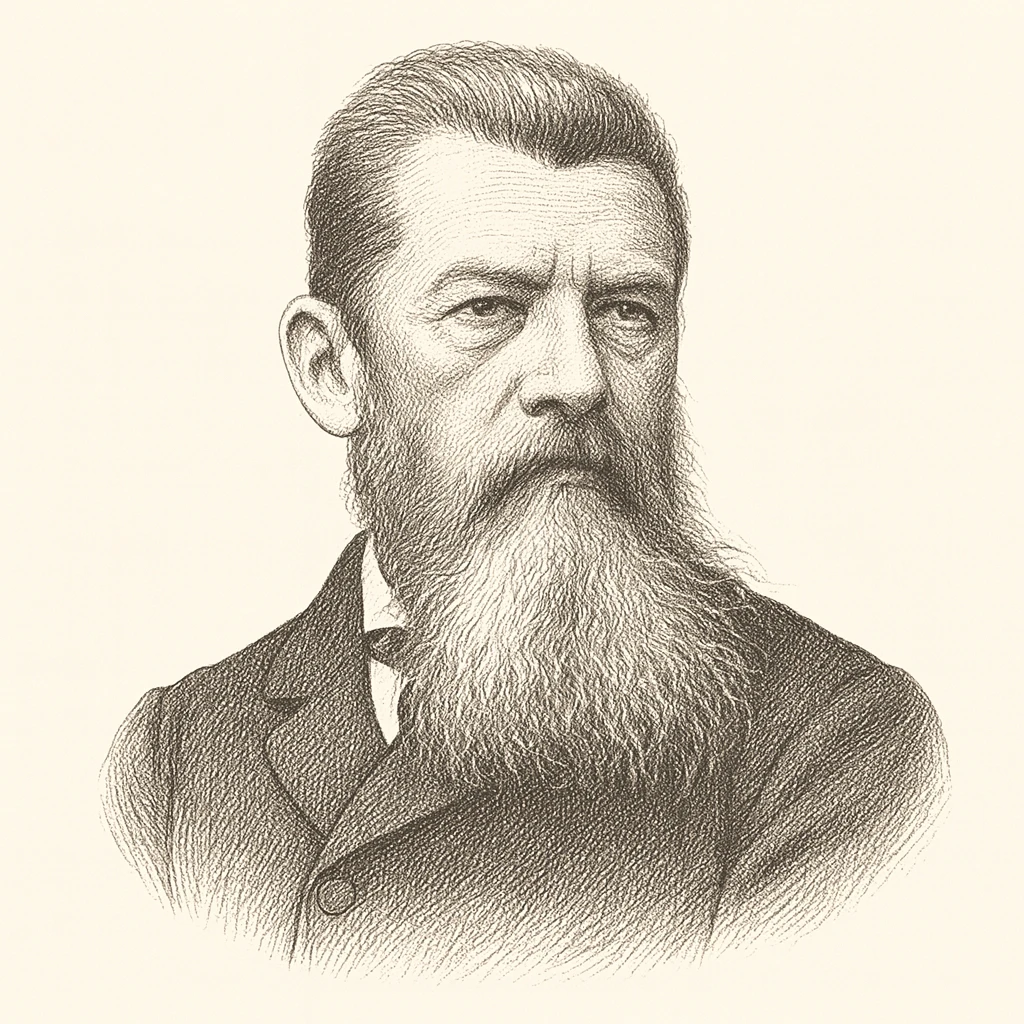
Ludwig Feuerbach went to Berlin to hear Hegel, abandoned theology for philosophy, and destroyed his own academic prospects at twenty-six with an anonymous book denying personal immortality. Identified as its author, he never held a proper post again, and lived on his wife's share of a porcelain factory until it failed.
The Essence of Christianity of 1841 is the book that detonated. Its thesis is that theology is anthropology misread. The attributes ascribed to God — infinite love, perfect knowledge, unlimited will — are the predicates of human nature in the species, abstracted from the limits of any individual and projected outward as an independent being. Religion is therefore not a lie but the earliest form of humanity's self-knowledge, in which we encounter our own essence as though it were another's. The cost is that the projection impoverishes what it comes from: to enrich God, man must become poor. The remedy is not to abolish religion but to recognize it, converting the love of God into love of the human, and theology into anthropology.
The method beneath this is what mattered to his contemporaries. Hegel had made the material world the self-externalization of Spirit; Feuerbach turned the relation the other way up. Thought does not produce being, being produces thought; the real subject is the sensuous, embodied, needy human being, and philosophy must start from him. Speculative philosophy, he wrote, is rational mysticism, and its inversions can be corrected simply by making the predicate the subject.
Engels recorded the effect: enthusiasm was general, and we all became at once Feuerbachians. Marx took the transformative method and applied it to political economy and the state, then broke with him in the Theses on Feuerbach of 1845 — objecting that Feuerbach's human being is an abstraction rather than an ensemble of social relations, that his materialism is contemplative rather than practical, and that dissolving religion into its earthly basis leaves the question of why the earthly basis produces the illusion. The eleventh thesis, that philosophers have only interpreted the world while the point is to change it, is aimed squarely at him.
Without Feuerbach the route from Hegel to Marx has no middle term, which is the reason he is remembered at all.
Wondering where you land? Take the 4-minute assessment