
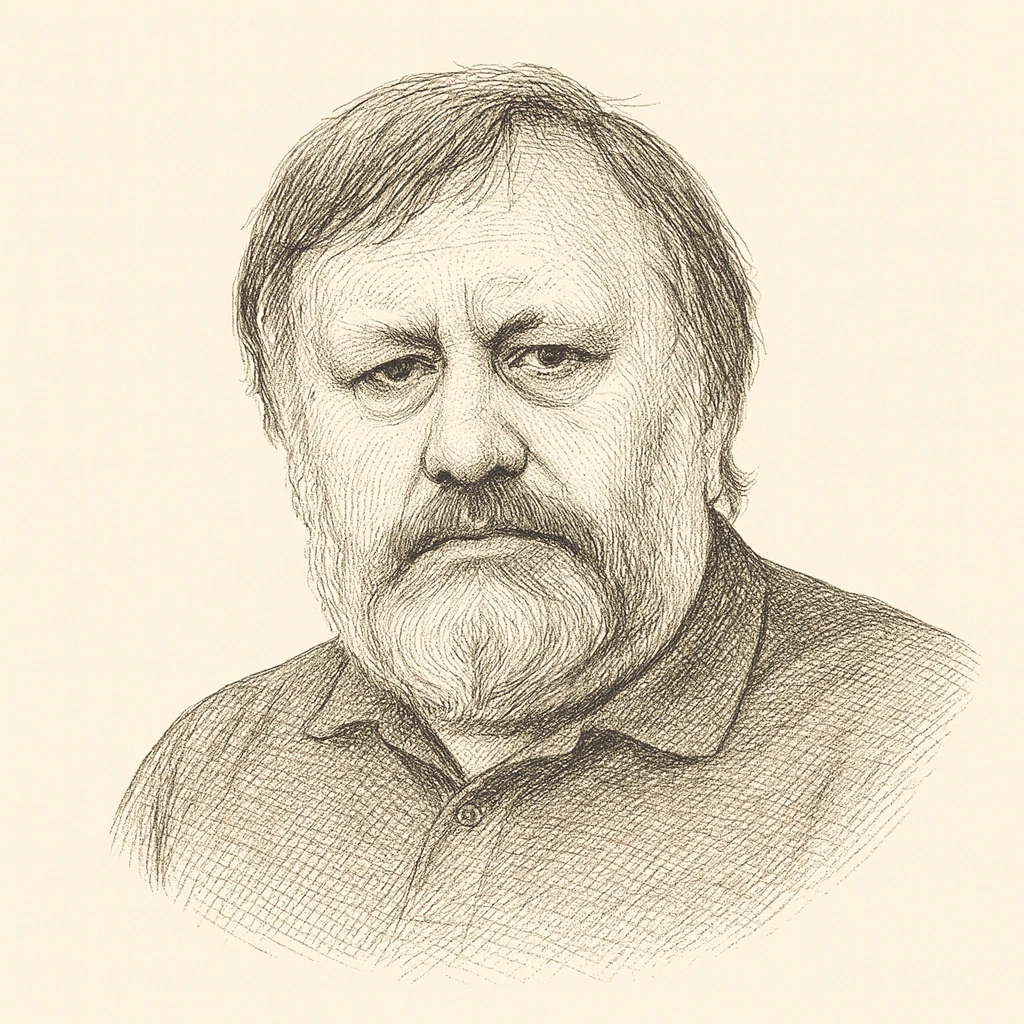
Slavoj Žižek is a Slovenian philosopher and cultural critic whose work brings together German idealism, especially Hegel, the psychoanalysis of Jacques Lacan, and the Marxist tradition of ideology critique. Emerging from the intellectual milieu of late-socialist Slovenia, he became internationally known for arguing that ideology is not merely a set of false beliefs to be corrected by knowledge, but a set of unconscious attachments and fantasies that organize how people enjoy, desire, and act. On this account, subjects can "know very well" that something is illusory and continue to behave as if it were true, because ideology operates at the level of practice and libidinal investment rather than conscious opinion.
Much of Žižek's political writing targets liberal capitalism and what he calls its accompanying ideological forms, including multiculturalism, tolerance, and forms of charitable or ethical consumption that, in his reading, help the existing order reproduce itself while presenting themselves as its correction. He is a self-described communist who defends the continued relevance of a radical, emancipatory Left and has been sharply critical of a Left he sees as retreating into moralism, identity-based politics, or purely cultural gestures. He frequently reads films, jokes, and popular culture as symptomatic material that reveals the hidden logic of political and economic life.
His positions are widely contested. Critics accuse him of provocation, inconsistency, and a taste for deliberately shocking formulations, including remarks on revolutionary violence, authority, and figures such as Lenin and Stalin that opponents read as flirtations with authoritarian politics, while defenders treat them as dialectical provocations meant to unsettle liberal common sense. He has also drawn criticism for commentary on immigration and refugees that some read as unexpectedly hardline. Debates within the academy question how systematic his philosophy actually is beneath its rhetorical energy.
Regardless of these disputes, Žižek has done as much as any contemporary thinker to return words like ideology, capitalism, and communism to mainstream public discussion. Through prolific books, lectures, documentaries, and media appearances, he popularized the idea that critique of capitalism must engage the psychic and cultural attachments that bind people to it, making him one of the most recognizable representatives of a living Marxist tradition.
Slavoj Žižek is associated with Trad Socialist. See the archetype