
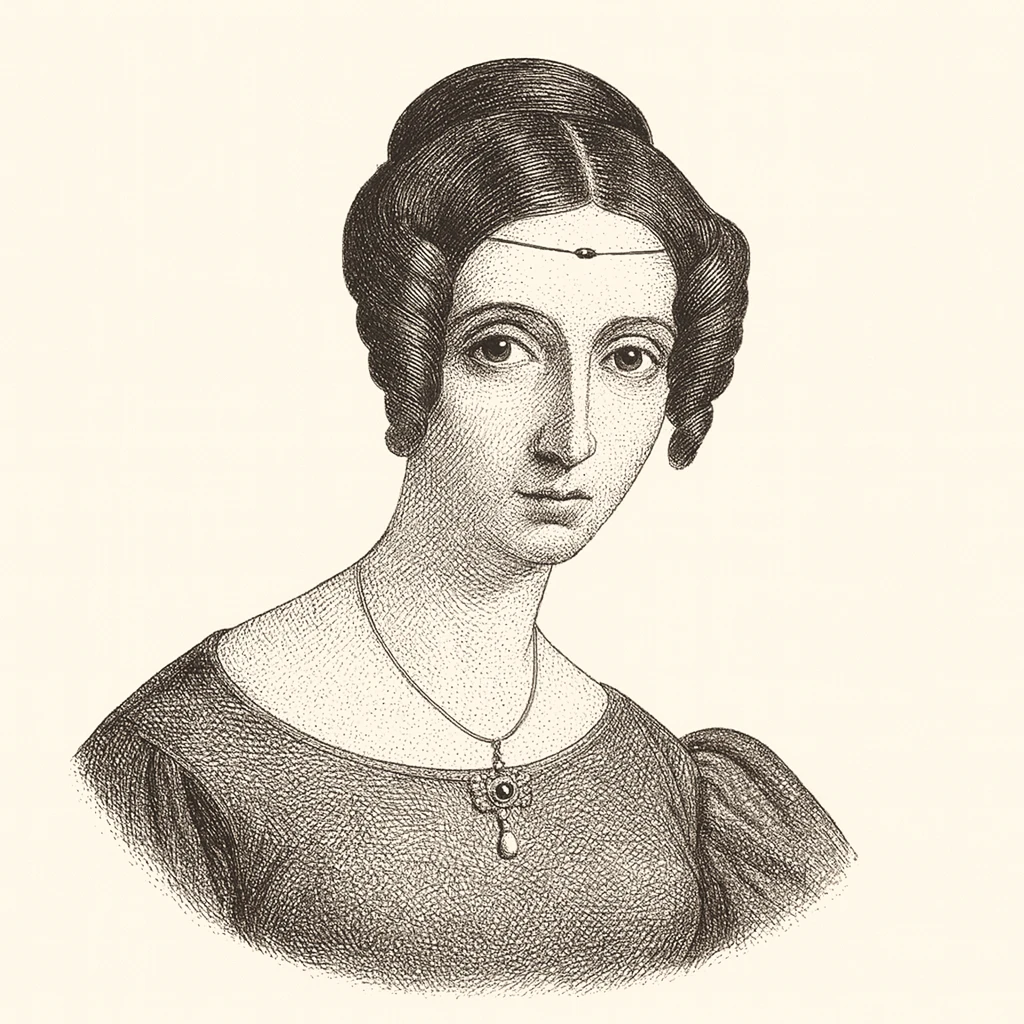
Harriet Taylor Mill was one of the most important 19th century British philosophers of women's rights, individual liberty, and the ethical foundations of marriage, a thinker whose intellectual partnership with John Stuart Mill produced some of the foundational texts of liberal political philosophy and whose independent writings made substantial contributions to the feminist tradition in their own right. For most of the 20th century, her intellectual influence on Mill's work was systematically minimized or dismissed by scholars who treated her as a domestic muse rather than as a philosophical collaborator. More recent scholarship has recovered her as a genuine co-author whose ideas shaped some of the most important passages of On Liberty (1859) and whose independent work deserves recognition alongside the male-authored philosophical canon of her era.
Harriet Hardy was born in London in 1807, the daughter of a surgeon. She received the limited formal education typical for middle-class English girls of her era but made up for its limitations through voracious reading and through the intellectual friendships she cultivated throughout her adult life. In 1826, at nineteen, she married John Taylor, a wholesale druggist, and the marriage produced three children. By the early 1830s Harriet had become part of the Unitarian radical intellectual circle that gathered around the minister William Fox, and through this circle she met John Stuart Mill in 1830. Their immediate intellectual and emotional connection turned into one of the most unusual intimate partnerships in 19th century English intellectual life. For the next twenty years, while remaining formally married to John Taylor, Harriet maintained a close but ostensibly non-physical relationship with Mill, sharing ideas, drafting essays together, and discussing everything that Mill was writing. John Taylor tolerated the arrangement, and the three adults lived as a kind of unconventional triangle until Taylor's death in 1849.
In 1851, two years after John Taylor's death, Harriet and John Stuart Mill finally married. They had waited out the social decency period after Taylor's death, though the marriage still scandalized Mill's family and many of his friends. Harriet was by then in poor health from tuberculosis, and their marriage lasted only seven years before her death in 1858 from a pulmonary hemorrhage during a trip to France. Mill was devastated. He spent the rest of his life attempting to honor her memory through his work, completing and publishing On Liberty in 1859 (which he had drafted jointly with her during her final illness) and dedicating it to her memory in an effusive tribute that later scholars dismissed as sentimental exaggeration. Contemporary scholarship has increasingly taken Mill's tribute more seriously and treated Harriet as the genuine co-author Mill always said she was.
Harriet's most important independent work was her 1851 essay The Enfranchisement of Women, published anonymously in the Westminster Review while she and Mill were still engaged. The essay was a direct and uncompromising argument for women's suffrage, for equal legal rights, for equal access to education and the professions, and for the abolition of the legal subordination of women within marriage. The argument went substantially further than Mill's own later work would go — The Enfranchisement demanded full equality immediately, while Mill's The Subjection of Women (1869) was more cautious about how quickly the transformation could be accomplished. The essay also developed arguments about women's economic independence that anticipated later feminist discussions of paid labor, unpaid domestic work, and the material foundations of gender equality. It was one of the most radical feminist documents published in English in the 19th century, and its anonymous publication meant that Harriet never received public credit for it during her lifetime.
The question of Harriet's influence on On Liberty has been extensively debated. Mill himself was unequivocal about it: he claimed that the book was essentially co-authored, that Harriet had shaped its arguments fundamentally, and that key sections reflected her thinking more than his. For most of the 20th century, scholars treated Mill's claims as exaggerations prompted by grief, partly because of the prevailing assumption that women of the period could not have been serious intellectual contributors. More recent scholarship, particularly by feminist philosophers including Jo Ellen Jacobs and Dale Miller, has taken Mill's attributions seriously and identified specific passages in On Liberty that draw on Harriet's earlier letters and essays. On the current best reading, Harriet was a true collaborator whose ideas shaped some of the most important arguments in one of the most influential works of liberal political philosophy ever written.
Harriet's intellectual contributions extended beyond the feminist essays and the collaboration on On Liberty. Her correspondence with Mill, much of which has been published, shows a mind engaged with political economy, ethical theory, and social reform across a wide range of topics. She wrote on the ethics of marriage and divorce, arguing that genuine marriage should be a partnership of equals freely chosen rather than a legally coercive arrangement. She wrote on working-class education, on the moral status of capital punishment, and on the relationship between individual freedom and social progress. Her independent philosophical voice has been gradually recovered over the last several decades, and she is now recognized as one of the important figures in the 19th century British liberal tradition and in the prehistory of modern feminism.
Harriet died in 1858 at fifty-one in Avignon, France, and was buried there. John Stuart Mill moved to Avignon to be near her grave and spent as much of his remaining life as possible there, writing at a desk he placed where he could see the cemetery. The tribute he had given her in the dedication of On Liberty was not the sentimental hyperbole of grief that later critics assumed. It was his honest assessment of what she had contributed to his life and work, and contemporary scholarship has increasingly confirmed that assessment.
Harriet Taylor Mill is associated with Social Liberal. See the archetype