
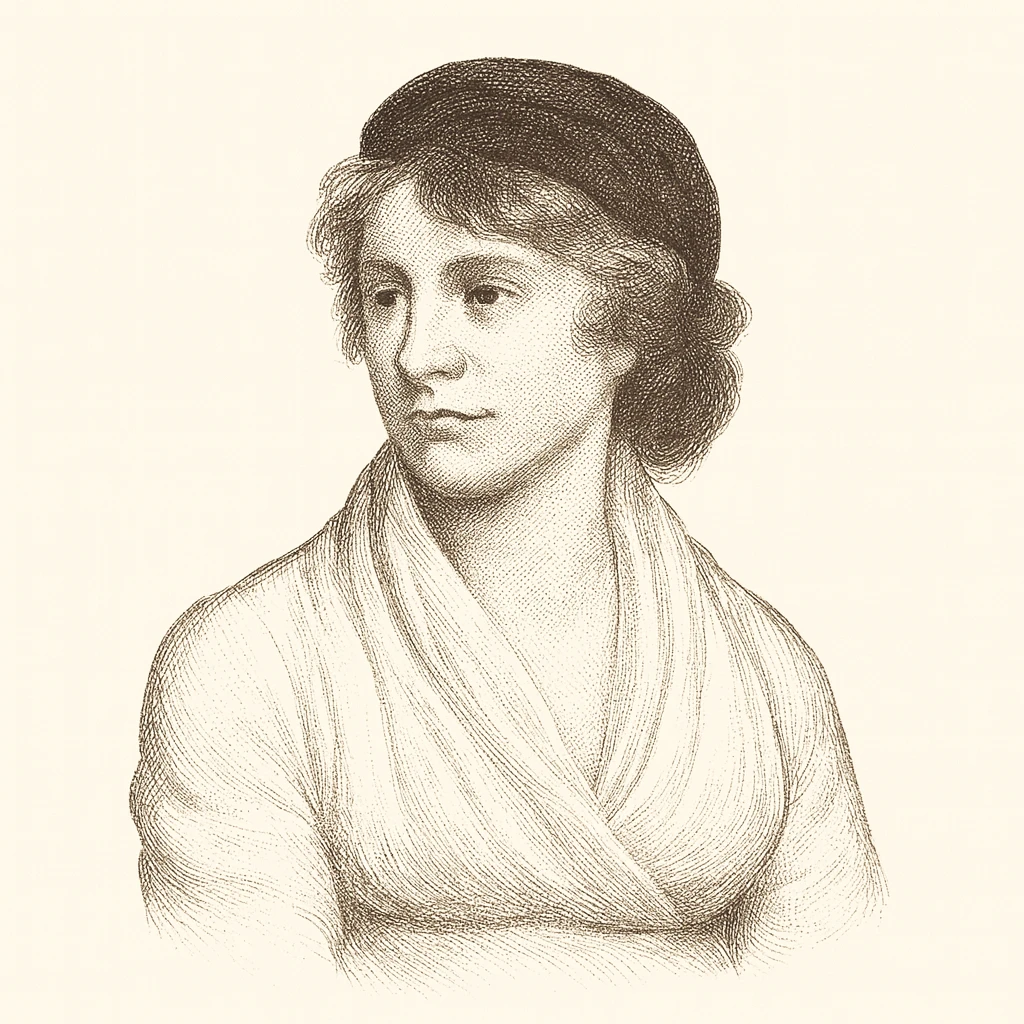
Mary Wollstonecraft lived a life that would have been considered impossible by almost everyone she grew up around. She was born in London in 1759 to a violent, alcoholic father and a passive, religious mother in a family that was steadily falling out of the middle class. Her father beat her mother. He drank away the family's money. He bullied his daughters and indulged his sons. By her teens, Wollstonecraft had decided that the position of women in eighteenth-century English society was not a natural arrangement but a brutal and indefensible system that needed to be torn down. She spent the rest of her short life building the philosophical case for that conclusion.
She left home as soon as she could, working as a lady's companion, then as a teacher, then as a governess — the limited careers available to a woman of her class who refused to marry. In her early thirties she moved to London, found work as a writer and editor for the radical publisher Joseph Johnson, and became part of a circle of dissenting intellectuals that included Thomas Paine, William Godwin, William Blake, and Joseph Priestley. When the French Revolution broke out in 1789, almost everyone in this circle celebrated it as the dawn of a new era of human freedom. When Edmund Burke published his Reflections on the Revolution in France in 1790 attacking the revolution, Wollstonecraft was one of the first to write a published response — A Vindication of the Rights of Men, which appeared anonymously and then under her own name within weeks. It was the first major published response to Burke from anyone, predating Paine's more famous Rights of Man by months.
But Wollstonecraft's most important work came two years later. In 1792, while living in London and watching the French Revolution unfold across the Channel, she wrote A Vindication of the Rights of Woman — the founding text of modern feminist political philosophy. The argument was straightforward but devastating in its implications. The Enlightenment thinkers who were demanding rights for men were operating with a theory of human nature according to which all rational beings deserved liberty, equality, and the chance to develop their faculties. But these same thinkers either explicitly denied or quietly assumed that women were not fully rational, and therefore did not qualify for the rights they were demanding for themselves. Wollstonecraft showed that there was no consistent way to apply Enlightenment principles to men without also applying them to women. If reason was the foundation of human dignity, and women had reason, then women had dignity. If liberty was the natural right of all rational creatures, women were rational and therefore had the right to liberty. The implications — equal education, equal participation in public life, equal legal status, the dismantling of the dependent and infantilized position women were forced into — followed inescapably.
The book made Wollstonecraft famous and controversial. She was attacked from every side: by traditionalists who thought she was destroying the family, by radicals who thought she was distracting from more important questions, and by moralists who were horrified that a woman would write so directly about her own life and her own anger. She traveled to revolutionary France in 1792, witnessed the Terror firsthand, fell in love with an American adventurer named Gilbert Imlay, had a child with him, was abandoned by him, attempted suicide twice, and somehow recovered enough to write a brilliant travel memoir about a journey through Scandinavia that she undertook partly to escape her grief. She returned to London, met William Godwin again, fell in love with him, married him in 1797, became pregnant, and died ten days after giving birth to her daughter Mary — the daughter who would grow up to write Frankenstein and become known as Mary Shelley.
Wollstonecraft was thirty-eight when she died. After her death, Godwin published a memoir of her life that was so honest about her affairs, her suicide attempts, and her unconventional choices that it destroyed her reputation for nearly a century. The Victorian feminists who would carry her ideas forward had to do so without claiming her as a foundress, because her life had become synonymous with scandal. It wasn't until the 20th century, when first-wave feminism rediscovered her and second-wave feminism canonized her, that Wollstonecraft was restored to her proper position as one of the founding figures of modern political thought. She is now read everywhere, taught in every introductory political philosophy course, and recognized as the philosopher who first showed that Enlightenment liberalism, taken seriously, requires feminism.
Mary Wollstonecraft is associated with Social Liberal. See the archetype