
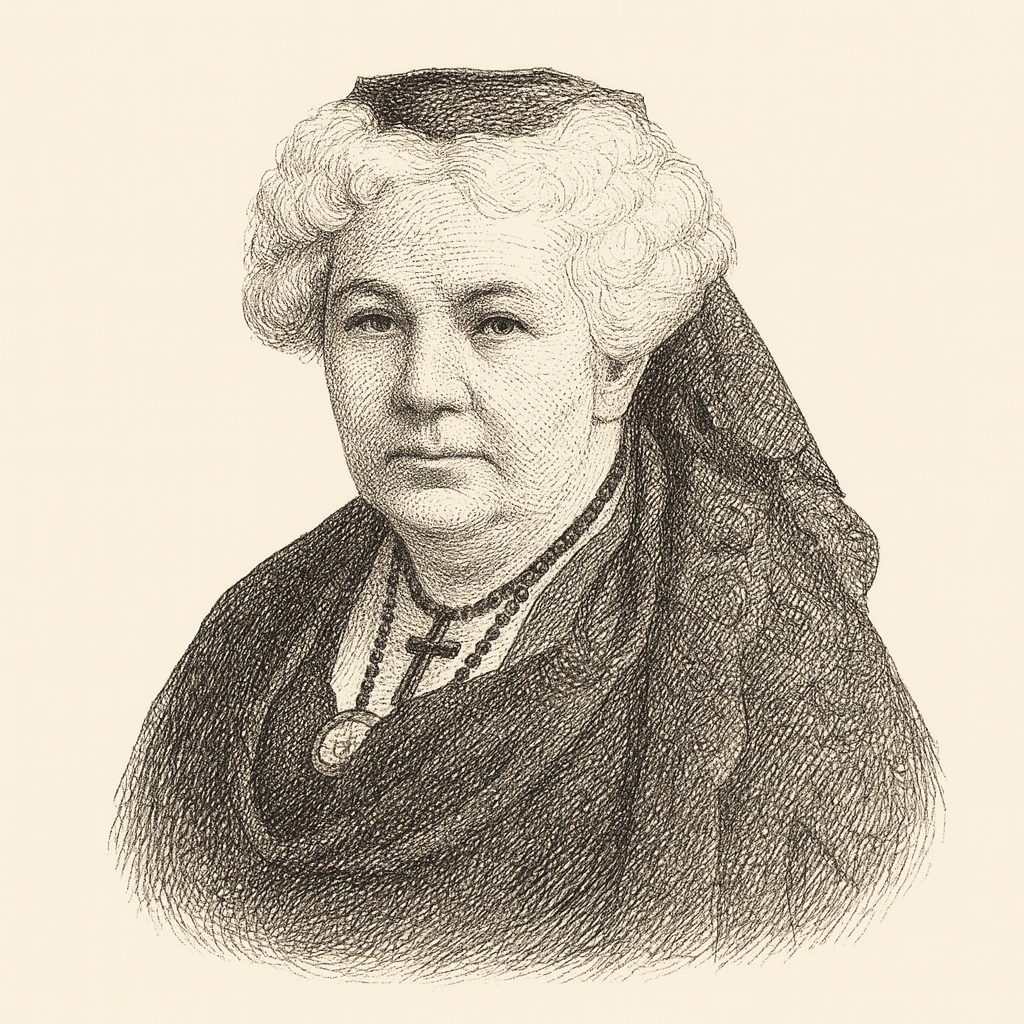
Elizabeth Cady Stanton was the principal theorist of the nineteenth-century American women's rights movement, the figure who gave its grievances systematic form. At the 1848 Seneca Falls Convention she drafted the Declaration of Sentiments, deliberately modeled on the Declaration of Independence, which reframed the founding language of natural rights and consent of the governed to expose women's exclusion from it. By insisting that "all men and women are created equal," she argued that the logic of the American Revolution demanded its own extension, and she made the ballot central to that claim by including a suffrage resolution that was, at the time, its most radical element.
Stanton's political thought rested on Enlightenment individualism: she treated the woman as a self-owning person entitled to the same civil and political standing as any man, not merely as wife, mother, or dependent. This led her to press beyond the vote alone to married women's property rights, reform of divorce law, and equal guardianship of children—an agenda that located female subordination in law, custom, and religion together. In her later years she extended this critique to organized Christianity, arguing that scriptural interpretation had been used to sanctify women's inferiority, a stance that alienated more conservative reformers and marked her as among the movement's most secular and confrontational voices.
Her decades-long partnership with Susan B. Anthony structured the movement's division of labor: Stanton largely supplied the arguments, writing, and public statements, while Anthony organized and campaigned. That collaboration also carried a serious and well-documented blemish. After the Civil War, Stanton opposed the Fifteenth Amendment because it enfranchised Black men while leaving women out, and in doing so she at times deployed racist and nativist rhetoric, contrasting educated white women unfavorably with newly freed Black men and immigrants. This contributed to a bitter split in the suffrage movement and remains central to modern reassessments of her legacy.
Stanton's enduring influence lies in her framing of political membership itself. She argued that a democracy claiming to rest on consent could not consistently deny half its population a voice, and she treated legal equality as the precondition for genuine self-government. That argument—that formal citizenship without political voice is a contradiction—shaped how later reformers understood the unfinished business of American democracy.
Elizabeth Cady Stanton is associated with Progressive Activist. See the archetype