
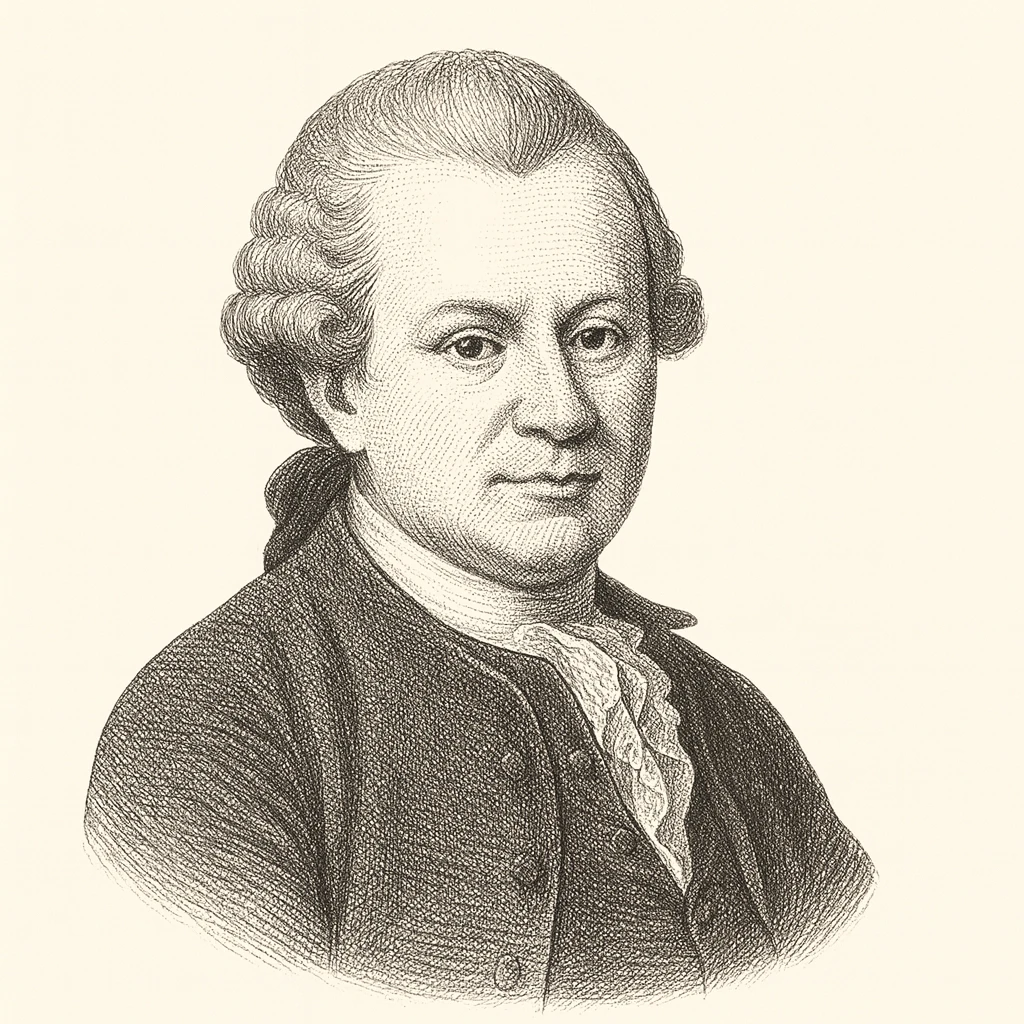
Gotthold Ephraim Lessing was the first significant German writer to live by his pen, a dramatist, a critic, and finally a librarian at Wolfenbüttel, where he found the manuscript that occupied his last years. He is the point at which German letters became a European rather than a provincial affair.
The Laocoön of 1766 is a founding text of modern aesthetics. It argues that poetry and the visual arts have different capacities because they work in different dimensions — painting is spatial and shows a single moment, poetry is temporal and unfolds — and that the rules for each must follow from this rather than from the doctrine that a poem is like a picture. The Hamburg Dramaturgy attacked French neoclassical rules in the theater and read Aristotle against them in favor of Shakespeare, which was decisive for the generation that followed.
The controversy that made his reputation dangerous came from publishing extracts of Reimarus's manuscript, which treated the Gospels as historically unreliable and Jesus as a failed political messiah. Lessing published them anonymously as the Wolfenbüttel Fragments and, when the orthodox counter-attacked, replied in a series of pamphlets that state his own position. The accidental truths of history, he wrote, can never become the proof of necessary truths of reason — there is an ugly broad ditch between the two that he cannot cross, however often he tries. A religion cannot be established by evidence about events; its warrant must lie elsewhere.
Where it lies is set out in The Education of the Human Race. Revelation gives the race what education gives the individual: truths it could eventually have reached by reason, delivered earlier and in a form it can use. The Old Testament suited a childhood, the New a youth, and a third age is coming in which the good will be done because it is good and not for reward. Religions are stages, and the later does not simply refute the earlier.
Nathan the Wise dramatizes the conclusion. Its parable of three indistinguishable rings, given by a father to three sons, leaves the question of which faith is true undecidable and directs each brother to prove his ring by how he lives. Jacobi's claim after his death that Lessing had confessed himself a Spinozist set off the pantheism controversy that shaped German idealism.
Wondering where you land? Take the 4-minute assessment