
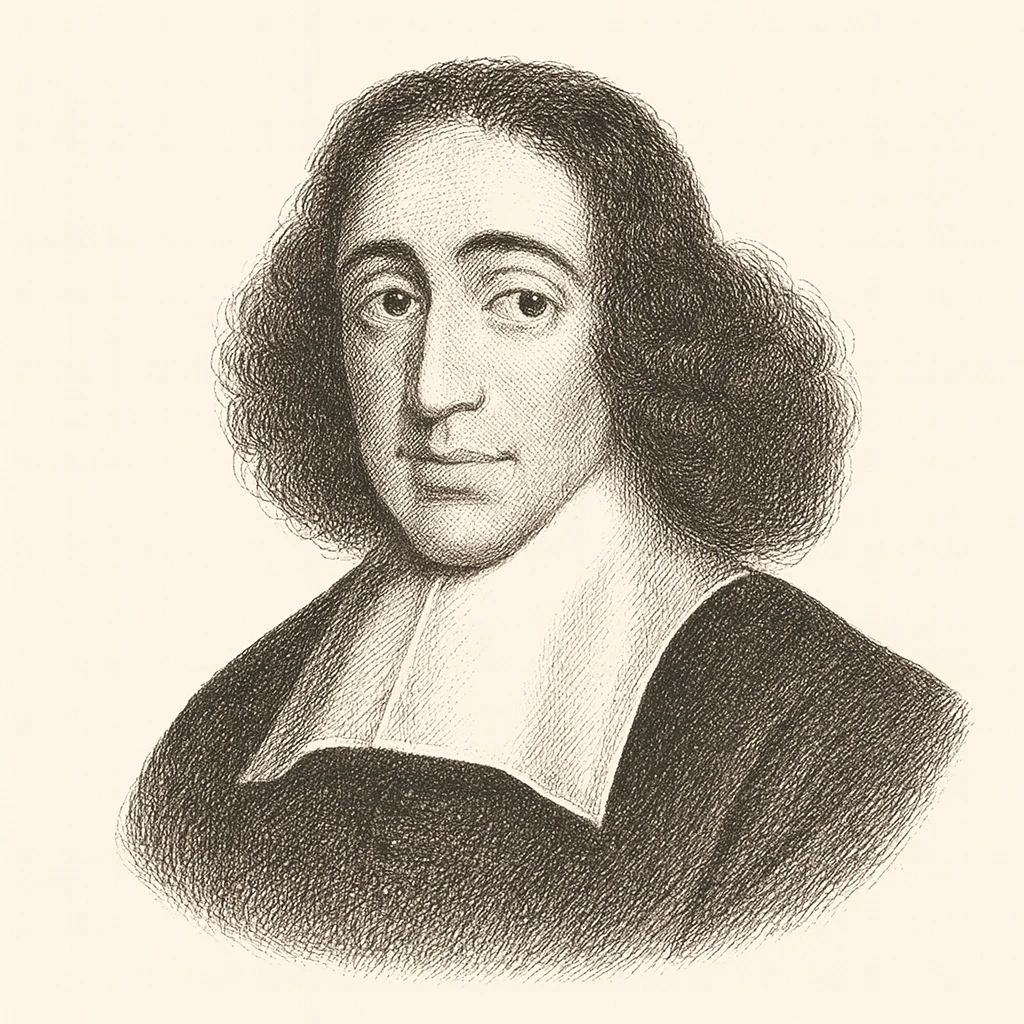
Baruch Spinoza was born in 1632 in Amsterdam, into the Portuguese-Jewish community that had fled Iberian persecution and built a remarkable intellectual and commercial life in the Dutch Republic. He received a traditional rabbinical education and was expected to become a merchant or a rabbi. Instead, sometime in his early twenties, he began developing philosophical views so radical that in 1656, at the age of twenty-three, he was excommunicated from the Jewish community with one of the most severe bans ever pronounced against any Jew. The text of the ban called for him to be cursed by day and by night, sleeping and waking, going out and coming in. It forbade any Jew from speaking to him, reading his writings, or coming within four cubits of him. He never reconciled with the community and never looked back.
What Spinoza developed in the years that followed was a philosophical system so radical that almost no one in the 17th century was ready for it, and that took nearly two centuries to be fully appreciated. His central claim was that there is only one substance in the universe, which he called God-or-Nature (Deus sive Natura). Everything that exists is part of this single substance. There is no transcendent personal God sitting outside the universe, no supernatural realm, no free will in the traditional sense, no reward and punishment after death, no miracles, no chosen people. The universe unfolds according to its own necessary laws, and human beings are part of it, not separate from it. What we call God is simply the totality of what exists, considered under the aspect of its infinite attributes.
This framework, developed most systematically in his Ethics (published posthumously in 1677), was so offensive to 17th century religious sensibilities that Spinoza was branded an atheist even by other heterodox thinkers. The word "Spinozism" became a term of abuse for over a century, and philosophers who were clearly influenced by him were careful to deny it in print. It took until the late 18th century and the Pantheism Controversy in Germany for Spinoza to be rehabilitated, and until the 19th century for him to be recognized as one of the central figures of modern philosophy. Today his Ethics is taught in every serious philosophy program, and his reputation as one of the most original and courageous thinkers in the Western tradition is secure.
Spinoza's political philosophy was nearly as radical as his metaphysics, and considerably more influential in its own time. His Theological-Political Treatise (1670), published anonymously and almost immediately banned in the Dutch Republic, argued for freedom of thought and speech on the grounds that any attempt to control what people believed was both futile (belief cannot be commanded) and destructive (it corrupts both religion and politics). He argued that the Bible was a human document, written by specific people at specific times, and should be read historically rather than as a literal revelation. He argued that religious authority should be firmly subordinated to political authority, and that political authority should in turn be limited to what could be publicly justified to free citizens. This was one of the earliest and most forceful defenses of what we would now call liberal toleration, and it had enormous influence on later figures like Locke, Montesquieu, and the French Enlightenment philosophers.
Spinoza lived the last twenty years of his life in the small Dutch town of Voorburg and then The Hague, supporting himself by grinding optical lenses while he wrote. He refused a professorship at Heidelberg because it came with conditions on what he could say. He refused patronage that would have compromised his independence. He lived simply, wrote patiently, and died in 1677 at forty-four, probably from lung disease aggravated by glass dust from his lens-grinding. His Ethics was published later that year under only his initials. The radical Enlightenment that would reshape Europe over the next century had, in many ways, already been anticipated in the quiet Dutch rooms where Spinoza had written it all down.
Baruch Spinoza is associated with Civil Libertarian. See the archetype