
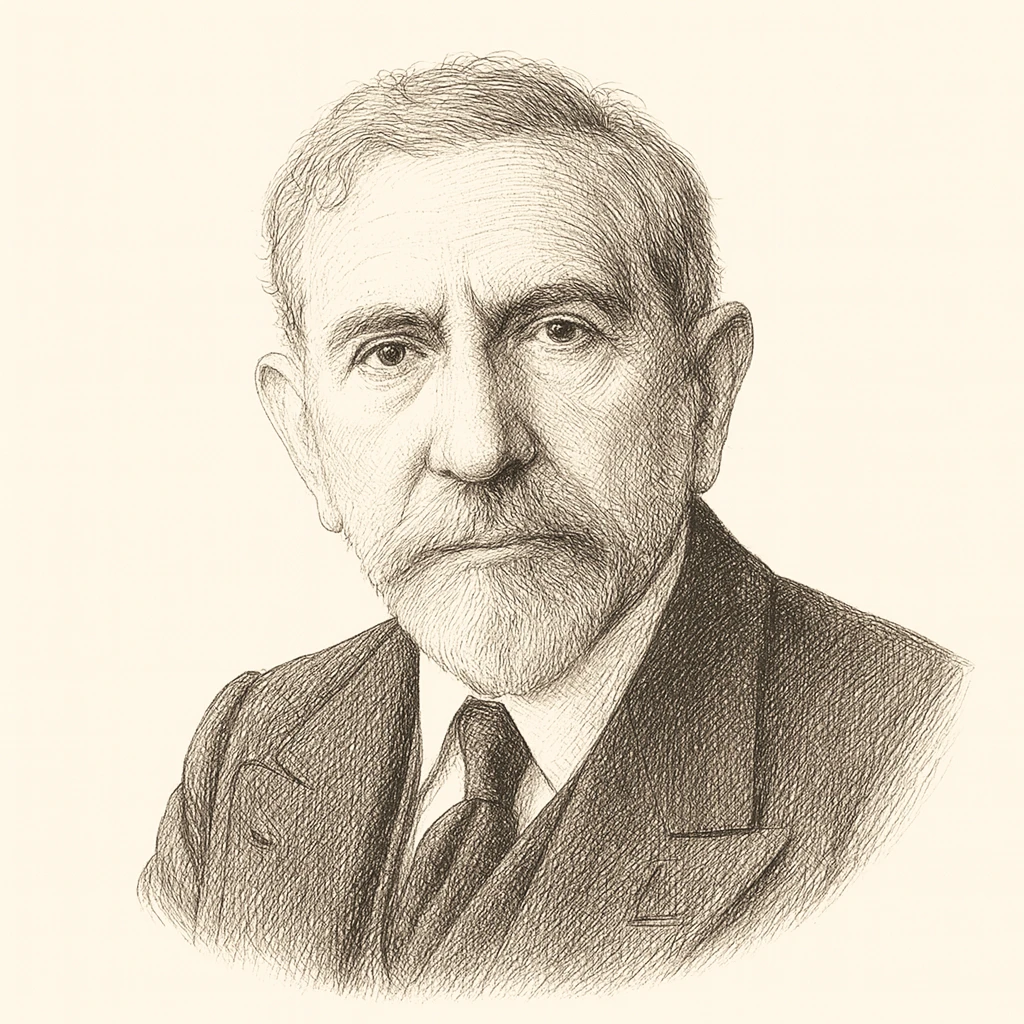
Charles Maurras went deaf at fourteen, which he said turned him from the world toward books, and became the dominant figure of the French radical right for fifty years. Action Française, the movement and the newspaper he directed from 1908, shaped a generation of the French right and supplied much of the personnel and doctrine of Vichy.
His nationalism is integral in the sense that everything else is subordinated to the nation's interest, and it is deduced rather than felt. France, he argued, is a natural and historical body whose flourishing requires certain institutions; the Revolution had substituted abstractions — liberty, equality, the rights of man — for the inherited arrangements that actually produced French greatness; and the Third Republic was the machinery by which four alien bodies, which he named as Jews, Protestants, Freemasons and foreigners, governed a country that was not theirs. This is a conspiratorial and racialized politics stated with the vocabulary of classical reason, and the combination is what made it dangerous.
His attitude to Catholicism is the notorious part. Maurras had no faith and said so; he valued the church as the institution that had disciplined the disorder of the Gospels into Roman order, and defended it as a pillar of French civilization on aesthetic and political grounds alone. Pius XI condemned the movement in 1926 for precisely this — using religion as an instrument — and the ban was not lifted until 1939.
He was formed by de Maistre and Bonald and made their counter-revolutionary case modern, replacing providence with a claim to empirical political science: the study of history, he said, showed which arrangements work, and the answer was hereditary monarchy, decentralized provinces and corporate representation.
He supported Vichy as a divine surprise, denounced resistance and Jews in his paper throughout the occupation, and was sentenced to life imprisonment in 1945 for intelligence with the enemy — receiving the verdict with the cry that it was the revenge of Dreyfus. His influence outlived the disgrace, running through the Algérie française movement and into later European nationalist thought.
Wondering where you land? Take the 4-minute assessment