
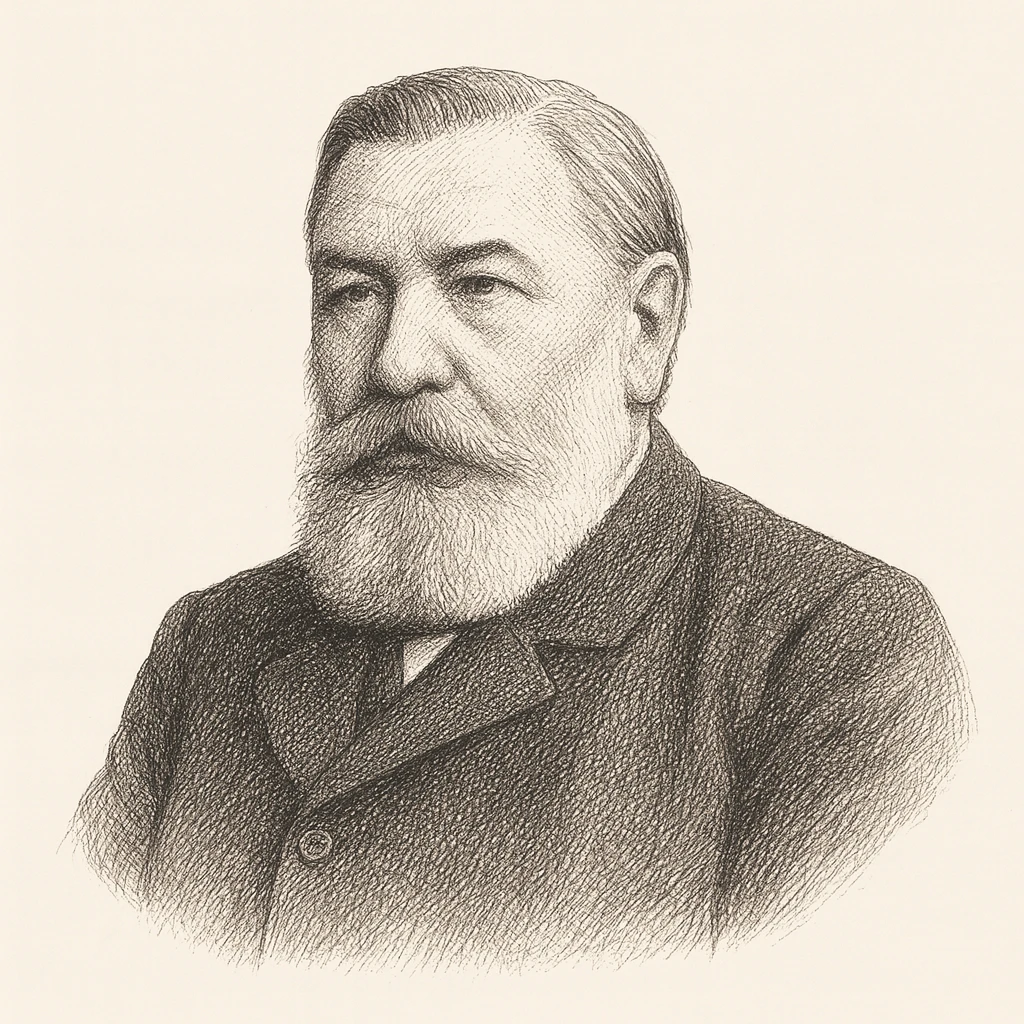
Heinrich von Treitschke was professor of history at Berlin, a member of the Reichstag, and official historiographer of the Prussian state. His lectures were a public event, attended by officers and officials as well as students, and his History of Germany in the Nineteenth Century made the case that German unification under Prussia was the fulfillment of the national destiny rather than one outcome among several.
His Politics, published from those lectures after his death, states a doctrine with unusual frankness. The state is power — Der Staat ist Macht — and its first duty is to maintain and increase it. A state that will not fight is not a state; small states are anomalies that ought to be absorbed; and the notion of an international law standing above sovereigns is a contradiction, since there is no authority to enforce it. War is not merely sometimes necessary but positively good, the great physician who keeps a people from the corruption and softness of long peace. Individuals exist for the state, not the state for individuals, and the liberal error is to imagine that a nation is an association formed for the convenience of its members.
He began as a moderate liberal and moved steadily rightward with the Reich, and by the 1870s he was its most effective intellectual advocate. In 1879 he opened a public campaign against German Jews with the article containing the sentence taken up everywhere afterwards: the Jews are our misfortune. The importance of this is not that the sentiment was new but that Treitschke was not a crank — he was the most eminent historian in Germany, and his intervention moved antisemitism from the gutter press into respectable academic and official society. Mommsen answered him publicly and the exchange became a landmark.
His effect was enormous and almost entirely destructive. A generation of German officials, officers and schoolmasters learned their politics from him; his doctrines were quoted approvingly across Europe in 1914 as evidence of what Germany had become, and the National Socialists claimed him as a forerunner with more justification than they had for most of their claims.
Wondering where you land? Take the 4-minute assessment