
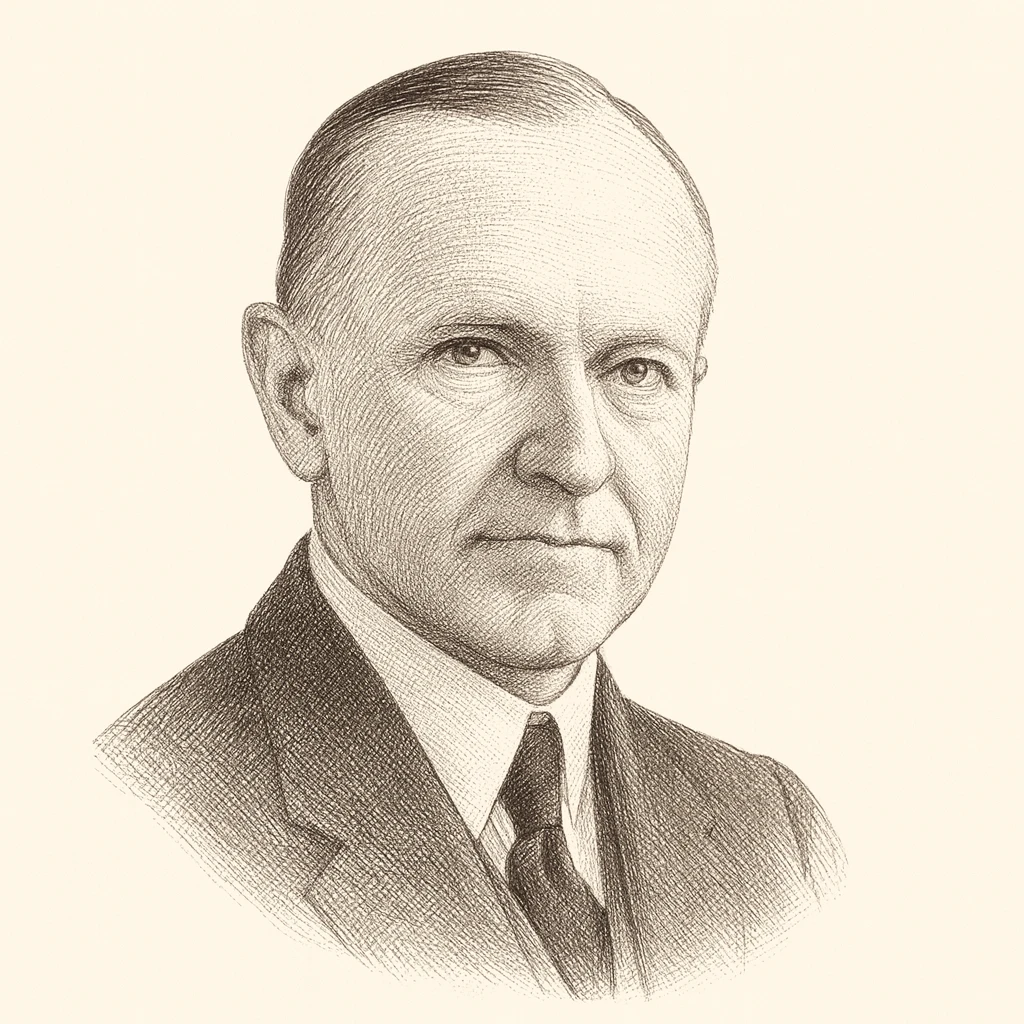
Calvin Coolidge was the 30th President, whose limited-government philosophy presided over the prosperity of the 'Roaring Twenties.' A Vermont lawyer who rose through Massachusetts politics, 'Silent Cal' became famous for laconic wit and for doing as little as possible. His national reputation was made as Massachusetts governor during the 1919 Boston police strike, when he declared there was no right to strike against the public safety by anybody, anywhere, any time. That stand carried him onto the 1920 Republican ticket as Warren Harding's running mate, and he succeeded to the presidency on Harding's death in 1923, winning election in his own right in 1924.
Coolidge believed government governs best that governs least. He cut taxes, reduced federal spending, and restrained regulation, believing that business growth would lift all Americans. 'The chief business of the American people is business.' His Treasury Secretary Andrew Mellon argued that lower marginal rates would spur enterprise and increase revenue, and the successive tax cuts of the 1920s coincided with prosperity; GDP rose from $85.2 billion in 1924 to $101.4 billion in 1929. Coolidge's frugality was philosophical as much as temperamental: he saw thrift, self-restraint, and a modest executive as safeguards of ordered liberty, a Republican answer to the Progressive faith in expert administration.
He twice vetoed the McNary-Haugen farm bill, rejecting federal price supports for a farm sector already in depression, and he signed the Immigration Act of 1924, which set national-origin quotas and effectively barred immigration from Asia. His administration left unregulated the margin trading that preceded the 1929 crash, and he declined to seek reelection in 1928, leaving office months before it.
After the Depression began, many linked the collapse to his policies, and his reputation for inaction was blamed for it. His reputation has since revived among limited-government conservatives who admire his restraint, his fiscal discipline, and his skepticism of activist reform, and who describe him as the last president who understood constitutional limits; Ronald Reagan hung Coolidge's portrait in the Cabinet Room. For them he is the anti-FDR, a model of a presidency that deliberately declined power rather than expanding it.
Calvin Coolidge is associated with Classical Liberal. See the archetype