
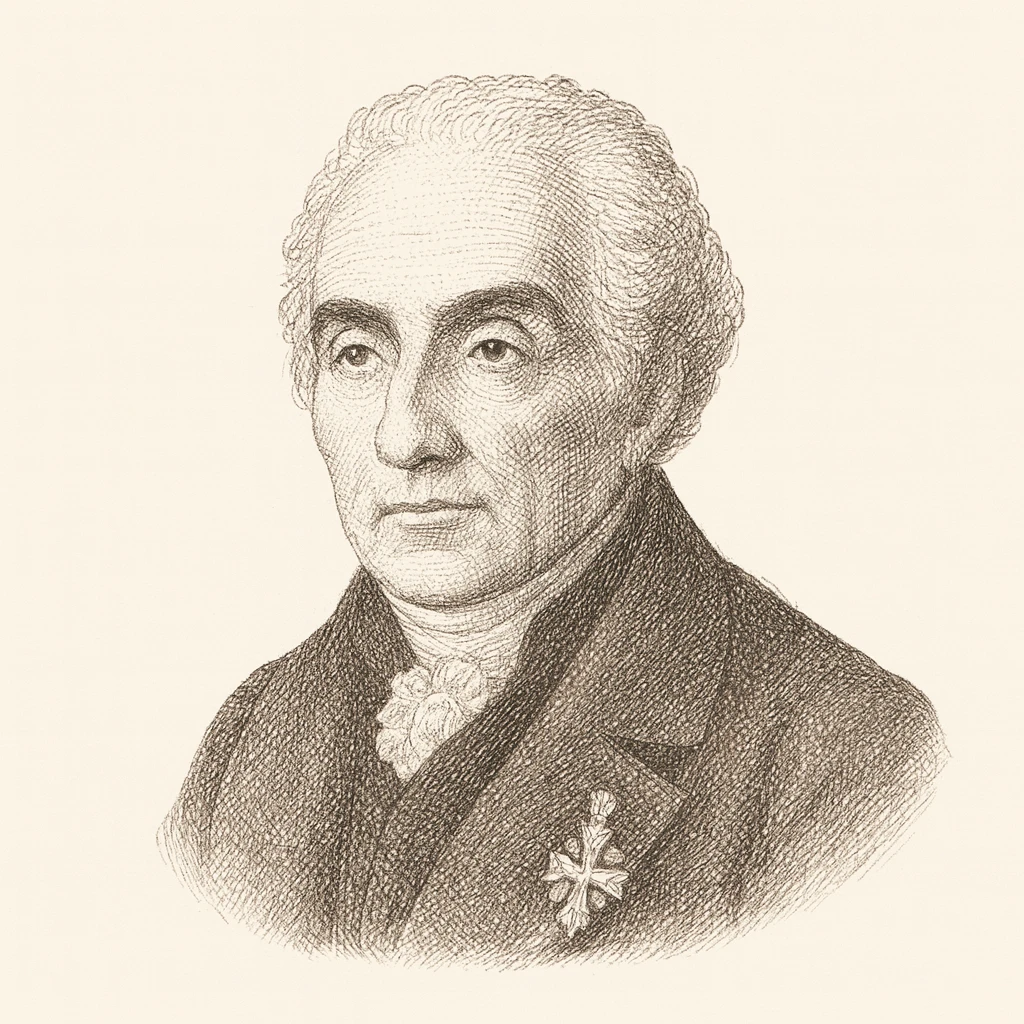
Joseph de Maistre was born in 1753 in Chambéry, the capital of Savoy, then part of the kingdom of Sardinia, into a family of lawyers and magistrates who had served the Savoyard state for generations. His father was president of the Senate of Savoy — an administrative rather than legislative body — and de Maistre followed the family vocation, studying law, working as a magistrate and senator, and absorbing the legal culture of an ancient state whose institutions predated the Enlightenment that was now calling them into question. He was educated by the Jesuits and maintained a lifelong admiration for the Society even after its suppression in 1773 — their combination of intellectual rigor, institutional discipline, and political sophistication struck him as a model of what genuine authority could look like.
The detail that most complicates his later reputation is this: Joseph de Maistre was a Freemason. He joined a lodge in Chambéry in the 1770s and was deeply engaged with Masonic mysticism — the occult and Rosicrucian currents that ran through certain branches of eighteenth-century Freemasonry — for years before the Revolution. He sought out Martinism, a mystical Catholic variant of Masonic thought that attempted to reconcile esoteric spirituality with orthodox theology. This background is not incidental: it means that de Maistre's counter-revolutionary Catholicism was not the simple traditionalism of a man who had never questioned received authority but the deliberate choice of someone who had explored the alternatives and returned to orthodoxy with the conviction of someone who understood what he was rejecting. His critique of Enlightenment rationalism came from someone who had tried to synthesize reason and mystery and concluded that the synthesis was impossible on rationalism's terms.
The Revolution reached Savoy in 1792, when French republican armies swept through the territory and abolished the old order. De Maistre fled to Lausanne, then to Turin, and eventually to St. Petersburg, where he served for fifteen years as Sardinian ambassador to the court of Tsar Alexander I. The exile was the paradox of his intellectual life: removed from practical politics and from the specific pressures of Counter-Revolutionary legitimism, he had more freedom to think than he had ever had in Chambéry. The Russian years produced the major works — Considerations on France (1796), the Essay on the Generative Principle of Political Constitutions (1809), Du Pape (1819), and the posthumous St. Petersburg Dialogues — that made him the intellectual godfather of European counter-revolutionary thought.
His fundamental argument was anthropological before it was theological. The Enlightenment's liberal politics rested on a conception of man as a rational, autonomous agent capable of designing institutions suited to human happiness through the exercise of reason. This conception, de Maistre insisted, was a fantasy that the Revolution had now conclusively refuted. Man was not rational but passionate, not autonomous but social and creaturely, not the author of institutions but their creature and product. What actually held societies together was not rational consent but habit, tradition, religion, and the willingness to use violence against those who threatened the social order. The executioner was, in his most famous formulation, the cornerstone of society — not a necessary evil but a necessary good, the figure whose existence made civilization possible by maintaining the fear that prevented its dissolution. He elaborated this with a relish that his critics found sadistic and that he would have recognized as a deliberate provocation: if you flinched from the executioner, you had not understood what civilization required.
The French Revolution had proceeded on the assumption that a rational secular republic could be constructed from first principles, sweeping away the inherited institutions — monarchy, church, aristocracy — that centuries of experience had produced. What it actually produced was the Terror, the execution of the king, and Napoleon. For de Maistre this was not an accident but a demonstration: attempt to build a political order on abstract reason rather than tradition and divine authority, and you will get blood. The lesson was not that the revolution had been badly executed but that its principles made good execution impossible. Providence, in his interpretation, was using the revolutionary violence to punish a civilization that had abandoned its spiritual foundations — a reading that required believing simultaneously that the revolution was evil and that God was directing it, a tension he explored in the Considerations on France with an intellectual audacity that even his opponents found impressive.
His most politically extreme position was ultramontanism. Du Pape (1819) argued that the Pope was the only possible basis for genuine political authority in the modern world — the one institution capable of standing above the warring interests of states and providing the transcendent sanction that political order required. Without a sovereign authority over sovereigns, every political dispute became a battle to the death with no legitimate arbiter. The Pope was that arbiter, and the secular state's rejection of his authority was the root of the political chaos that modernity was producing. This argument was too extreme for most of his conservative contemporaries, including Burke, and de Maistre remained a thinker's thinker rather than a movement's philosopher. The counter-revolutionary politics that took practical form in the Restoration and the Holy Alliance drew on Burke more than on de Maistre, whose conclusions were too uncompromising for practical use.
His influence has been most powerful underground and in retrospect. Isaiah Berlin devoted a major essay to him as one of the Counter-Enlightenment's most important figures. Carl Schmitt's political theology developed within the tradition de Maistre founded. The Catholic integralism that has experienced a revival in recent academic theology is essentially Maistre's position updated. He remains the most honest statement of the position that liberalism's critics sometimes approach and rarely quite say: that the problem with liberal political principles is not that they are impractical but that they are false.
Joseph de Maistre is associated with Reactionary Strongman. See the archetype