
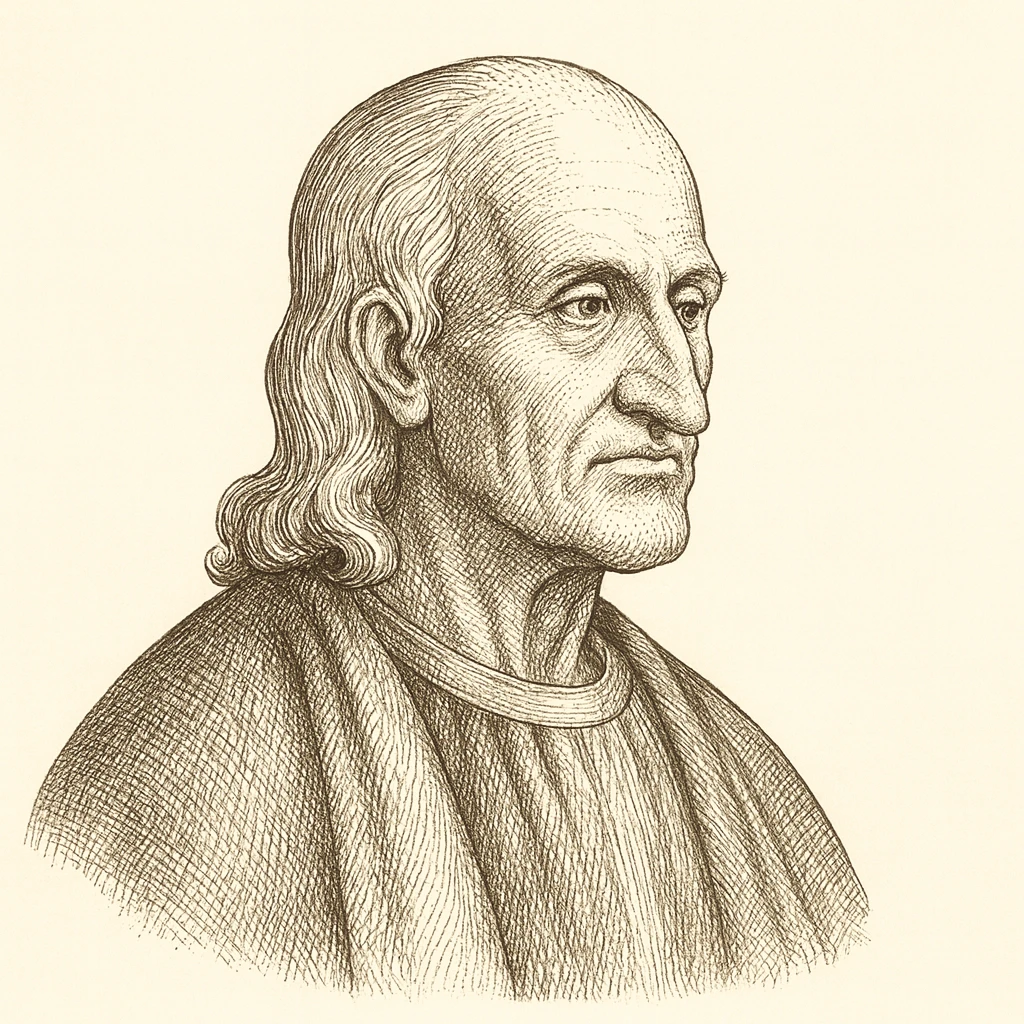
Anselm was born in Aosta, became a monk at Bec in Normandy, and was made Archbishop of Canterbury in 1093 by a king who had kept the see vacant for four years in order to pocket its revenues. He spent much of his episcopate in exile.
His intellectual program is captured in a phrase he used as an early title: faith seeking understanding. He held that the believer should not believe in order to understand but understand in order that he may believe — the content of faith is given, and reason's work is to grasp why it must be so. He then pursued this with a confidence that startles: in the Monologion he argues for the divine nature without appeal to scripture at all, and in the Proslogion he produces the argument that has occupied philosophers ever since. God is that than which nothing greater can be conceived; such a being must exist in reality and not merely in the understanding, because a being existing in reality would be greater. The argument was disputed immediately by the monk Gaunilo, rejected by Aquinas, revived by Descartes and Leibniz, demolished by Kant, and revived again in modal form in the twentieth century. No other single paragraph in medieval philosophy has had a longer afterlife.
The same method produces his account of the atonement. In Cur Deus Homo he sets aside the older view that the crucifixion was a ransom paid to the devil and argues instead from the logic of obligation: sin is a debt of honor owed to God, the debt is infinite, only man owes it and only God can pay it, and therefore the one who pays must be both. It is a piece of feudal reasoning turned into theology, and it became the standard Western account.
His political significance lies in the investiture conflict. Anselm returned from exile refusing to do homage to the king for his lands or to accept bishops appointed by royal authority, on the ground that spiritual office cannot be in the gift of a layman. The compromise eventually reached in England left the king with real influence and the church with the principle. What mattered for later political thought was the principle itself: that there exists an authority the crown does not constitute and cannot absorb. Every subsequent European argument for a limit on sovereign power has some debt to the conflict Anselm was prepared to be exiled twice for.
Wondering where you land? Take the 4-minute assessment