
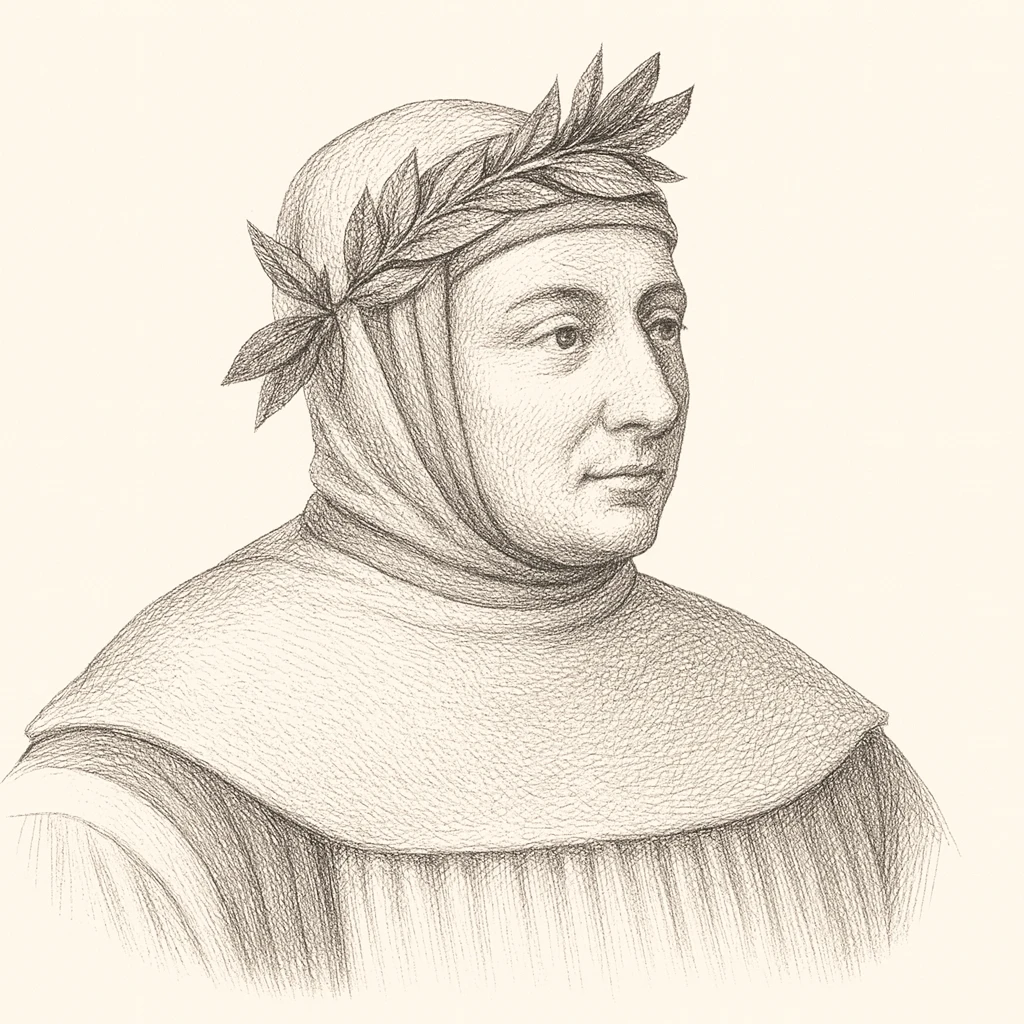
Francesco Petrarca — Petrarch — was the son of a Florentine exile, trained in law at Bologna, and abandoned it for letters. He spent his life moving between Avignon, Italian courts and rural retreats, corresponding with everyone who mattered, and being crowned poet laureate in Rome in 1341 in a ceremony he largely arranged himself.
His importance is less any single argument than a change of orientation. Petrarch was the first to describe the centuries between the fall of Rome and his own as a period of darkness, and to propose that the remedy was to go back past them — to read the Romans not as authorities to be excerpted for arguments but as people who had written well and lived thoughtfully, and whose language could be recovered. That program is what humanism was. It made philology a discipline with a purpose, it made the manuscript hunt a scholarly vocation, and it produced within a century a Europe that could read its own past in something like the original.
He hunted manuscripts himself, and his finds mattered. At Verona in 1345 he discovered Cicero's letters to Atticus, which showed him a Cicero unlike the marble orator of the schools: anxious, vacillating, deeply implicated in the politics he wrote about. Petrarch's response was to write Cicero a letter of reproach, which is characteristic of him — he treated the ancients as correspondents rather than as monuments, and the collections of letters he assembled, including a set addressed to dead authors, invent a stance toward the past that Europe kept.
The Secretum, an imagined dialogue with Augustine, is the other side of him: a self-examination in which his own ambition, his love for Laura and his desire for glory are put on trial by the saint and not acquitted. He is the first European writer to make the divided self a literary subject in his own voice.
His politics were unstable and largely disappointing — he supported Cola di Rienzo's Roman revolution, then abandoned him, and spent years in the pay of the Visconti tyrants while writing letters in praise of liberty. What he transmitted was not a doctrine but a set of tools and a conviction that the ancients had known how to live, which the civic humanists of the next generation put to political use he would not have predicted.
Wondering where you land? Take the 4-minute assessment