
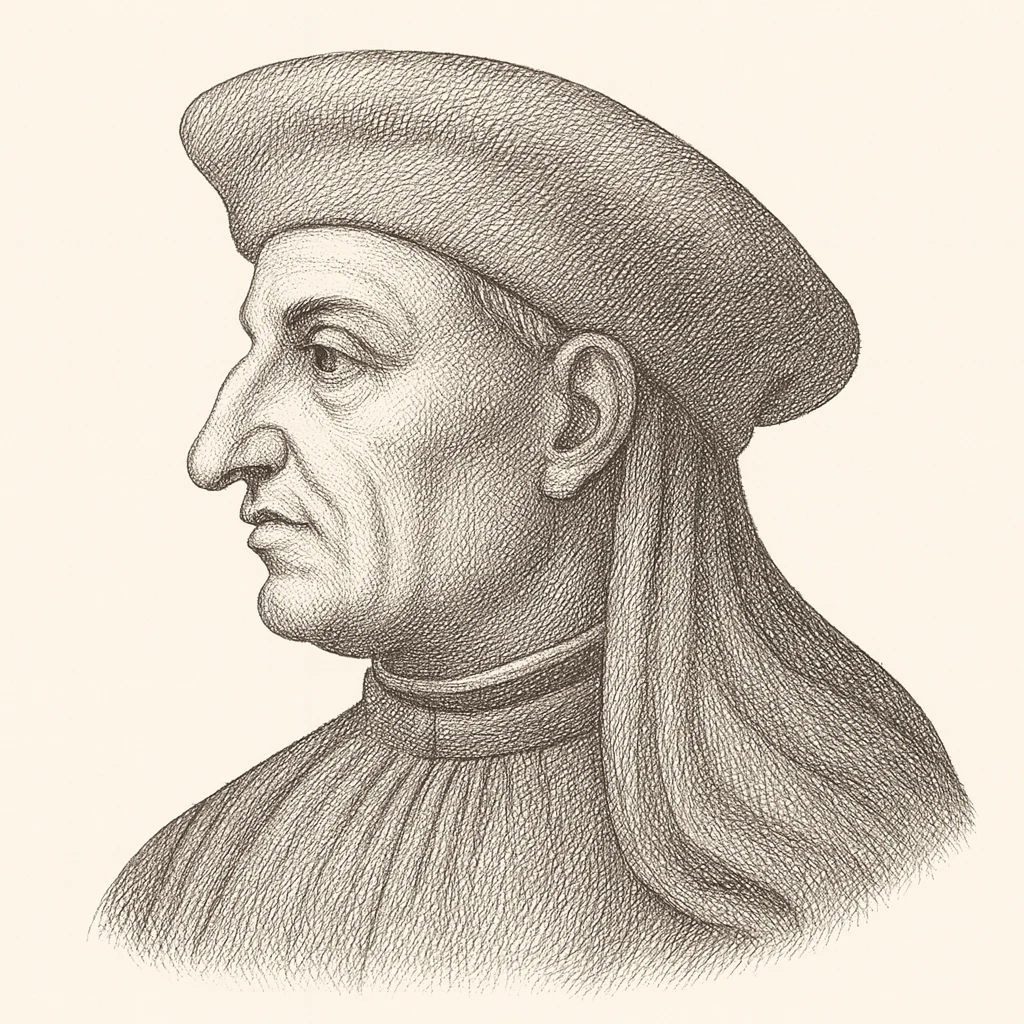
Leonardo Bruni was a papal secretary, then Chancellor of Florence from 1427 until his death, and the most influential translator of his century. He learned Greek from Chrysoloras when Greek had effectively been lost to the Latin west for eight hundred years, and used it to put Aristotle's Ethics and Politics into Latin that could be read as argument rather than decoded as jargon. The scholastic versions had rendered the Greek word by word; Bruni translated for sense, and the fight over whether this was license or improvement was one of the formative quarrels of Renaissance scholarship.
His political contribution is what Hans Baron named civic humanism. In the Panegyric to the City of Florence, written around 1404 while Florence stood alone against Milanese expansion, Bruni argues that the city's greatness follows from its liberty: free cities produce citizens who cultivate their talents because those talents can be used, while under a prince ability is a liability. He grounds the claim historically, arguing that Florence was founded under the Roman Republic rather than the Empire, and therefore inherits republican rather than imperial liberty — a genealogy he needed and largely constructed.
The History of the Florentine People, in twelve books, applies humanist method to a modern subject: sources weighed, miracles omitted, causes sought in interest and faction rather than providence. It is the first history written on those terms since antiquity, and it made a template.
The consequence of Bruni's work was to reverse the direction of the humanist program. Petrarch had read the ancients as a retreat from a debased present. Bruni read them as instruction for the active life of a citizen, and argued that the contemplative withdrawal the scholastics praised was a poor second to service in a free republic. Machiavelli inherited the Florentine argument in this form, and the whole later republican tradition — Harrington, the Commonwealthmen, the American founders — descends from the claim Bruni made first: that liberty is not merely a condition of comfort but the cause of a people's achievements.
Wondering where you land? Take the 4-minute assessment