
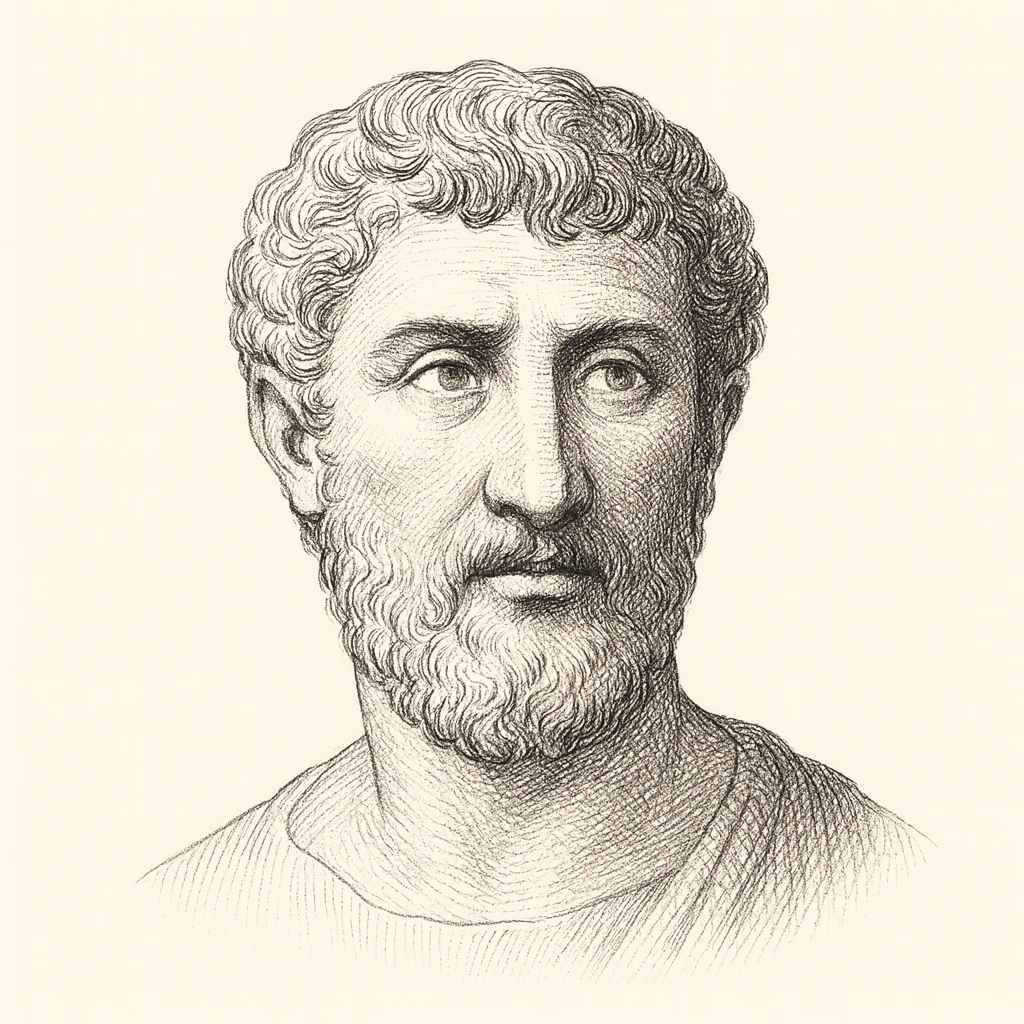
Almost nothing is known about Titus Lucretius Carus. He left one poem in six books, dedicated to a Roman aristocrat, arguing in hexameters for a physics and an ethics that most of his readers would have found repellent. Jerome reports that he was driven mad by a love potion and killed himself, a story with no independent support and every appearance of being invented to discredit him.
De Rerum Natura sets out to remove fear. Its premise is that the universe consists of atoms falling through void, that they combine and dissolve without design, and that everything — bodies, minds, worlds — is a temporary arrangement of matter. The soul is material and dies with the body; there is no afterlife and therefore nothing to dread in death. The gods exist but inhabit the spaces between worlds, undisturbed and indifferent. Religion, far from consoling, is the source of the terror: the poem's most famous passage describes the sacrifice of Iphigenia and concludes that such wickedness could only be urged by religion.
The poem is also, incidentally, the fullest surviving account of Epicurean physics, and it contains ideas that would wait two thousand years to be taken seriously — the swerve that introduces indeterminacy into atomic motion and leaves room for free action, an account of the origin of language as natural rather than conventional, a description of the emergence of society from a state of scattered violence through compacts of mutual restraint, and a sketch of species competition in which the ill-adapted die out.
It survived by a thread. A single manuscript was found in a German monastery in 1417 by the papal secretary Poggio Bracciolini, and copies spread quickly through Italy. The consequences were enormous and largely unintended: the poem supplied the Renaissance with a fully worked out materialism, an argument that the world requires no designer, and a language in which pleasure could be defended as the proper end of life. Montaigne quoted it constantly. Gassendi used it to make atomism respectable. Newton's contemporaries read it. Jefferson owned five copies. Marx returned to it in his dissertation, drawn by the swerve. A poem written to free a few Roman readers from superstition became one of the routes by which Europe learned to describe a universe with nothing above it.
Wondering where you land? Take the 4-minute assessment