
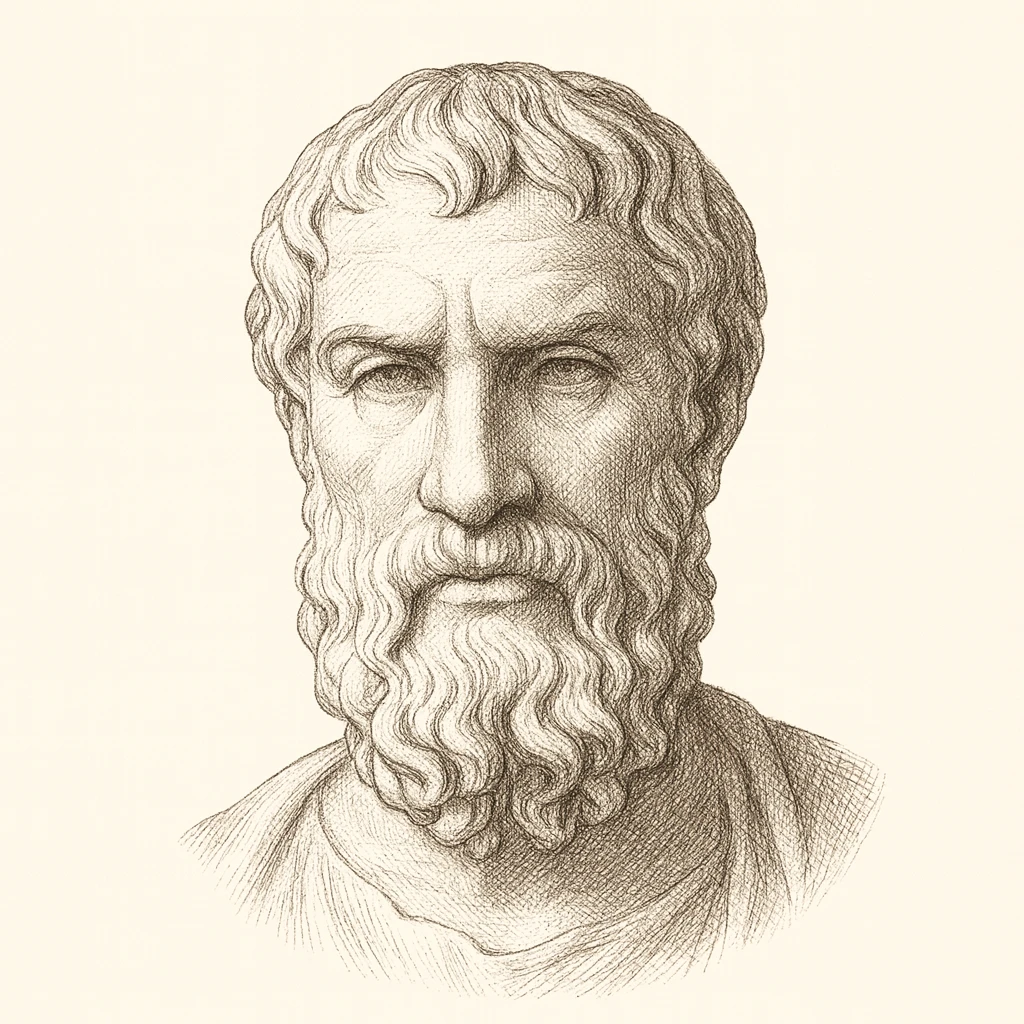
Epicurus founded a school in a garden outside Athens around 307 BC and admitted women and slaves to it, which scandalized his contemporaries more than his doctrines did. He wrote a great deal and almost all of it is lost; what survives is three summary letters, two collections of maxims, and the reports of hostile witnesses, which is why his reputation for centuries was of a sensualist rather than a man who lived on bread and water and thought cheese an occasional luxury.
The physics comes first and the ethics follows from it. Everything is atoms and void; the soul is atomic and disperses at death; the gods exist but are perfectly at rest and take no interest in human affairs. From this he draws the conclusion that gives the system its point: death is nothing to us, since where death is we are not, and the gods are nothing to fear, since they neither reward nor punish. Remove those two fears and what remains is the manageable problem of living well, which requires far less than people suppose — the absence of bodily pain and mental disturbance, secured by simple food, friendship, and withdrawal from the competition for honors. Pleasure is the standard, but the pleasure he means is the state of a body not in want and a mind not in fear, not the accumulation of sensation.
The politics is the part usually missed. Epicurus held that justice is not natural but a compact of mutual advantage, an agreement neither to harm nor be harmed, valid for as long as it remains useful to the parties. This is the first clear statement of a conventionalist and contractual account of justice, and it descends through Hobbes and Hume to every later theory that grounds obligation in reciprocal benefit rather than in a cosmic order. His practical advice — live unnoticed, avoid public life — was a rational response to the political conditions of the Hellenistic cities, and it made the school permanently suspect to the civically minded.
His influence is largely subterranean and then sudden. Lucretius made the system into Latin verse; the recovery of that poem in 1417 put atomism back into European circulation; Gassendi rehabilitated the ethics in the seventeenth century; Jefferson called himself an Epicurean; and Marx wrote his doctoral dissertation on the difference between Democritean and Epicurean natural philosophy, drawn by the swerve that leaves room for contingency in a material world.
Wondering where you land? Take the 4-minute assessment