
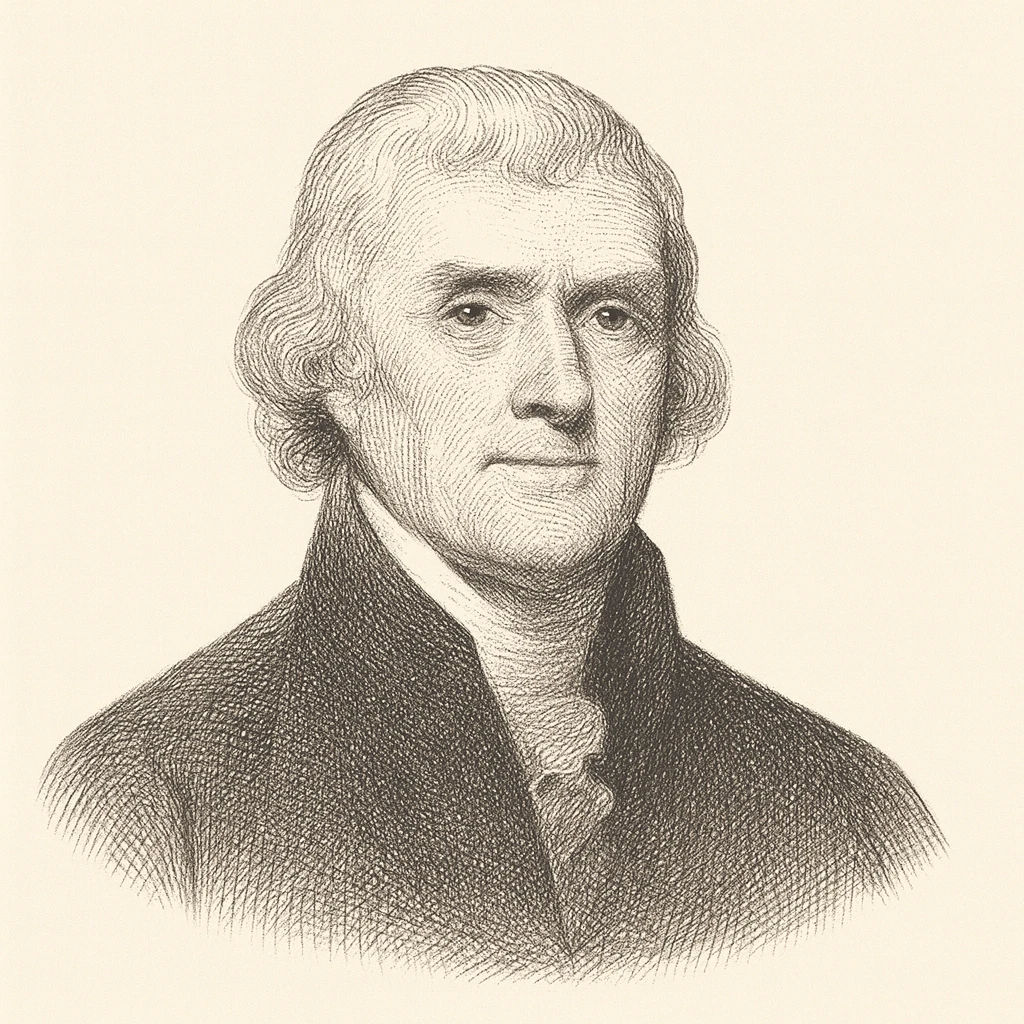
Thomas Jefferson is one of the most consequential and contradictory figures in American political thought, a slaveholder who wrote that all men are created equal, an agrarian idealist who doubled the size of the United States, a small-government republican who used federal power boldly when it suited his purposes, and a philosophical liberal whose most famous words continue to shape how Americans understand their political inheritance more than two centuries after he wrote them. Reading Jefferson carefully means accepting this complexity rather than resolving it in either direction. He was neither the moral hero of 19th century American civic religion nor the hypocritical monster of later revisionist accounts. He was something more unsettling: a thinker whose clearest philosophical convictions were entirely at odds with the life he actually lived, and whose inability to reconcile the two has become the permanent inheritance of the American political tradition.
Jefferson was born in 1743 in colonial Virginia, the son of a wealthy planter, and received the classical education that was standard for Virginia gentry: Latin, Greek, philosophy, law, natural science, and the political and historical writers who shaped Enlightenment thought. He trained as a lawyer, entered the Virginia House of Burgesses in 1769, and was pulled into revolutionary politics almost immediately as tensions with Britain escalated. In 1776, when the Continental Congress needed a document explaining to the world why the American colonies were declaring independence, the drafting committee (Franklin, Adams, Sherman, Livingston, and Jefferson) assigned the writing to Jefferson because, as John Adams later put it, Jefferson had a "peculiar felicity of expression."
What Jefferson produced, through several drafts and editorial revisions by Franklin and Adams, was the Declaration of Independence. Its famous second paragraph — "We hold these truths to be self-evident, that all men are created equal, that they are endowed by their Creator with certain unalienable Rights, that among these are Life, Liberty and the pursuit of Happiness" — distilled the Lockean natural rights tradition into a single paragraph that would shape democratic political rhetoric around the world for centuries. It was the clearest philosophical statement of liberal political thought any American had yet produced, and it gave the American Revolution its moral foundation in terms that transcended the specific grievances against George III. The Declaration's philosophical argument was not original to Jefferson — it drew directly on Locke, on the Scottish Enlightenment, on the British republican tradition — but Jefferson's compression and elevation of that argument gave it a literary power that none of his sources had achieved.
Jefferson's political career after the Declaration was long and consequential. He served as Virginia's wartime governor, as minister to France during the lead-up to the French Revolution, as Washington's first Secretary of State, as vice president under John Adams, and as the third President of the United States from 1801 to 1809. As president, he doubled the size of the country through the Louisiana Purchase, sent Lewis and Clark to explore the continent, and consistently pushed for limited federal power and agrarian economic development. He founded the University of Virginia in his retirement and considered it, along with the Declaration and his authorship of the Virginia Statute for Religious Freedom (1786), one of his three proudest accomplishments.
The Virginia Statute for Religious Freedom deserves particular attention because it represented the most radical philosophical position Jefferson ever advanced: the complete separation of religious conviction from civic status. Jefferson argued that no person should be compelled to support any religious establishment, or penalized in any way for their religious beliefs or lack of them, and that civic rights and duties should be entirely independent of religious commitment. This was more radical than anything in Locke's writings on toleration, and it directly shaped the First Amendment's establishment and free exercise clauses. Jefferson considered it one of his greatest contributions and asked that it be mentioned on his tombstone along with the Declaration and the University of Virginia. He did not mention the presidency.
Jefferson's political philosophy, worked out across fifty years of letters and occasional writings, centered on several core commitments: natural rights as the foundation of legitimate government, consent of the governed as the basis of political authority, limited federal power within a framework of state and local self-government, the moral and political importance of independent yeoman farmers as the foundation of republican virtue, and deep suspicion of concentrated economic or political power. His vision of an agrarian republic of small independent property holders shaped 19th century American political rhetoric and remains a touchstone for contemporary classical liberal and populist traditions that distrust urban commercial and financial elites.
And there was slavery. Jefferson owned more than 600 enslaved human beings across his life, freed only a handful of them, and famously wrote in Notes on the State of Virginia that slavery was a moral catastrophe that was corrupting both enslaved and enslaver while simultaneously articulating racial theories that denied the full humanity of African people. He fathered children with Sally Hemings, an enslaved woman on his plantation, and never acknowledged them publicly. His inability to reconcile his clearest philosophical commitments with his practical life is not a minor footnote to his thought. It is central to any serious reading of him, and it has become the defining difficulty of the American political tradition that descends from his work.
Jefferson died on July 4, 1826 — exactly fifty years after the signing of the Declaration of Independence, on the same day as John Adams — at his home at Monticello, deep in debt, his plantation soon to be sold and his enslaved workers dispersed to new owners. His political influence on American classical liberalism, libertarian thought, and democratic republicanism runs through the entire subsequent history of American political development.
Thomas Jefferson is associated with Classical Liberal. See the archetype