
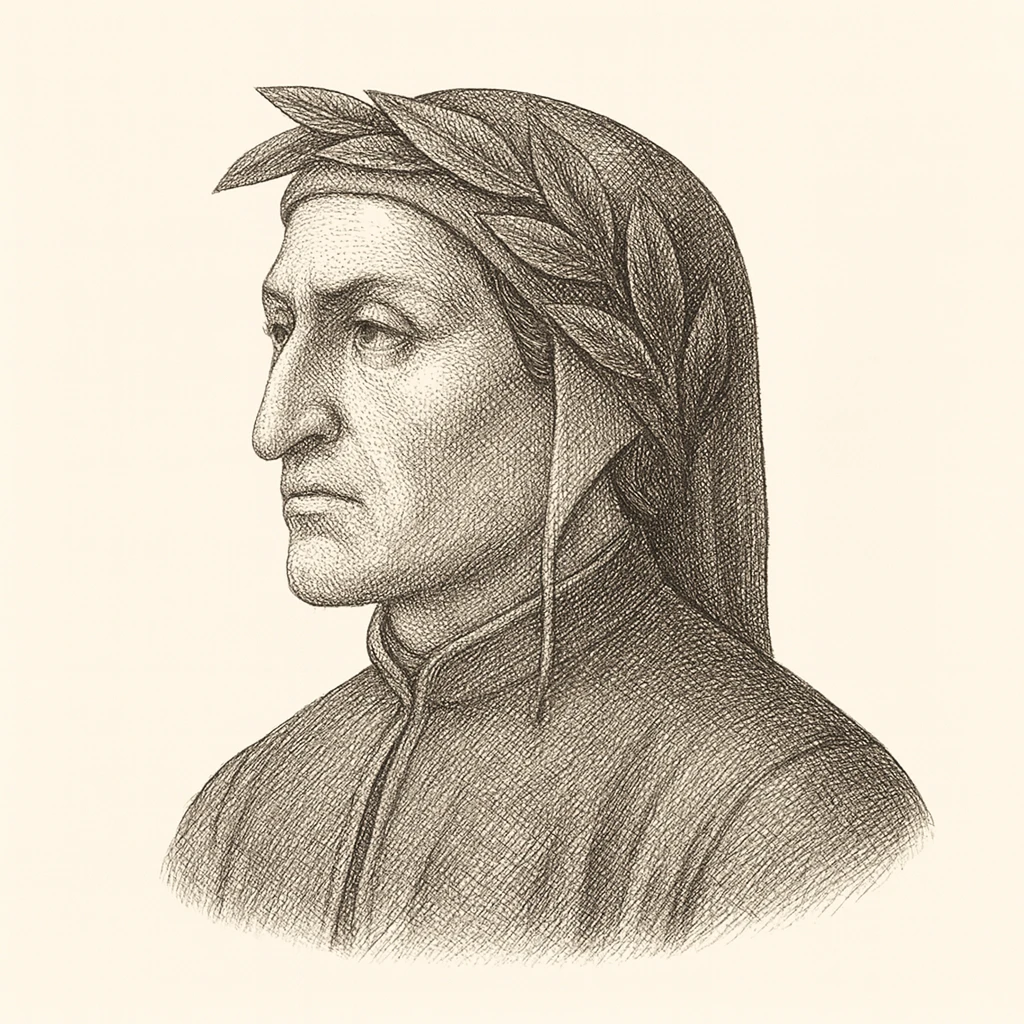
Dante was a Florentine of the governing class who was exiled for life in 1302 when his faction lost, condemned to be burned if he returned, and never went back. Everything he wrote afterwards was written by a man with a grievance against the politics of his city and a theory about what had gone wrong with the world.
The Commedia is not usually read as political theory, but it is saturated with judgment: popes are in hell for simony, Florence is denounced in every canticle, and the design of the poem asserts that there is an order in which every soul is placed exactly where its choices put it. The lowest circle holds traitors to lords and benefactors, which is a political conviction about the gravity of broken faith.
The Monarchia, written in Latin around 1313, is the argument stated directly, and it is startlingly systematic. It asks three questions. Is a universal monarchy necessary for the world's wellbeing? Did the Roman people acquire that office by right? Does the monarch's authority come from God directly or through the pope? Dante answers yes, yes, and directly. The first argument is the most interesting: humanity has a capacity — the full actualization of the intellect — that no individual and no single city can realize, and which requires peace, and peace requires a judge above all disputes, since where two princes are equals neither can judge the other. Universal monarchy is therefore a condition of humanity fulfilling its distinctive end.
The third book is the polemical one. Against the hierocratic case that Giles of Rome had made at full strength, Dante argues that humanity has two ends, blessedness in this life and blessedness in the next, and that God has provided two guides for them: the emperor by philosophy for the first, the pope by revelation for the second. Neither derives from the other. The empire existed and was legitimate before the church, and so cannot owe its authority to it.
The book was burned as heretical, placed on the Index, and remained there until 1881. It is the clearest medieval statement of the autonomy of secular authority, and its argument that political power answers to a natural human end rather than to ecclesiastical grant is one of the routes by which the idea of a self-standing political sphere entered European thought.
Wondering where you land? Take the 4-minute assessment