
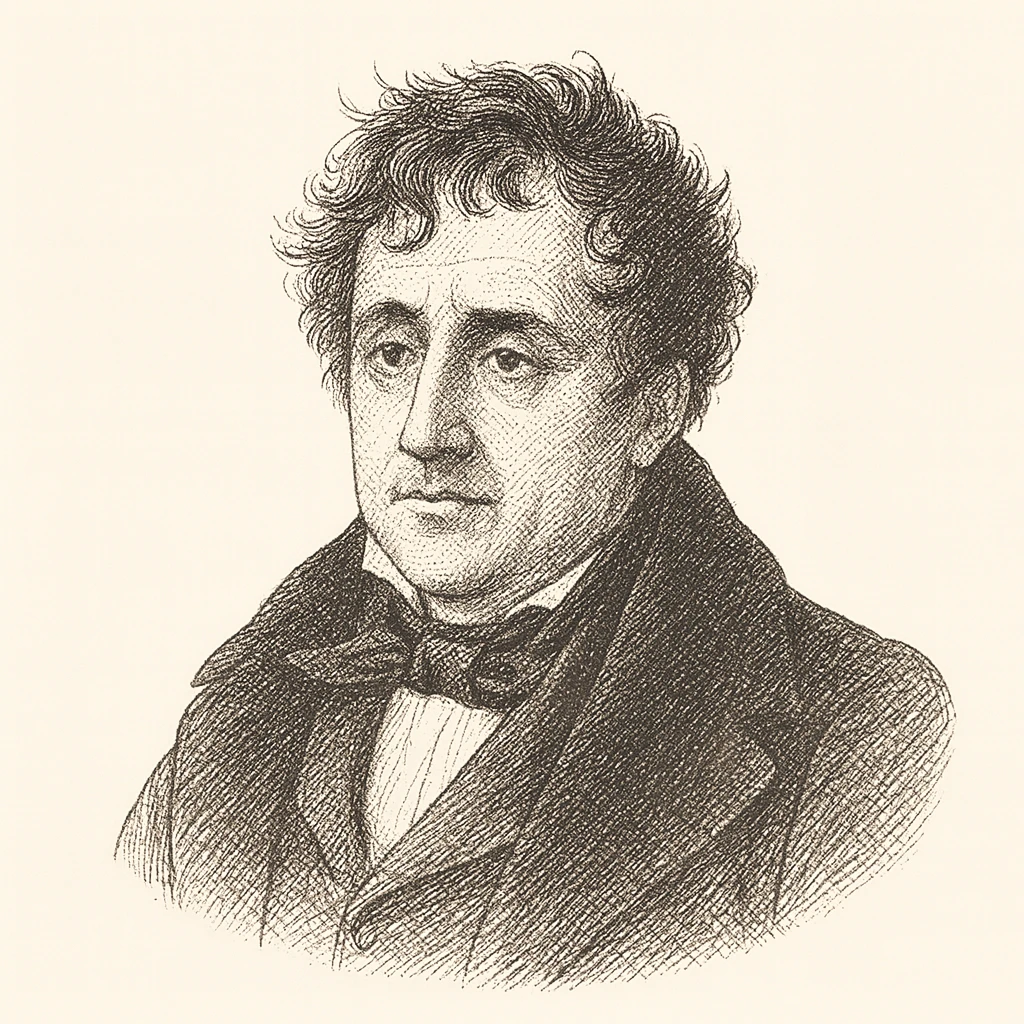
François-René de Chateaubriand fled revolutionary France, traveled in America, fought with the émigré army, was wounded, and spent seven years in poverty in London before returning under Napoleon. He then served the Bourbons as ambassador and foreign minister, resigned, went into opposition, and wrote his memoirs for publication after his death.
The Genius of Christianity, published in 1802 a few days after Napoleon's Concordat with the papacy, is the book that made him. Its strategy is a deliberate refusal of the ground the eighteenth century had fought on. Chateaubriand does not argue that Christianity is true; he argues that it is beautiful, that it produced the cathedrals, the poetry, the paintings and the moral sensibility of Europe, and that a civilization which discards it discards the source of its own capacity for feeling. Voltaire had attacked religion as absurd and cruel; Chateaubriand answers with Gothic architecture, ruins, bells heard across a valley, and the sublime in nature. It is an aesthetic apologetics, and it worked on a generation exhausted by argument.
That move — defending an inheritance by what it has made rather than by what it asserts — is his lasting contribution to conservative thought, and it recurs everywhere afterwards. It also founded French Romanticism: René, the short novel embedded in the larger work, gave European literature the figure of the young man afflicted by a vague and unfocused longing, and le mal du siècle became a diagnosis of the age.
His politics were a legitimism nobody found reliable. He served the Restoration and attacked it; he defended press freedom against the ultras, opposed the censorship of 1824, and was regarded by the court as an inconvenient ally and by the liberals as an inconsistent opponent. He supported the Greek insurgents and Spanish intervention in the same decade.
The Memoirs from Beyond the Grave, withheld until his death, are the enduring book — a self-portrait staged against the collapse of one world and the arrival of another, and the model for a whole tradition of French memoir in which a life is offered as the register of an epoch.
Wondering where you land? Take the 4-minute assessment