
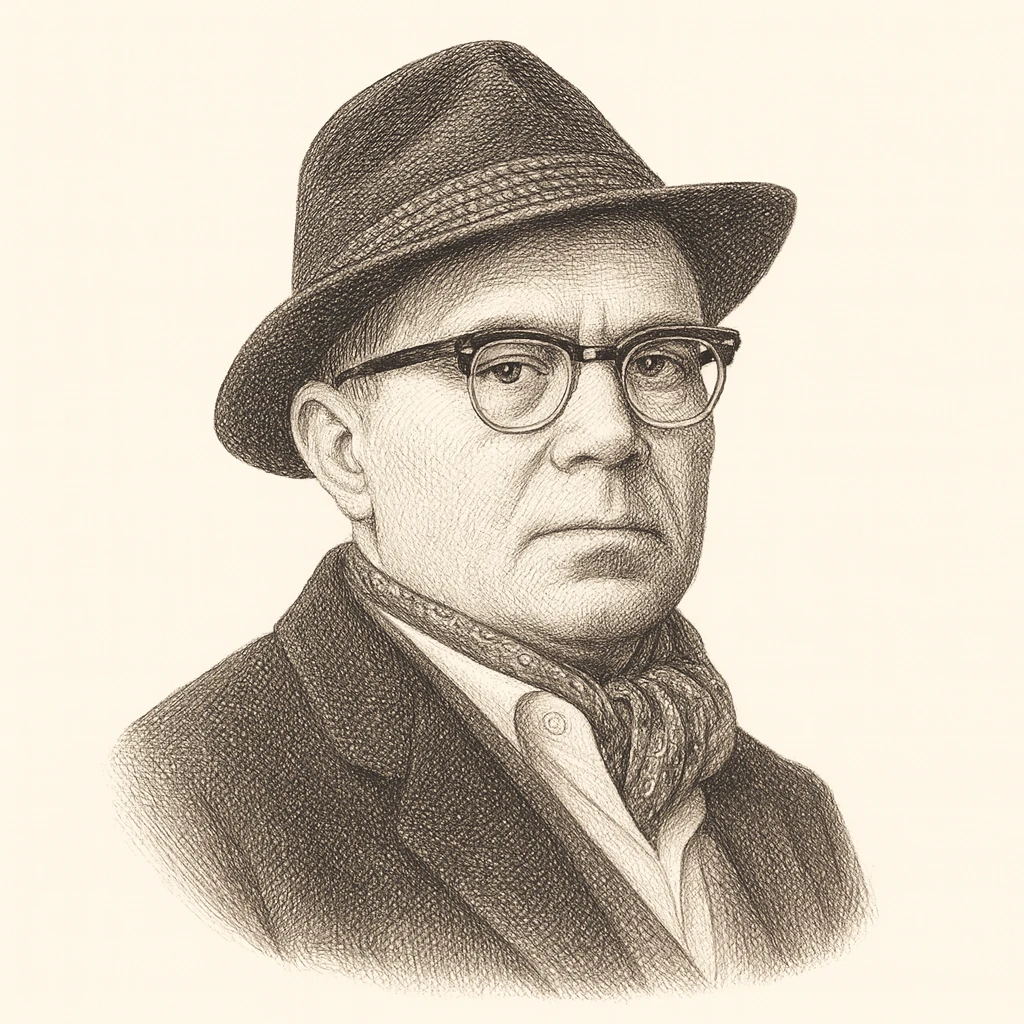
Russell Kirk was born in 1918 in Plymouth, Michigan, into the kind of modest circumstances that rarely produce major political philosophers. His father worked for the railroad; his family had deep roots in rural Michigan stretching back generations. He grew up partly in Plymouth and partly in Mecosta, a small village in the central part of the state where his great-grandmother still lived, and where he absorbed, without quite realizing it, the texture of a way of life organized around family, community, and the rhythms of agricultural seasons rather than the logic of industrial capitalism. He was a voracious reader from childhood, and the local library gave him a foundation in American history and literature that shaped everything that followed. He attended Michigan State College on scholarship, studying history, and then earned a master's degree at Duke. His doctoral dissertation — on the conservative tradition in British and American political thought — became, after a decade of revision and expansion, The Conservative Mind.
The war interrupted this scholarly formation in a way that proved unexpectedly clarifying. Kirk served from 1942 to 1946 at the Dugway Proving Ground in the Utah salt flats — a landscape of such monumental emptiness that it gave him, he later said, an ineradicable appreciation for everything civilization had achieved through centuries of effort. The desert was the perfect negative image of what he cared about: the accumulated achievements of ordered human life, the "unbought grace" of institutions and customs that made civilized existence possible. He returned to his dissertation with a conviction, newly visceral, that what Burke had called the "contract of eternal society" was not a rhetorical flourish but a reality worth defending intellectually.
The Conservative Mind appeared in 1953, and its reception was extraordinary for a work of intellectual history. Lionel Trilling had recently declared that conservative impulses expressed themselves only in "irritable mental gestures which seek to resemble ideas." Kirk's 450-page argument that conservatism had a coherent tradition — running from Burke through John Adams, Walter Scott, Tocqueville, Coleridge, Disraeli, and Henry Adams into the twentieth century — was taken as a direct refutation. The book organized this tradition around six "canons": belief in transcendent moral order; appreciation of the variety of human experience against abstract schemes; the link between civilized society and private property; faith in prescription — the wisdom embedded in custom and precedent; and the recognition that change and reform are not identical. These were not axioms derived from first principles but empirical observations about what had actually sustained civilized life across centuries and continents.
What the book did for American conservatism was give it an intellectual identity that went beyond anti-New Dealism and anti-Communism. It provided a lineage, a set of ancestors, and an account of what conservatism was for rather than merely against. It also set the terms for a lasting internal argument: Kirk's traditionalism, rooted in culture, religion, and inherited institutions, was always in tension with the free-market libertarianism that Hayek and Friedman represented. Kirk never trusted capitalism as an ally of tradition. He thought it corroded the very structures it needed to flourish — that the dynamism of markets was as destructive of inherited ways of life as the dynamism of revolution, and that the American right had made a serious error in treating economic liberalism as its natural ally. He said this loudly and repeatedly, and libertarians never forgave him.
The subsequent decades produced an extraordinary volume of work in an improbable setting. He settled permanently in Mecosta, in a large Victorian house he called Piety Hill, which he gradually filled with books, students, visiting scholars, and an extended informal household. He wrote gothic fiction alongside political philosophy — ghost stories set in rural Michigan and ancestral English houses — because he believed the supernatural tale conveyed truths about human nature that realistic fiction could not reach. The Roots of American Order (1974) traced the civilizational sources of American political culture through five cities: Jerusalem, Athens, Rome, London, and Philadelphia. He also wrote extensively on education, university culture, and the fate of the humanities in a technocratic age, producing Decadence and Renewal in the Higher Learning (1978) as a sustained critique of what the American university had become.
He was lionized by a conservative movement that never quite understood what he believed. The Reagan administration invited him to speak but pursued economic policies he regarded with deep skepticism. The neoconservatives who came to dominate Republican intellectual life in the 1980s and 1990s were, in his view, classical liberals in disguise — committed to the universalization of democratic capitalism, which was precisely the kind of abstract ideological project that genuine conservatism existed to resist. He died in 1994 having watched the movement he helped create become something substantially different from what he had intended. His house at Mecosta is now a study center, and his books remain continuously in print, read by each new generation that finds the permanent things worth defending.
Russell Kirk is associated with National Conservative. See the archetype