
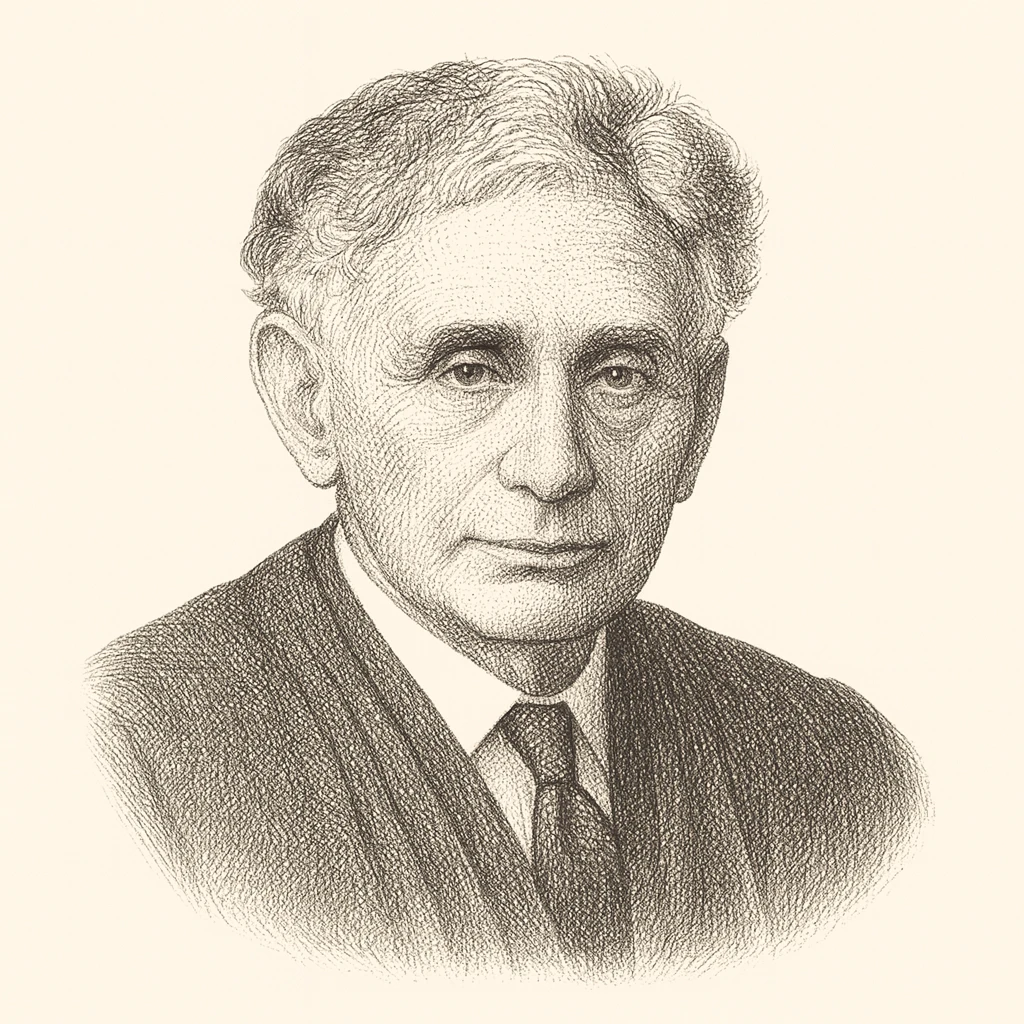
Louis Dembitz Brandeis was born in Louisville, Kentucky, on November 13, 1856, to Jewish immigrants from Prague. After secondary schooling in Germany he studied at Harvard Law School, graduating with record grades, and built a successful practice in Boston. In 1890 he and his law partner Samuel Warren published "The Right to Privacy" in the Harvard Law Review, arguing that the common law should protect what Judge Cooley had called the right "to be let alone" against "instantaneous photographs and newspaper enterprise." His practice let him take on public-interest cases, which earned him the name "the people's lawyer." In 1908 he defended a state limit on the working hours of women in laundries before the Supreme Court with a 113-page brief built on economic and social data, the model for what became known as the Brandeis Brief.
His economics centered on the dangers of concentrated power. In Other People's Money and How the Bankers Use It (1914), essays first published in Harper's Weekly, he drew on the findings of the Pujo Committee to attack the Money Trust and the practice of interlocking directorates, which he called "the root of many evils." One chapter is titled "A Curse of Bigness." Another made the case for disclosure: "Sunlight is said to be the best of disinfectants; electric light the most efficient policeman."
Wilson nominated him to the Supreme Court in 1916. The Wall Street Journal and the New York Times called him a radical, and William Howard Taft, Henry Cabot Lodge, Elihu Root and six former presidents of the American Bar Association opposed him. The Senate held its first hearing on a Supreme Court nomination and confirmed him 47 to 22 on June 1, 1916, making him the first Jewish justice. On the Court he joined Holmes's dissent in Abrams, and in Whitney v. California (1927) he wrote a concurrence holding that only an emergency can justify repressing speech: "the remedy to be applied is more speech, not enforced silence." Dissenting in New State Ice Co. v. Liebmann (1932), he wrote that "a single courageous state may, if its citizens choose, serve as a laboratory."
Brandeis was introduced to Zionism by the English Zionist Jacob de Haas. During the First World War he chaired the Provisional Executive Committee for General Zionist Affairs and strengthened the American movement's organization and finances. He resigned the post on joining the Court but continued to press Wilson to support the Zionist cause, and after the war a dispute with Chaim Weizmann over the movement's direction left Weizmann in control. Brandeis treated Zionism as part of American ethnic identity. He retired from the Court on February 13, 1939, and died in Washington on October 5, 1941.
Louis Brandeis is associated with Rooted Progressive. See the archetype