
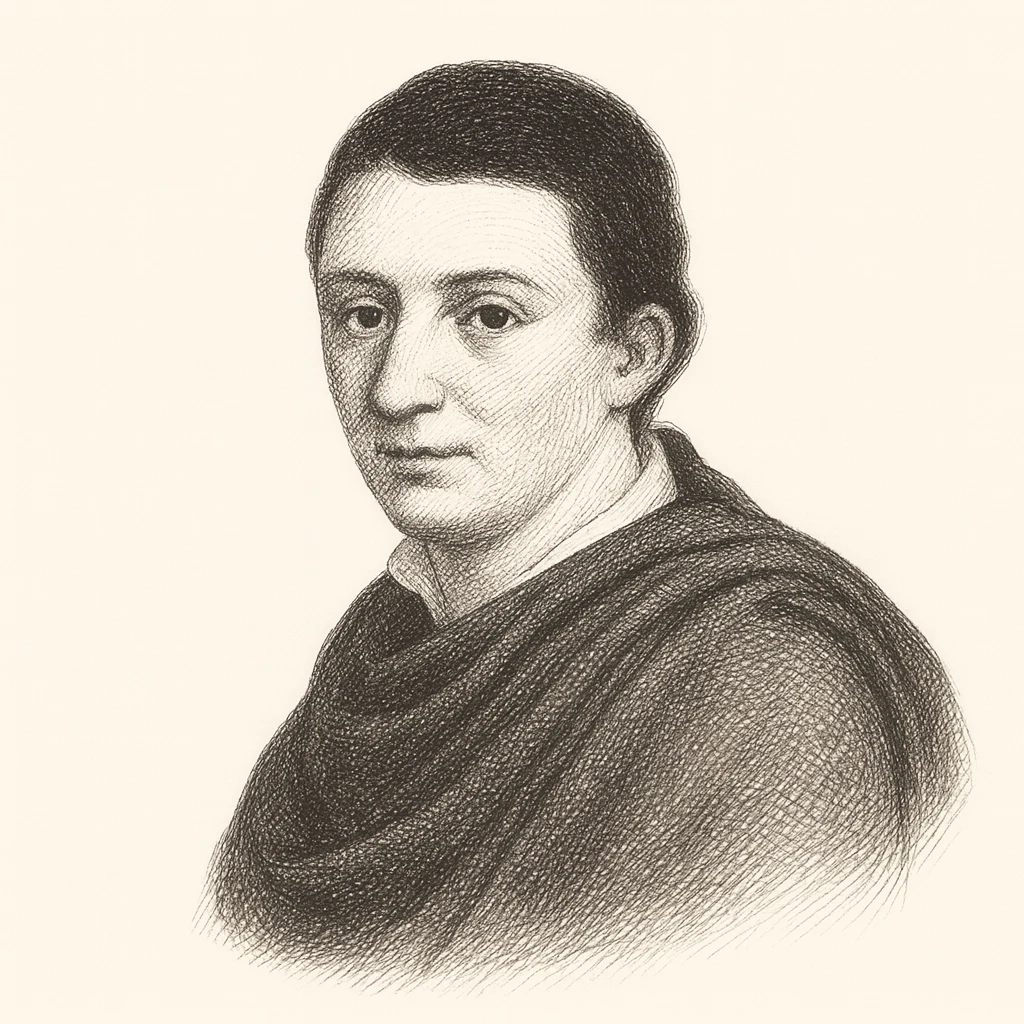
Friedrich Schlegel gave Romanticism its name as a program and much of its theory. With his brother August Wilhelm he ran the journal Athenaeum from 1798, around which the Jena circle formed — Novalis, Tieck, Schleiermacher, Schelling, and Caroline Schlegel — and in whose fragments the movement stated itself.
His definition of Romantic poetry, in Athenaeum fragment 116, is the key document: a progressive universal poetry whose vocation is to reunite the separated genres and to put poetry in touch with philosophy and rhetoric, and which is still in the process of becoming — that indeed is its real essence, that it is eternally becoming and can never be completed. The claim is that the modern work is necessarily unfinished, self-aware and ironic, because it knows itself to be a construction rather than a natural growth, and this self-knowledge is not a defect but the condition of modern art. Romantic irony is the artist's simultaneous commitment to a creation and detachment from it.
He also effectively invented criticism as a genre with intellectual standing. Earlier critics judged works against rules; Schlegel argued that criticism completes the work, that a review may be a philosophical act, and that the critic's business is to grasp the internal principle of a book rather than measure it externally. His essay on Wilhelm Meister demonstrates the method, and Walter Benjamin's dissertation on the concept of criticism in German Romanticism is a study of it.
His Ancient and Modern Literature lectures introduced the comparative study of European literatures, and On the Language and Wisdom of the Indians, following his study of Sanskrit in Paris, is one of the founding texts of comparative philology and of Indo-European linguistics — with the unhappy consequence that his term for the language family, and the racial mythology later built on it, entered European circulation partly through him.
He converted to Catholicism in 1808, entered Austrian service under Metternich, and spent his later years writing philosophy of history in defense of the restored order. The trajectory from revolutionary aesthetics to Habsburg conservatism is common enough in the generation to be almost a pattern, and it is the reason Heine and later the Marxist critics treated Romanticism as reaction from the beginning.
Wondering where you land? Take the 4-minute assessment