
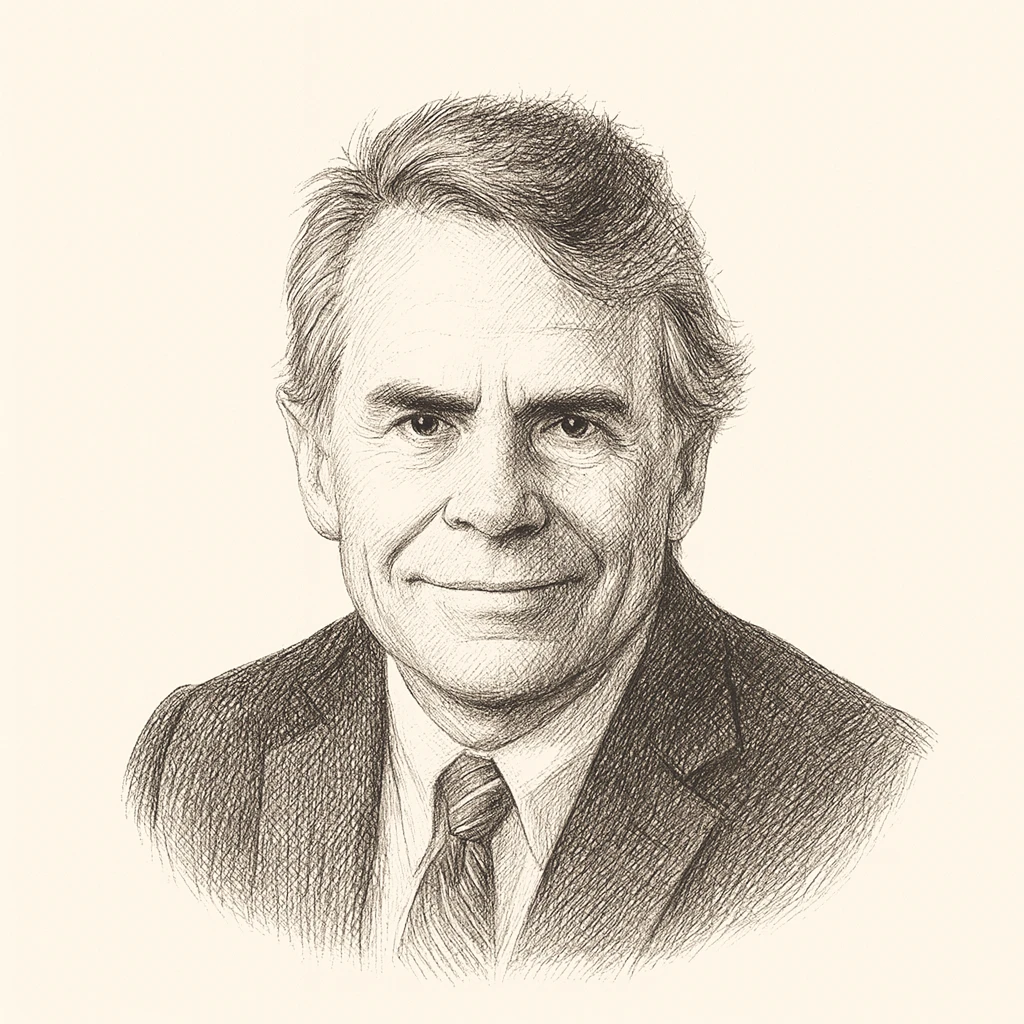
Christopher Lasch was born in 1932 in Omaha, Nebraska, and grew up in a household shaped by his father's progressive journalism and his mother's strong social convictions — both parents were secular liberals of the type that dominated the American professional class in the middle decades of the twentieth century, and Lasch absorbed from them both the commitment to social justice that would organize his career and the frustration with liberal complacency that would distinguish it. He attended Harvard, where he majored in history and was shaped by the social history that was then transforming the discipline, and then went to Columbia for his doctorate, writing a dissertation on American liberals and the Russian Revolution that demonstrated, from the beginning, his willingness to criticize his own ideological camp with the same rigor he applied to its opponents.
He taught at Iowa and then at Northwestern before moving to the University of Rochester in 1970, where he would spend the rest of his career. Rochester was not Harvard or Yale, and this was not incidental: Lasch was consciously positioning himself outside the elite institutional culture that he increasingly saw as part of the problem he was diagnosing. He married Nell Commager, the daughter of the historian Henry Steele Commager, in 1956, and they raised four children in circumstances that were comfortable but deliberately unaffluent — he drove old cars, traveled modestly, and maintained the kind of domestic seriousness that he was simultaneously describing as a disappearing cultural formation.
His early work was conventional social and intellectual history: The American Liberals and the Russian Revolution (1962), The New Radicalism in America (1965), The Agony of the American Left (1969). These were well-received books that established him as a serious historian of American radical thought, but they were also preparation for the more ambitious synthetic work that he was developing through the 1970s. He was reading widely in psychoanalysis, sociology, and social criticism — Philip Rieff's The Triumph of the Therapeutic, Richard Sennett's work on public life, the Frankfurt School's critique of mass culture — and developing a diagnosis of American cultural pathology that would prove simultaneously more sweeping and more precise than any of his sources.
The Culture of Narcissism (1979) was the result, and its public reception bore no relationship to what the book actually said. Jimmy Carter read it, or had it read to him, in preparation for his "malaise" speech of July 1979, and the association with a failed presidency damaged the book by implication. It was received as a diagnosis of selfishness — Americans too absorbed in personal fulfillment to care about the common good. Lasch's argument was more careful and more disturbing: narcissism was not vanity but a clinical category, a personality structure characterized by grandiosity and fragility, by the inability to form deep attachments, by a profound dependence on external validation to compensate for an impoverished inner life. This pathology had emerged, he argued, not from individual moral failure but from the systematic destruction of the cultural formations — skilled work, stable family, religious community, neighborhood — that had previously provided people with sources of identity and meaning that did not depend on external performance and validation.
The True and Only Heaven (1991) was his most ambitious work and, he believed, his best. It was a history of what he called the "productivist" tradition in American political thought — the tradition of small producers, artisans, farmers, and skilled workers who valued independence, craft, and the competence of ordinary working people, and who had resisted the encroachment of both capitalist rationalization and progressive technocracy on the conditions that made such independence possible. Lasch was not advocating a return to the nineteenth century; he was recovering a set of moral and political commitments — a politics of limits, a suspicion of unlimited economic growth, a valuation of local community and particular attachments over universal progress — that he thought more adequate to the actual conditions of human life than either liberalism or socialism had been.
The Revolt of the Elites and the Betrayal of Democracy, published posthumously in 1995 after his death from cancer the previous year, was the most directly political of his books. Its central argument — that the meritocratic professional class had seceded from common life into a world of private schools, gated communities, globalized careers, and cosmopolitan culture that gave them no real stake in the health of local institutions — explained the political alienation and populist backlash that were already becoming visible in the early 1990s. The elites had not merely abandoned the working class economically; they had abandoned it culturally, replacing the shared institutions and common obligations of civic life with a therapeutic culture of self-improvement and a politics of personal identity that left the working class with no one to represent its actual interests. Lasch died before he could see how accurately this analysis described the next two decades of American political life.
Christopher Lasch is associated with Rooted Progressive. See the archetype