
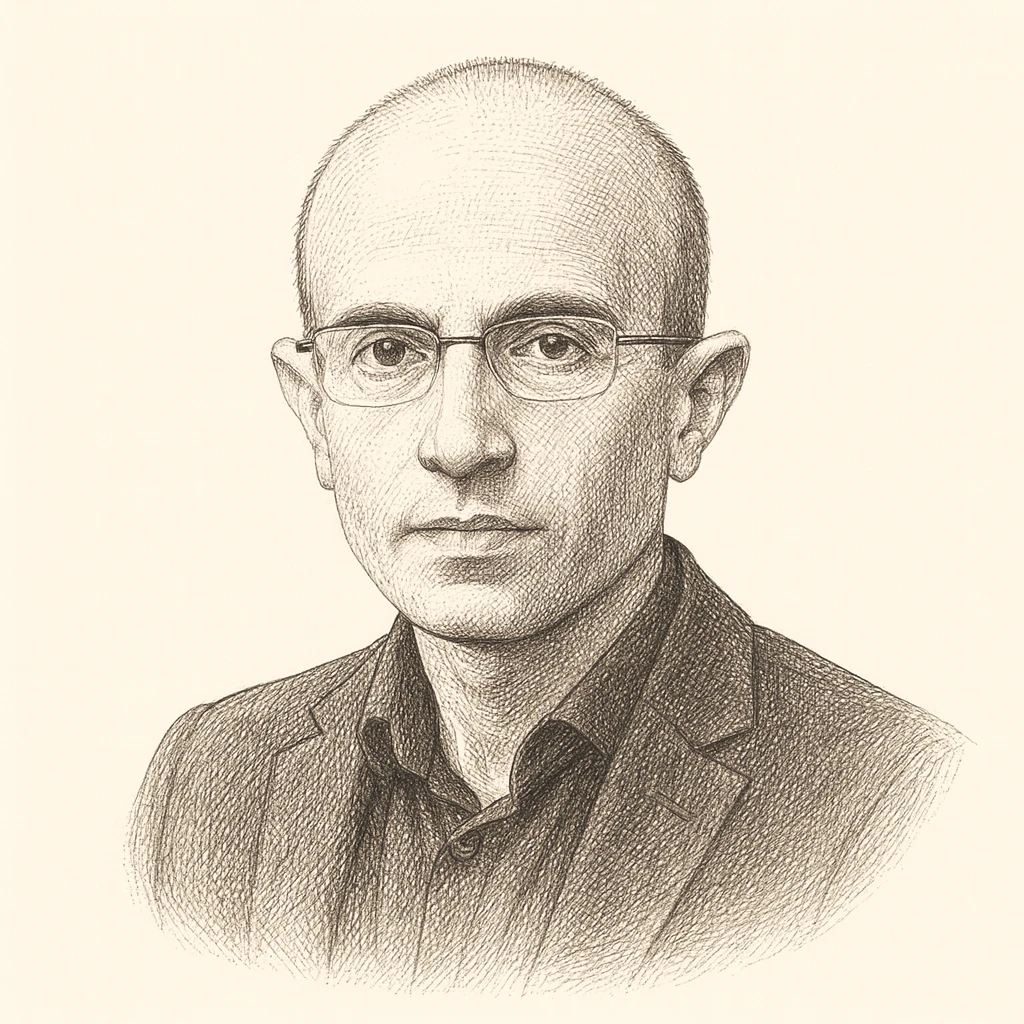
Yuval Noah Harari is an Israeli historian, born in 1976, who received his doctorate from the University of Oxford in 2002 and has lectured in the Department of History at the Hebrew University of Jerusalem and been a Distinguished Research Fellow at the University of Cambridge's Centre for the Study of Existential Risk. Sapiens: A Brief History of Humankind, first published in Hebrew in 2011 and in English in 2014, argues that humans came to rule the world because they alone can cooperate flexibly in large numbers by believing in things that exist only in their imagination, such as gods, states, money and human rights. He followed it with Homo Deus: A Brief History of Tomorrow, published in English in 2016, which argued that humanity will pursue immortality, happiness and divine powers of creation, and that authority would shift from individual humans to networked algorithms once companies like Google and Facebook know people better than they know themselves. 21 Lessons for the 21st Century appeared in 2018.
His political argument turns on scale. In a 2017 TED dialogue he said that "the old 20th-century political model of left versus right is now largely irrelevant, and the real divide today is between global and national." He called patriotism a force that had let large numbers of people care for one another, but argued that without global cooperation "nationalism is just not on the right level to tackle the problems, whether it's climate change or whether it's technological disruption."
Nexus: A Brief History of Information Networks from the Stone Age to AI (2024) carries that argument into technology. In an extract published by the Guardian, he wrote that most human networks have been "built and maintained by spreading fictions, fantasies and mass delusions," and that AI differs from every earlier invention because it can make decisions and create ideas by itself: "AI isn't a tool – it's an agent." He warned of a "silicon curtain" dividing the world into rival digital spheres, and of data colonies controlled by whoever holds their information. "As long as humanity stands united, we can build institutions that will regulate AI," he wrote, adding that humanity has never been united.
In Israel he opposed the government's 2023 plan to curb the Supreme Court. "The most precious aspect of liberal democracy isn't majority rule, but limiting the power of the ruler in order to protect citizen rights," he wrote in February 2023, and he later warned that without the court as a check the country could keep holding elections and still become a dictatorship. In 2019 he co-founded Sapienship, a social impact company, with his husband, Itzik Yahav, and in 2026 he joined the board of the AI safety organization LawZero.
Yuval Noah Harari is associated with Social Liberal. See the archetype