
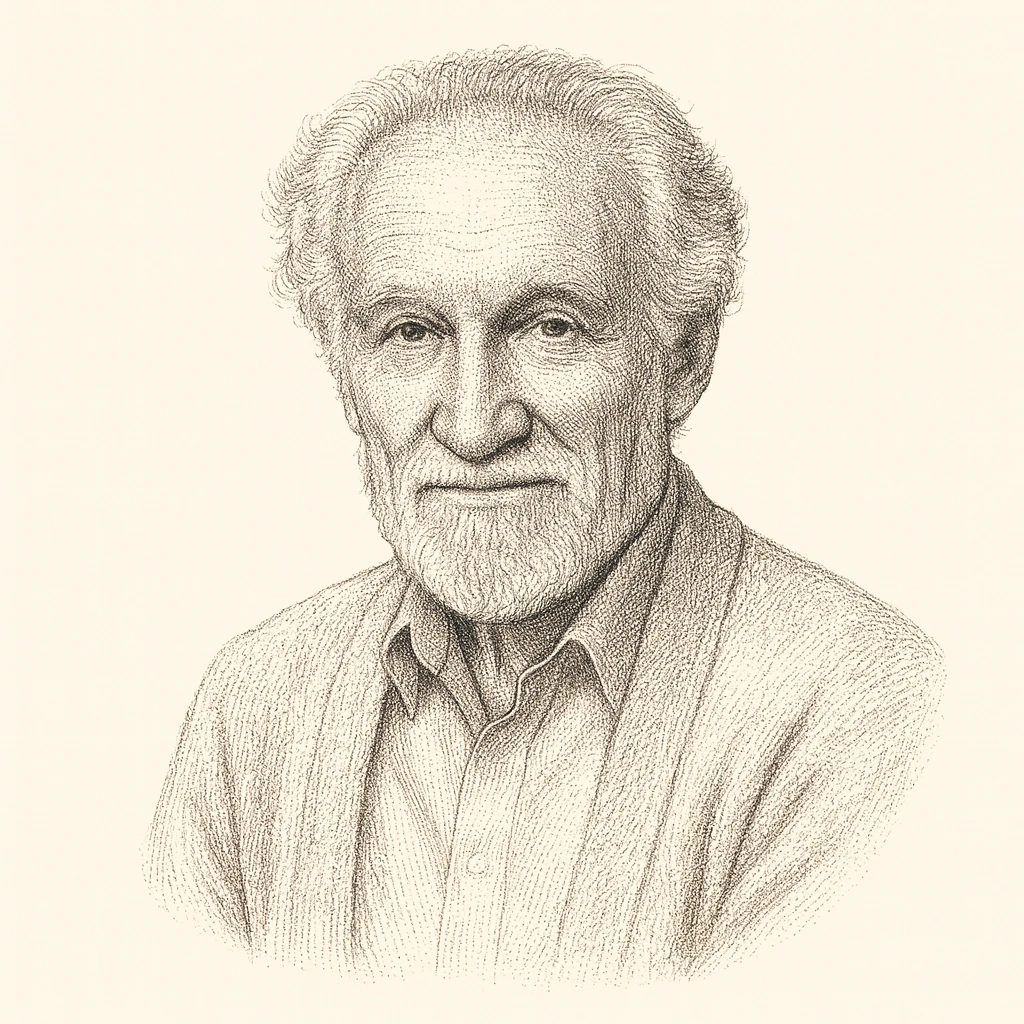
Sheldon Wolin was born on August 4, 1922, in Chicago and grew up in Buffalo, New York; his father, an immigrant from Russia, was a clothing designer. He left Oberlin College after two years to enlist in the Army Air Forces, serving as a bombardier and navigator in the Pacific, and returned to finish his degree in 1946. He took his doctorate at Harvard in 1950 with a dissertation on English constitutional thought in the late eighteenth century, and went on to teach at the University of California, Berkeley.
His first book, Politics and Vision: Continuity and Innovation in Western Political Thought (1960), appeared when American political science was dominated by the behavioralist movement and its quantitative study of political behavior. Wolin gathered the major political philosophers from the Greeks onward into a long argument about democracy and read them as resources for criticizing present institutions. The American Political Science Association gave the book its Lippincott Award in 1985, and an expanded edition appeared in 2004. His 1969 essay "Political Theory as a Vocation" called for "epic" theories that change how people see their societies. With Michael Rogin, Hanna Pitkin and others he made Berkeley a center of what became known as the Berkeley school. Political theory, he wrote, "is primarily a civic and secondarily an academic activity."
He practiced that view in public. With his colleague John Schaar he wrote in the New York Review of Books on the Free Speech Movement and campus unrest at Berkeley, essays collected in The Berkeley Rebellion and Beyond (1970). In 1972 he moved to Princeton, where he taught until 1987; his students included Wendy Brown, Peter Euben and Cornel West. In 1981 he founded Democracy: A Journal of Political Renewal and Radical Change, which he edited until it ceased publication in 1983. "A more decentralized and local politics, scattered and diffuse, is the first best hope," he told the New York Times in 1982.
Over time Wolin concluded that corporate and political power in the United States were becoming closely intertwined, and that participatory democracy survived mainly in rare "fugitive" expressions of the popular will. "Democracy in the late modern world cannot be a complete political system," he wrote in a 1994 essay. His last book, Democracy Incorporated (2008), described a "managed democracy" in which the public is shepherded rather than sovereign, and warned that unchecked economic power risks verging on total power, a condition he called "inverted totalitarianism." He stated that the United States was in no way morally or politically comparable to totalitarian states like Nazi Germany, and he placed his hope in citizens learning again to exercise power locally. He died at his home in Salem, Oregon, on October 21, 2015, at the age of 93.
Sheldon Wolin is associated with Left Libertarian. See the archetype