
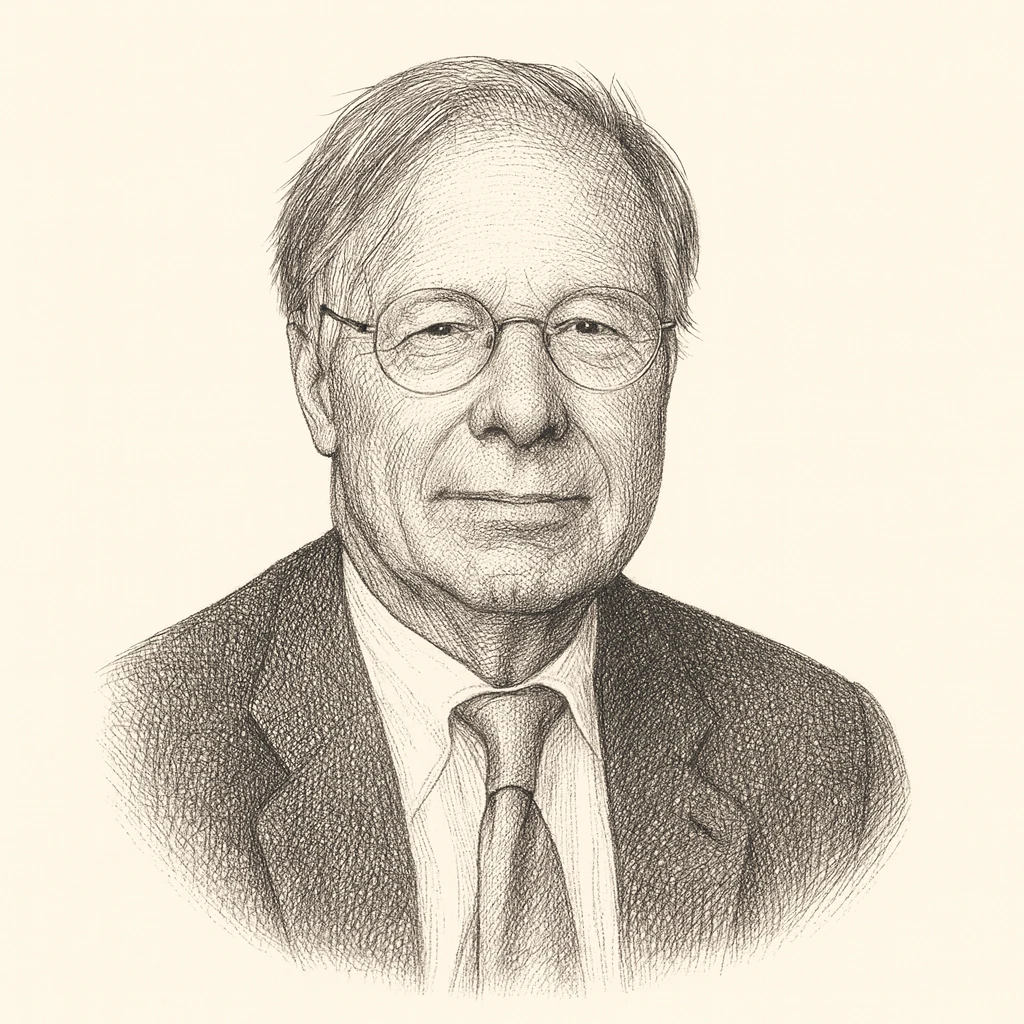
Ronald Dworkin was born on December 11, 1931, in Providence, Rhode Island. He studied at Harvard and then, as a Rhodes Scholar, at Oxford, where H. L. A. Hart was among his teachers. After law school at Harvard he clerked for Judge Learned Hand of the federal Court of Appeals in New York and joined the law firm Sullivan & Cromwell. He returned to academic life at Yale Law School in 1962, and in 1969 he became professor of jurisprudence at Oxford, a chair he held until 1998. He later taught as the Frank Henry Sommer Professor of Law at New York University and as professor of jurisprudence at University College London.
His first major book, Taking Rights Seriously (1977), rejected the two theories that had dominated legal thinking in Britain and the United States: legal positivism, which held that people have only the rights that political decisions or settled practice grant them, and utilitarianism, which judged law by the greatest good of the greatest number. Both had been defended by his own mentors, Hart and Hand. Dworkin argued that a legal system contains principles of a moral nature as well as rules, and that judges must draw on those principles in hard cases. His metaphor for the special force of rights was that they are "trumps": they hold even when overriding them would serve some ordinary social goal.
Law's Empire (1986) developed the idea of "law as integrity," under which judges interpret the law through a consistent set of moral principles. Freedom's Law (1996), subtitled The Moral Reading of the American Constitution, applied that approach to the Bill of Rights. In his theory of equality of resources, Dworkin imagined an auction in which everyone bids for resources with equal means until no one envies another's bundle. Inequalities that follow from people's own choices are fair; those caused by brute luck and unequal natural gifts should be offset through a hypothetical insurance scheme whose premiums are collected as taxes. He pursued these themes in Life's Dominion (1993), Sovereign Virtue (2000), and Is Democracy Possible Here? (2006), on majority rule and principle in a divided country.
For decades Dworkin also wrote for a general audience in the New York Review of Books, applying his views to abortion, affirmative action, free speech, campaign finance, terrorism, civil liberties and physician-assisted suicide. He received the Holberg Prize in 2007. In 2011 he joined the professoriate of the New College of the Humanities. He died of leukemia in London on February 14, 2013, at the age of 81.
Ronald Dworkin is associated with Social Liberal. See the archetype