
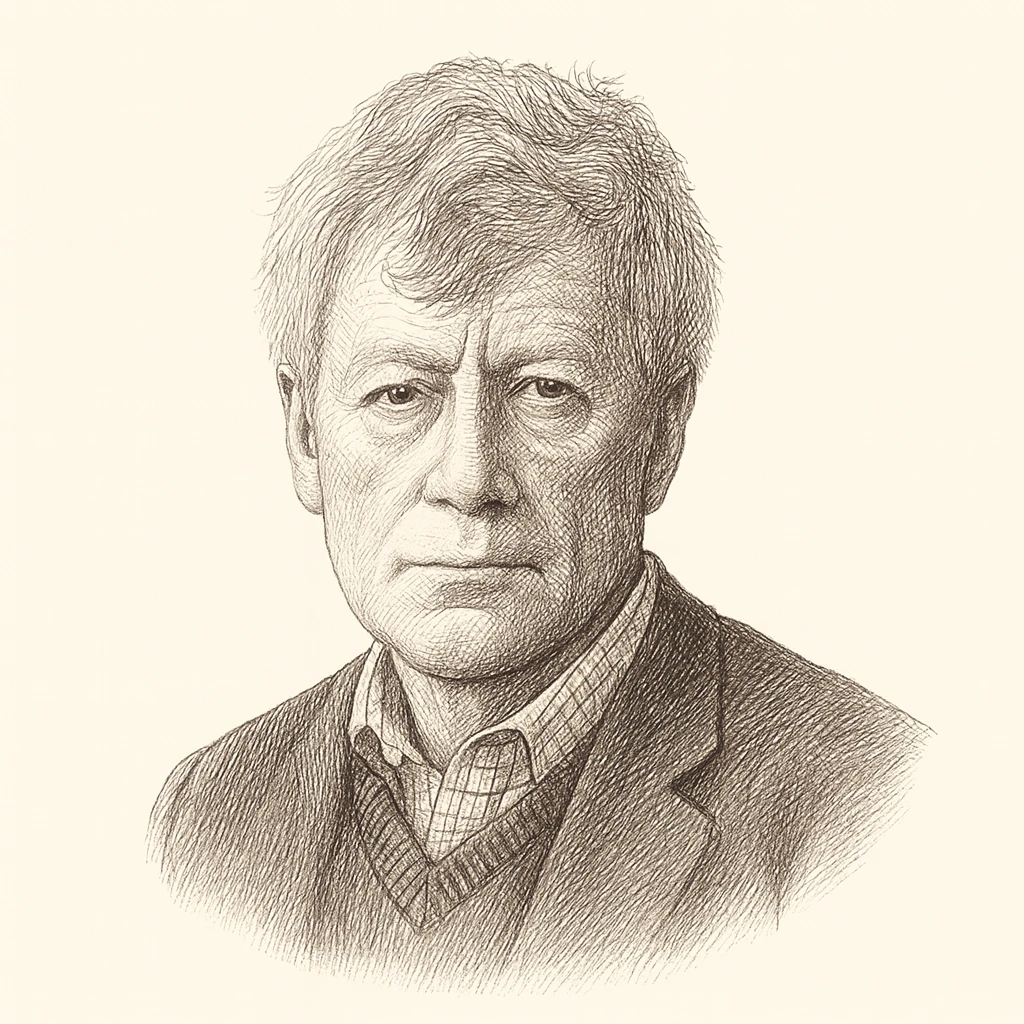
Roger Scruton was born in 1944 in Buslingthorpe, Lincolnshire, the son of a primary school teacher of working-class origins and strong Labour sympathies. His childhood in a succession of modest postwar homes gave him an early acquaintance with the England that conservative cultural criticism was usually accused of having no actual contact with — not the England of country houses and Oxford common rooms but the England of council estates, grammar schools, and the suburban respectability that the postwar settlement had made possible for people like his parents. He won a scholarship to Jesus College, Cambridge, where he studied philosophy, and then spent time in Paris in 1968 — an experience that proved crucial not because it radicalized him but because it did the opposite. Watching the student revolution from the Parisian streets, he felt not inspiration but revulsion: the destruction of beautiful things by people who claimed to be building a better world, the contempt for everything inherited and particular in the name of an abstract liberation that turned out, in practice, to mean the liberation of the well-educated to indulge their enthusiasms at everyone else's expense.
He returned to Cambridge and then moved to Birkbeck College, London, where he taught philosophy for twenty years. The experience of teaching philosophy at a working-class institution — Birkbeck's students attended evening classes while working during the day — reinforced his sense that the institutions and cultural achievements of British civilization were things actual working people had a stake in preserving, and that the academic left's contempt for those achievements was itself a form of class condescension. His first major work, Art and Imagination (1974), was a philosophy of aesthetic experience that argued against the reductionism of both behaviorism and idealism — the book that established his reputation as a serious philosopher rather than merely a conservative polemicist.
The Meaning of Conservatism (1980) was the work that defined his public role. It was a provocation: dense, Hegelian, deliberately rejecting the free-market libertarianism that was then sweeping the British right under Thatcher. Scruton's conservatism was not about low taxes or deregulation. It was about attachment — to particular places, particular people, particular institutions — and about the political philosophy required to protect such attachments from the abstract ideologies that would dissolve them. What conservatives conserved, in his account, was not a set of policy positions but a form of life, a way of belonging to somewhere and someone that the modern world systematically threatened. The state existed not to maximize individual utility but to protect the conditions under which genuine communities could flourish, and those conditions included things — inherited culture, religious tradition, civil association — that economic liberalism tended to destroy as thoroughly as socialist planning did.
The 1980s were the period of his most consequential political engagement, though it happened largely in secret. He began making clandestine visits to Czechoslovakia, Poland, and Hungary, smuggling books, establishing an underground network of philosophy seminars for dissidents who were teaching outside the official academic system, and building personal relationships with thinkers who were risking their careers and sometimes their freedom to maintain independent intellectual life under Communism. He was detained by Czech authorities on at least one occasion. The experience deepened his conviction that abstract ideals applied by central authority — the promise of liberation through ideology — were enemies of the human-scale communities that actually made life worth living. His engagement with Eastern European dissidents gave his anti-Communism a concreteness and moral weight that armchair opposition lacked, and it gave him a set of friendships with people who had paid real prices for their intellectual commitments that he valued for the rest of his life.
His intellectual range was remarkable and was itself a kind of argument. Beauty (2009) was a work of philosophical aesthetics. The West and the Rest (2002) applied his framework to the question of cultural difference and liberal universalism. Sexual Desire (1986) was an extended philosophical account of erotic experience. The Face of God (2012) engaged with questions of religious experience and transcendence. England: An Elegy (2000) was a meditation on English national culture and its vulnerability. He wrote about architecture, music, wine, fox hunting, and Wagner with the same philosophical seriousness that his colleagues reserved for topics the academy considered appropriately serious. This refusal to observe the disciplinary boundaries that academic culture enforced was itself a political act — a demonstration that conservative cultural life was capable of the same breadth and depth that the left claimed for itself.
He was knighted in 2016, after decades of being treated by the British academy as a marginal figure whose conservatism disqualified him from serious consideration. The knighthood came late, and he received it with the characteristic combination of gratitude and irony. He died in January 2020, weeks after completing his memoir Gentle Regrets, which traced his journey from the working-class childhood in Lincolnshire through the Parisian student revolution to his mature philosophical conservatism. He was one of the very few conservative thinkers who could be read seriously — seriously engaged with, seriously argued against — by people who disagreed with almost everything he concluded.
Roger Scruton is associated with National Conservative. See the archetype