
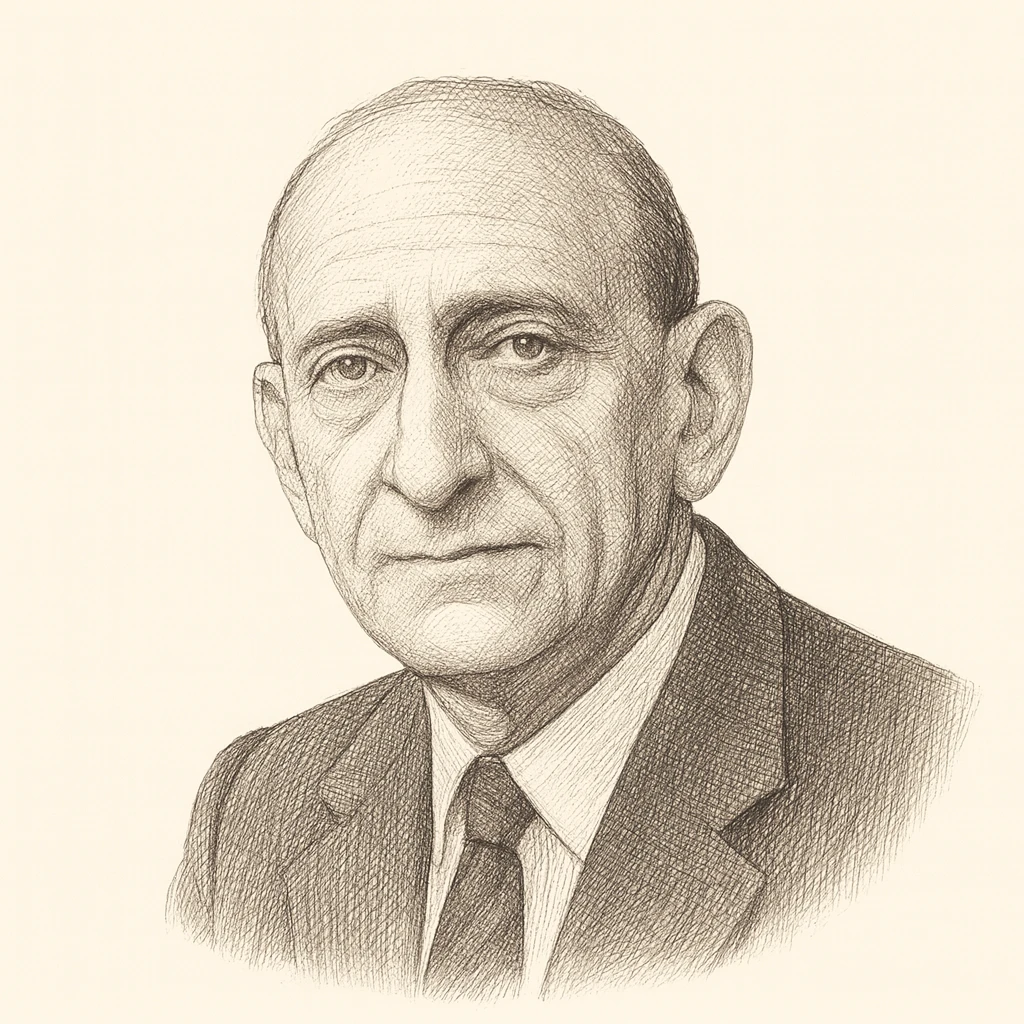
Raymond Aron was born in 1905 in Paris, into a secular Jewish family of the professional bourgeoisie — his father was a law professor — in the comfortable, cultivated world of the French intellectual meritocracy. He attended the École Normale Supérieure in the same cohort as Jean-Paul Sartre, Simone de Beauvoir, and Paul Nizan, passing the agrégation in philosophy in 1928 one year ahead of Sartre. The two men were friends and intellectual companions through the 1930s, sharing the same formation, the same teachers, the same social world. Their political trajectories then diverged so completely that by the 1950s they had become the defining poles of the French intellectual debate — Sartre representing the engaged Marxist intellectual who refused to "despair of the Left," Aron representing the liberal who thought this refusal was a form of dishonesty.
The divergence was rooted in their different responses to Germany. Aron went to Cologne and then Berlin in 1930-33 to study German philosophy and sociology, attending lectures, reading the newspapers, watching the Weimar Republic collapse and the Nazi movement organize. He returned to France in 1933 with a firsthand understanding of fascism that none of his Parisian contemporaries possessed, and an understanding of the way in which ideological certainty — the Communists' certainty as much as the Nazis', in different forms — blinded its adherents to the evidence in front of them. Sartre went to Berlin in 1933-34, the year after Aron, and returned having absorbed Husserl's phenomenology and having apparently noticed very little of the political catastrophe surrounding him.
His doctoral thesis Introduction to the Philosophy of History (1938) established his philosophical framework: a rigorous, Weber-influenced account of historical knowledge that insisted on the distinction between understanding the past from within its own categories and judging it by external standards, and that developed the concept of the "committed observer" — someone who engaged seriously with political life while maintaining the analytical distance necessary for honest assessment. This was explicitly an alternative to the Sartrean model of the "committed intellectual" who sacrificed analytical distance to political loyalty, and Aron was aware of what he was doing.
He joined the Free French in London in 1940, where he edited the journal La France Libre throughout the war, and returned to France in 1944 as a significant figure in Gaullist intellectual circles. He began writing a regular column for Le Figaro that he maintained for thirty years, becoming the most influential political journalist in France — not because his positions were popular but because his analysis was consistently accurate and his willingness to follow arguments to uncomfortable conclusions was consistently demonstrated. In a French intellectual culture where Sartre, Merleau-Ponty, and the left-wing intellectuals associated with Les Temps Modernes defined the terms of debate, Aron was simultaneously read, respected, and isolated — the person whose arguments had to be answered but whose politics could not be endorsed without risking social ostracism in the circles that mattered.
The Opium of the Intellectuals (1955) was his most polemical and most widely read work, a sustained critique of the French left's commitment to Marxism and its romance with the Soviet Union. His argument was not primarily that the Soviet Union was evil — though he thought it was — but that the French intelligentsia's attachment to revolutionary mythology had produced a systematic distortion of their capacity for honest political analysis. They applied the most exacting standards of evidence to capitalism's failures while excusing the Soviet Union's crimes as temporary deviations from a necessary historical logic. They demanded the abolition of "alienation" as a condition of genuine human freedom while building careers in an academic system that depended on the capitalist university they professed to despise. The book infuriated the Left and established Aron's reputation in the English-speaking world.
Peace and War (1962) was his most systematic theoretical work, a comprehensive analysis of international relations that drew on Clausewitz, Weber, and Thucydides to develop a realist framework that acknowledged the role of both power and values in international politics without reducing one to the other. He was, with Hans Morgenthau, one of the founders of international relations realism as an academic discipline, and his framework was considerably more philosophically sophisticated than the dominant American version.
His late career brought recognition and genuine rehabilitation. He was elected to the Collège de France, received honorary degrees from leading universities, and watched as the French Left's disillusionment with actually-existing socialism in the 1970s — following the publication of Solzhenitsyn and the dissident testimony from Eastern Europe — produced a slow convergence toward positions he had held for thirty years. He published his memoirs in 1983 and died two months after their publication, collapsing at a press conference in Paris following the testimony of the dissident historian Andrei Amalrik. He was seventy-seven.
Raymond Aron is associated with Pragmatic Centrist. See the archetype