
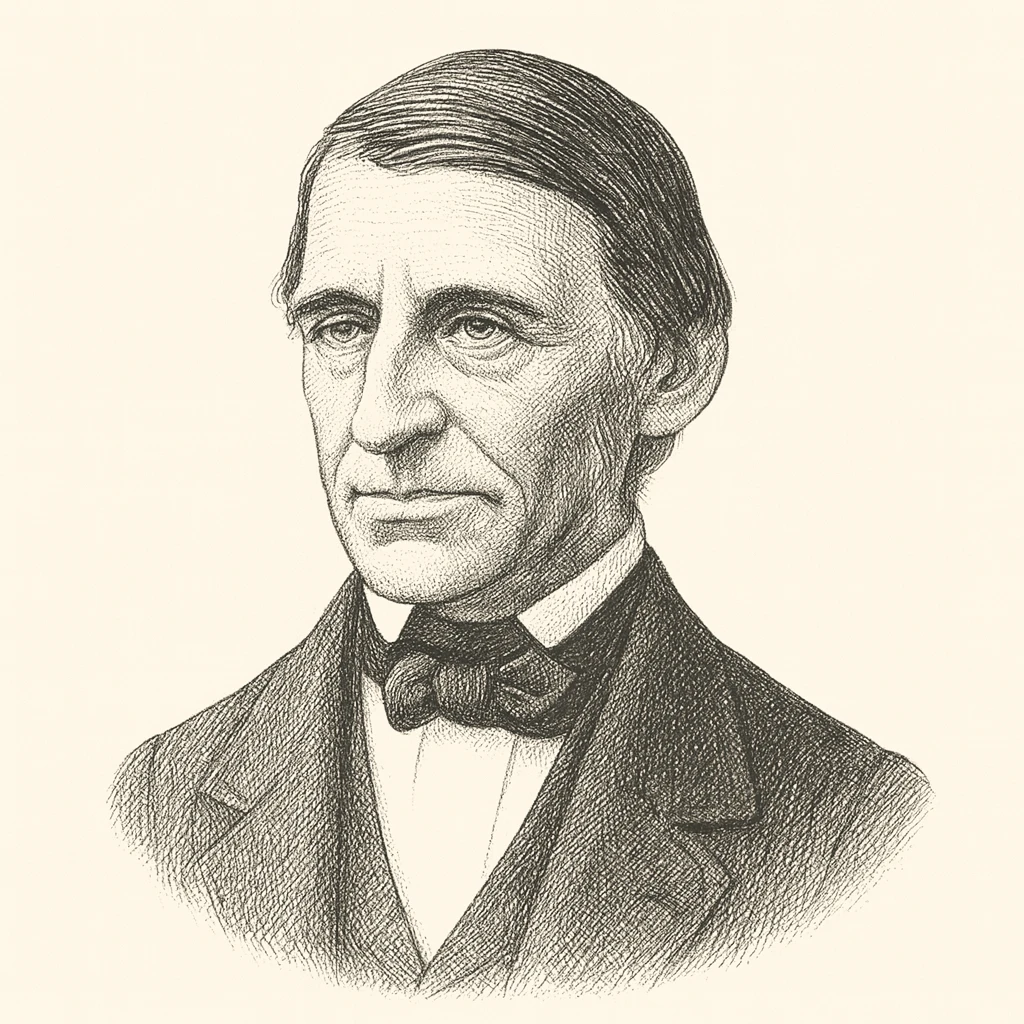
Ralph Waldo Emerson was born in Boston in 1803 and educated at Harvard College and Harvard Divinity School. He was ordained at Boston's Second Church in 1829 and resigned his pulpit in 1832. On a journey to Europe in 1833 he met Samuel Taylor Coleridge and Thomas Carlyle, and on his return he began the career as a lecturer and essayist that he pursued for the rest of his life, living in Concord, Massachusetts.
Nature (1836), his first book, urged readers to seek truth in their own experience of the world rather than in inherited doctrine. In "The American Scholar," his Phi Beta Kappa address at Harvard in 1837, he urged Americans to stop deferring to Europe: "We have listened too long to the courtly muses of Europe." He closed with the hope that "We will walk on our own feet; we will work with our own hands; we will speak our own minds." The Divinity School Address of 1838 challenged the Unitarian clergy on the same grounds. "Self-Reliance," published in his Essays of 1841, gave the idea its fullest form: "Whoso would be a man must be a nonconformist," and "Nothing is at last sacred but the integrity of your own mind." The essay warned that "Society everywhere is in conspiracy against the manhood of every one of its members" and that "A foolish consistency is the hobgoblin of little minds."
His essay "Politics," in the Second Series of 1844, carried that distrust into government. "Hence the less government we have the better," he wrote, "the fewer laws, and the less confided power." The state existed to educate the wise man, and "with the appearance of the wise man the State expires."
Emerson also spoke on public questions. In 1838 he wrote to President Martin Van Buren protesting the removal of the Cherokee. In 1844 he gave an address marking emancipation in the British West Indies, with Frederick Douglass on the platform. The Fugitive Slave Law of 1850 made him an active campaigner: in an 1851 address at Concord he called for the law's repeal and for disobedience to it, and he spoke against it through the decade, calling the Constitution's recognition of slavery in 1787 a "crime" in an 1855 lecture. He supported John Brown, and during the Civil War he raised money for Black regiments and wrote the poem "Boston Hymn." He died in Concord in 1882.
Ralph Waldo Emerson is associated with Independent Localist. See the archetype