
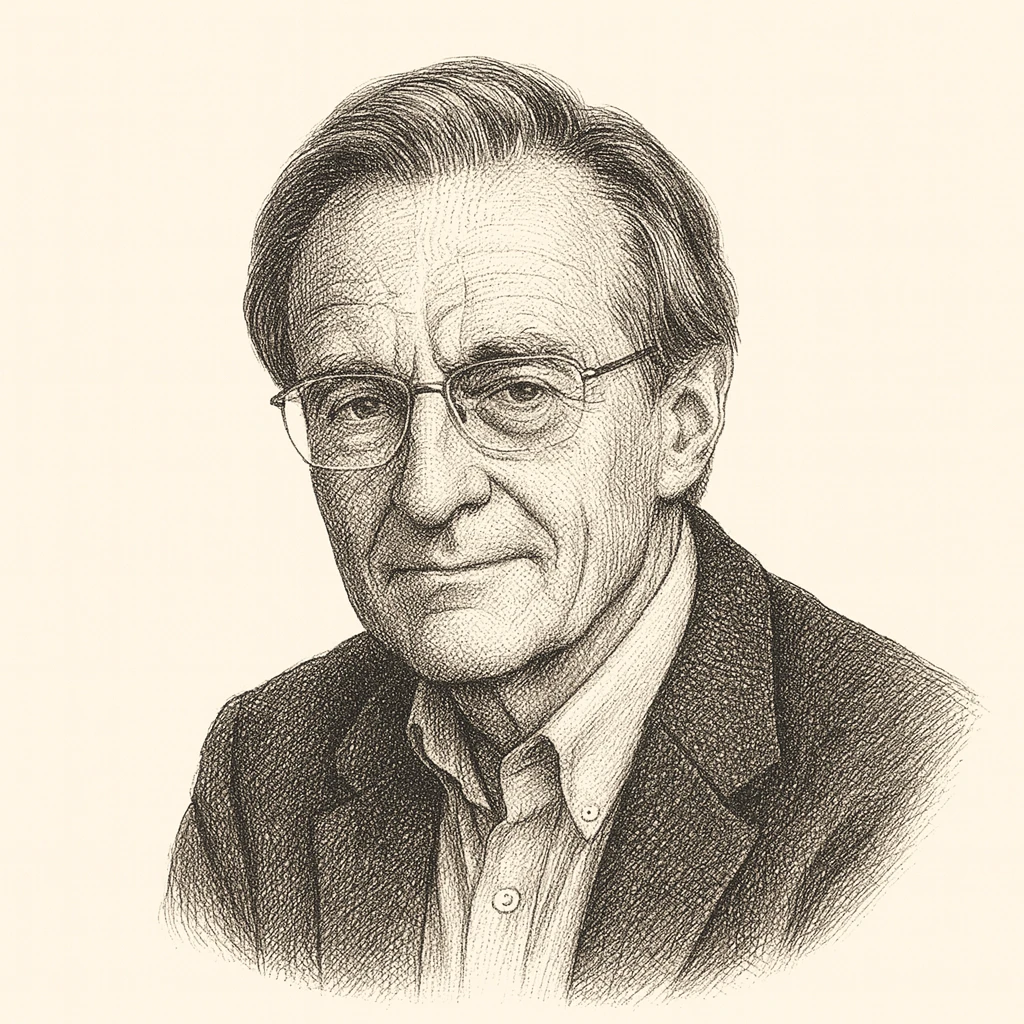
Quentin Skinner was born on November 26, 1940, in Oldham, Lancashire. He went up to Gonville and Caius College, Cambridge, as an entrance scholar in 1959, took his degree in 1962, and was elected a fellow of Christ's College the same year, a fellowship he held until 2008. After a period at the Institute for Advanced Study in Princeton from 1974 to 1979, he returned to Cambridge as Professor of Political Science. He was Regius Professor of History from 1996 to 2008, then Barber Beaumont Professor of the Humanities at Queen Mary University of London until 2022, and has been an emeritus professor there since.
Skinner made his name first as a theorist of method. In the late 1960s and early 1970s he argued that political writing should be understood as a series of linguistic acts, and that the historian's task is to interpret texts in the context in which they were written. He objected to histories of political thought that stripped classic works of their setting and presented them as if composed in a vacuum. His approach, shared with other historians who became known as the Cambridge School, reads authors such as Machiavelli and Hobbes alongside the lesser-known writers of their period in order to recover what those authors originally intended.
The approach produced The Foundations of Modern Political Thought (1978), a two-volume history of the Renaissance and the Reformation that won the Wolfson History Prize and was named by the Times Literary Supplement in 1996 among the hundred most influential books published since the Second World War. Studies of Machiavelli (1981) and Hobbes followed, among them Reason and Rhetoric in the Philosophy of Hobbes (1996) and Hobbes and Republican Liberty (2008), and his essays were collected in the three volumes of Visions of Politics (2002).
His inaugural lecture as Regius Professor, published as Liberty before Liberalism (1998), turned to the theory of freedom itself. Skinner recovered a "neo-Roman" understanding of liberty as freedom from arbitrary domination by others, and he presented it as a third concept of liberty alongside the negative and positive freedom distinguished by Isaiah Berlin. That account, together with Philip Pettit's, shaped the revival of republicanism in political theory. In 2025 he published Liberty as Independence. In 2006 he received the Balzan Prize, cited in part for "his acute reflections on the nature of liberty," and the Isaiah Berlin Prize of the Political Studies Association. Since 1986 he has been co-editor, later general editor, of the Cambridge University Press series Cambridge Texts in the History of Political Thought.
Quentin Skinner is associated with Social Liberal. See the archetype