
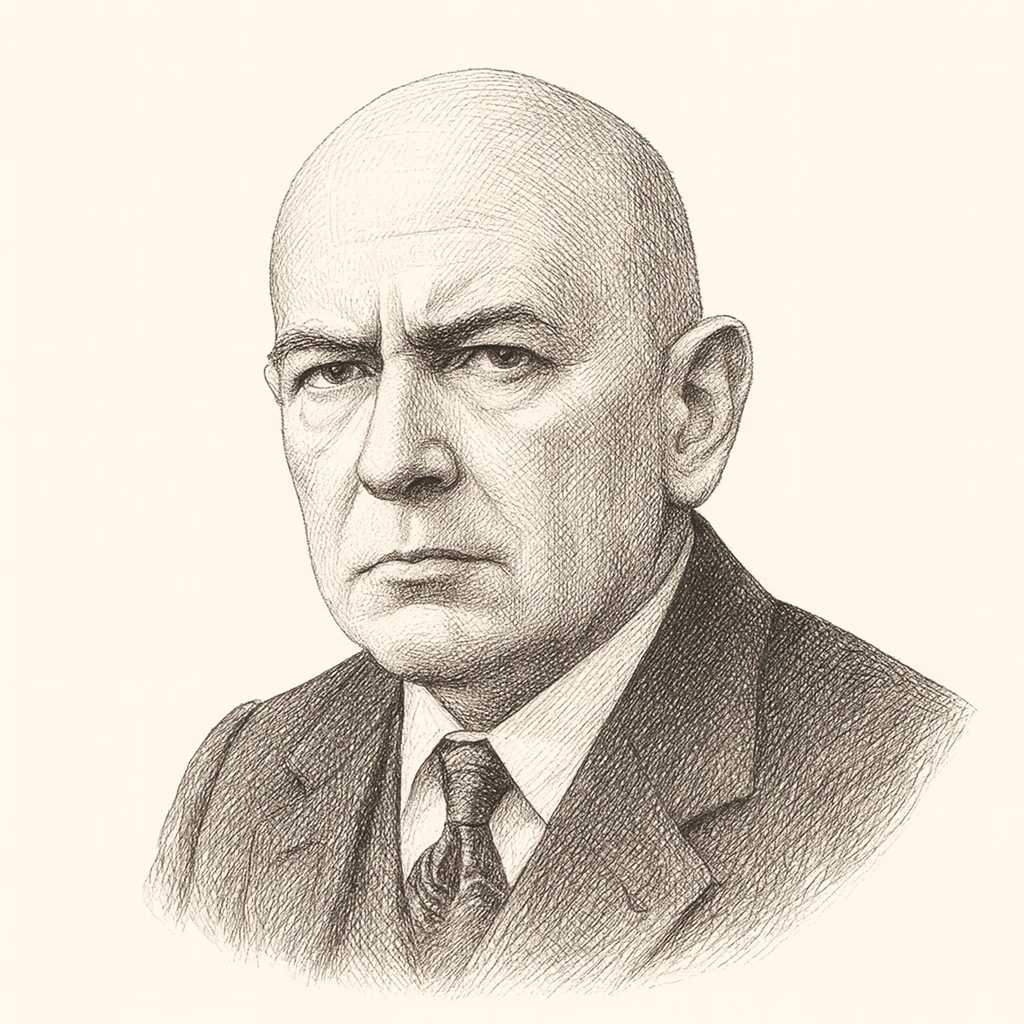
Oswald Spengler was born in 1880 in Blankenburg am Harz, the son of a postal official, and grew up in a provincial German household far removed from the academic or intellectual establishment that would eventually be forced to reckon with his work. He studied in Halle, Munich, and Berlin, taking his doctorate with a dissertation on Heraclitus, and then failed to obtain a university position — his habilitation thesis was rejected — and became a secondary school teacher in Hamburg. He taught mathematics and natural sciences, read enormously in history, art, biology, and mathematics on his own, and began, sometime around 1911, the work that would make him famous. He moved to Munich in 1911, living frugally on his inheritance, and spent the next seven years writing The Decline of the West.
The book's timing was extraordinary. Volume One appeared in 1918, as the German Empire was collapsing and the First World War ending in the catastrophe that Spengler had predicted — or seemed to have predicted, since the book had been substantially written before the war began. The effect was electrifying: here was a vast morphological analysis of world history that appeared to have foreseen the destruction of European civilization, published at the moment of its most acute crisis. Volume Two appeared in 1922. The combined work sold over 100,000 copies in a decade, an astonishing success for a work of that ambition and density, and generated debate across the political and intellectual spectrum of Weimar Germany and beyond.
Spengler's central claim was that civilizations were not progressively developing toward a universal end point — the assumption shared by liberals, Marxists, and nationalists alike — but were organic entities with their own internal logics of birth, growth, maturity, and decline. Each great civilization — he identified eight: Babylonian, Egyptian, Chinese, Indian, Mesoamerican, Classical (Greek and Roman), Arabian (what he called Magian), and Faustian (Western European) — expressed a distinctive soul, a fundamental orientation toward time, space, and the cosmos that determined the forms its art, mathematics, politics, and religion would take. The Faustian civilization, whose soul was characterized by infinite striving, the conquest of space, and the projection of will across unlimited distance, had expressed itself in Gothic cathedrals, harmonic music, perspective painting, calculus, and imperial expansion. It was now, in Spengler's analysis, entering its winter phase: the age of Civilization rather than Culture, of global cities rather than rooted communities, of money and politics rather than art and religion, of the masses rather than creative minorities.
The political implications were worked out with a bleakness that appealed to those who found liberal optimism and socialist utopianism equally deluded. Democracy, in Spengler's account, was not a permanent achievement but a phase — the political form of the Civilization stage, which would inevitably give way to Caesarism as money power and political manipulation exhausted themselves and strong individuals emerged to impose order on the resulting chaos. This was not a prescription but a prediction: Spengler believed that the coming of Caesarism was as inevitable as the other transitions in the civilizational cycle, and that intelligent people should understand it and position themselves accordingly rather than resist it in the name of liberal or democratic ideals that the cycle had already left behind.
He was politically active in the Weimar period, producing Prussianism and Socialism (1919) — an argument that genuine German socialism was the socialism of the Prussian state tradition rather than the Marxist international workers' movement, and that the German right and the German labor movement should find common ground in opposition to the liberal capitalism of the West — and The Hour of Decision (1933), published after Hitler's accession to power. The Hour of Decision was a qualified rejection of Nazism: Spengler thought Hitler's movement was too plebeian, too ideologically driven, and too oriented toward racial theory rather than geopolitical power, and he said so with a frankness that earned him Nazi hostility. His books were removed from prominent display in German bookshops after 1933. He died in 1936, isolated, disillusioned with the movement that had appropriated his vocabulary while ignoring his analysis.
His influence was carried primarily through intermediaries who absorbed his civilizational framework while departing from his specific conclusions. Huntington's The Clash of Civilizations acknowledged Spengler as a predecessor, adopting his morphological approach to comparing civilizations while replacing his pessimistic determinism with a more policy-oriented analysis. Burnham's Suicide of the West drew on the Spenglerian tradition of civilizational decline even without explicit citation. Toynbee's A Study of History was an explicit response and alternative to Spengler. The concept of Caesarism — the strong leader who emerges at the twilight of democratic civilization — has traveled through conservative political thought as a Spenglerian contribution, often without acknowledgment.
Oswald Spengler is associated with National Conservative. See the archetype