
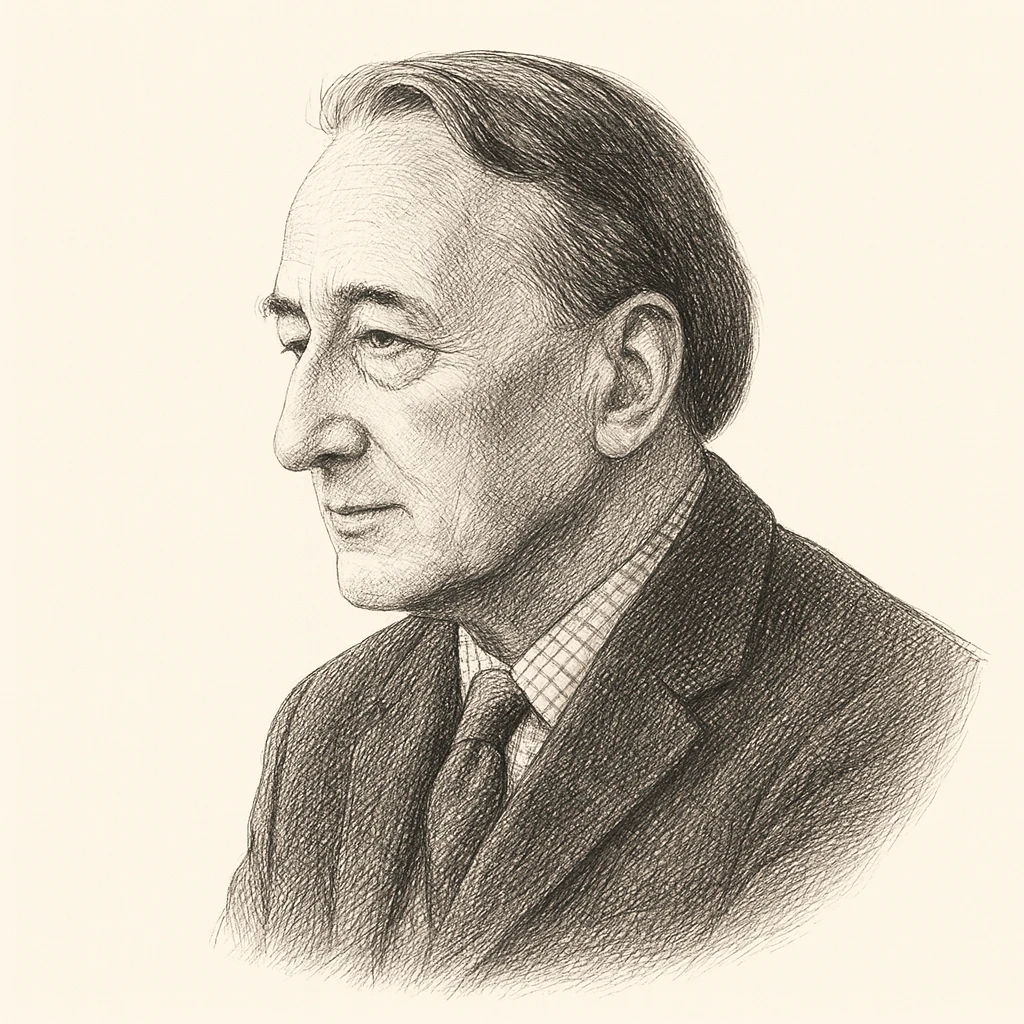
Michael Oakeshott was the most subtle and the least dogmatic of the 20th century's major conservative political philosophers. He had no use for the strident anti-communism, the religious nationalism, or the moral panics that defined much of the political right during his lifetime. He was a quiet skeptic of grand schemes in any direction, an ironic observer of human pretensions, and a defender of the conservative temperament as something quite distinct from any specific political program. Reading Oakeshott is to encounter a writer who treated political philosophy as a kind of contemplation rather than as a guide to action — and who thought political philosophy went badly wrong whenever it tried to tell people what to do.
Oakeshott was born in 1901 in Kent, the son of a civil servant and a former nurse. He studied history at Cambridge and stayed there as a fellow until the Second World War, during which he served in the British army. After the war he taught at Oxford for a few years before being appointed to the Chair of Political Science at the London School of Economics in 1951 — succeeding Harold Laski, the prominent socialist political theorist, in what was then one of the most distinguished academic positions in British political philosophy. The juxtaposition was telling. LSE had been a center of left-wing intellectual life under Laski; Oakeshott's appointment signaled a turn in British political philosophy toward something more philosophically modest and less politically engaged.
Oakeshott's most famous essay, "Rationalism in Politics" (1947, expanded into a book in 1962), was an attack on a particular cast of mind that he thought had come to dominate modern political thought. The Rationalist, in Oakeshott's analysis, was someone who believed that political problems could be solved by applying clearly stated principles and explicit techniques, derived from systematic reflection rather than from accumulated experience. The Rationalist distrusted habit, custom, and inherited practices; he wanted everything to be defensible from first principles or replaced. The Rationalist believed in expertise, in plans, in the possibility of getting things right by careful analysis. Oakeshott thought this entire cast of mind was a mistake — not because expertise was useless, but because the Rationalist fundamentally misunderstood what political knowledge actually was. Real political wisdom, Oakeshott argued, was a form of practical knowledge that could only be acquired through participation in a tradition. It couldn't be written down in a manual or taught in a seminar. The attempt to replace traditional practical knowledge with explicit rationalist principles always made things worse, because it cut political action off from the only source of wisdom that could actually guide it well.
This was a deeply conservative argument, but it was conservative in a distinctive way. Oakeshott was not defending any particular tradition as containing eternal truth. He was defending the conservative temperament — the disposition to prefer the familiar to the unknown, the actual to the possible, the limited to the unbounded — as a wise response to the human condition rather than as a philosophical doctrine. His most famous statement of this view came in another essay, "On Being Conservative" (1956), where he distinguished sharply between conservatism as a temperament and conservatism as a political ideology. He thought the temperament was valuable. He was suspicious of the ideology. The contemporary right, in his view, had often confused the two, becoming dogmatic in defense of positions that the conservative temperament would actually counsel approaching with skepticism.
Oakeshott's most ambitious philosophical work was On Human Conduct (1975), a difficult and abstract treatise that developed his distinction between two ways of understanding political association. He called them universitas and societas. Universitas was an association organized around a shared purpose — a cooperative enterprise pursuing a goal. Societas was an association organized around shared rules — a community of people governed by a common framework but free to pursue their own diverse purposes within it. Modern states, Oakeshott argued, were properly understood as societates rather than as universitates. They were frameworks within which people could live their own lives, not collective enterprises pursuing some shared substantive goal. Most of the political pathologies of the 20th century, in Oakeshott's view, came from confusing the two — from treating the state as if it were a great cooperative enterprise that could be organized around a single grand purpose, whether that purpose was building socialism, achieving national greatness, or any of the other rationalist projects that had defined modern politics.
Oakeshott retired from LSE in 1969 and lived another two decades in increasing seclusion at his cottage in Dorset, writing, reading, and largely ignoring the political controversies of his time. He died in 1990 at eighty-nine. His influence has grown steadily since his death, particularly among conservative political philosophers who find in him a more sophisticated and less doctrinaire alternative to the strident conservatism that has dominated much of the contemporary right. He is, perhaps more than any other 20th century thinker, the patron saint of conservatism as a temperament rather than a program.
Michael Oakeshott is associated with Traditionalist. See the archetype