
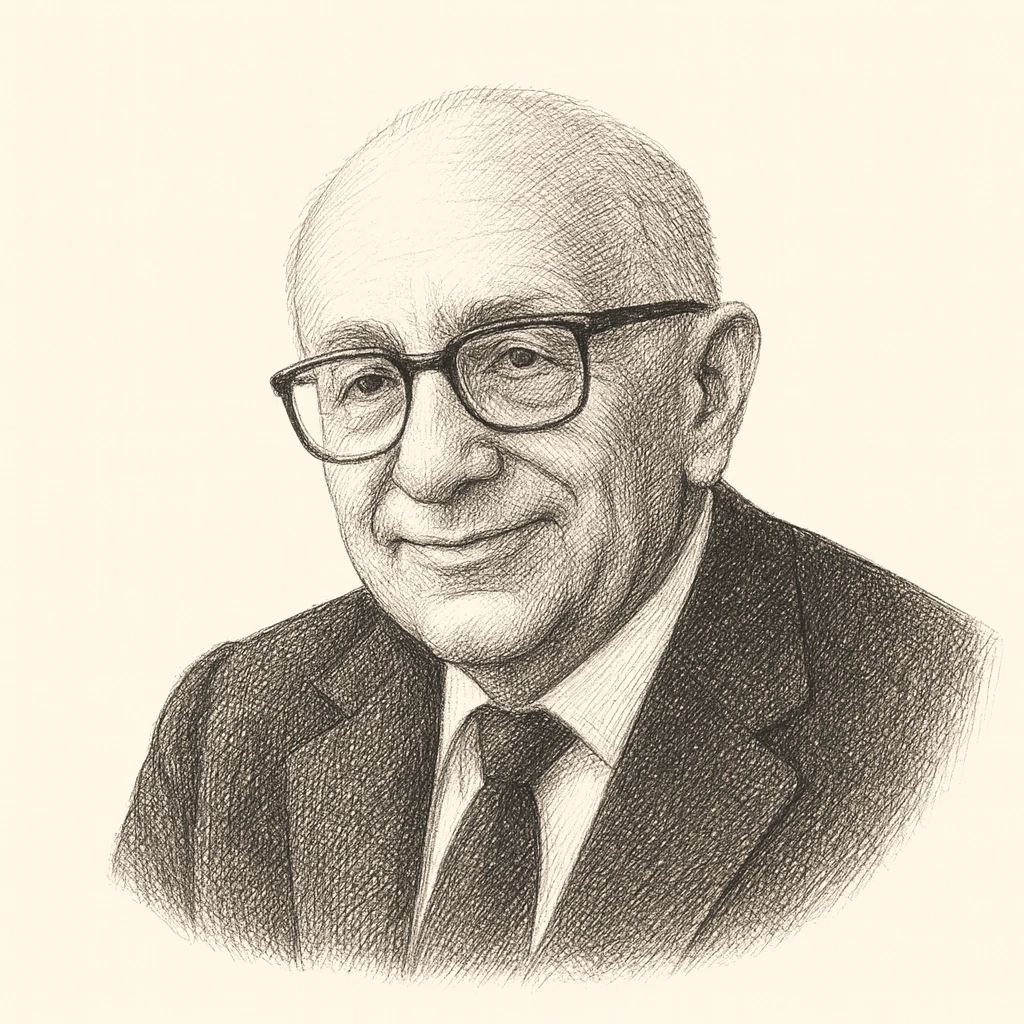
Max Horkheimer was born on February 14, 1895, in the Zuffenhausen district of Stuttgart, the only son of a conservative Jewish family; his father owned several textile factories there. Taken out of school in 1910 to work in the family business, he met Friedrich Pollock, who became his lifelong friend and closest colleague. After the First World War he studied psychology and philosophy in Munich and Frankfurt, mainly under the neo-Kantian Hans Cornelius, and completed his Habilitation in 1925.
In 1930 he was appointed professor of social philosophy at Frankfurt and director of the Institute for Social Research, which had begun as a Marxist study group funded by Felix Weil and had opened in 1924. His inaugural lecture in January 1931 set out a program of interdisciplinary social research, joining philosophy to the empirical social sciences. The program was soon interrupted. Shortly after Hitler became chancellor in 1933, the Institute was closed and its building seized by the Gestapo, and Horkheimer lost his posts. He relocated to Geneva, where the Institute had opened a satellite office, and in 1934 moved to Columbia University in New York, became an American citizen in 1940, and moved to the Los Angeles area in 1941.
His best-known essay, Traditional and Critical Theory (1937), contrasts a traditional theory that follows the method of Descartes' Discourse on Method with a Marxian critical theory, "a human activity which has society itself for its object." Social philosophy, he held, must connect with the practical aim of relieving suffering, and reason with the movement for emancipation. In the 1940s his outlook darkened. Eclipse of Reason (1947), drawn from lectures at Columbia in 1944, and Dialectic of Enlightenment, written with Theodor Adorno, criticize the reduction of reason to a tool for calculating means with no capacity to judge ends. The latter opens with the claim that "the wholly enlightened earth is radiant with triumphant calamity."
Horkheimer was restored to his Frankfurt professorship in July 1949, and the Institute returned the following year. He served two terms as rector of the university in the early 1950s and received the city's Goethe Plaque in 1953. In 1958 he retired to Montagnola in Switzerland, and Adorno succeeded him as director. His late writings combined criticism of organized religion with respect for the longing for the "wholly other," a better world that never forgets the suffering of this one. He was generally opposed to the radical student movements of the 1960s and, with much qualification, supported the Vietnam War as an attempt to halt the spread of Chinese Communism. He died on July 7, 1973, at the age of 78.
Max Horkheimer is associated with Democratic Socialist. See the archetype