
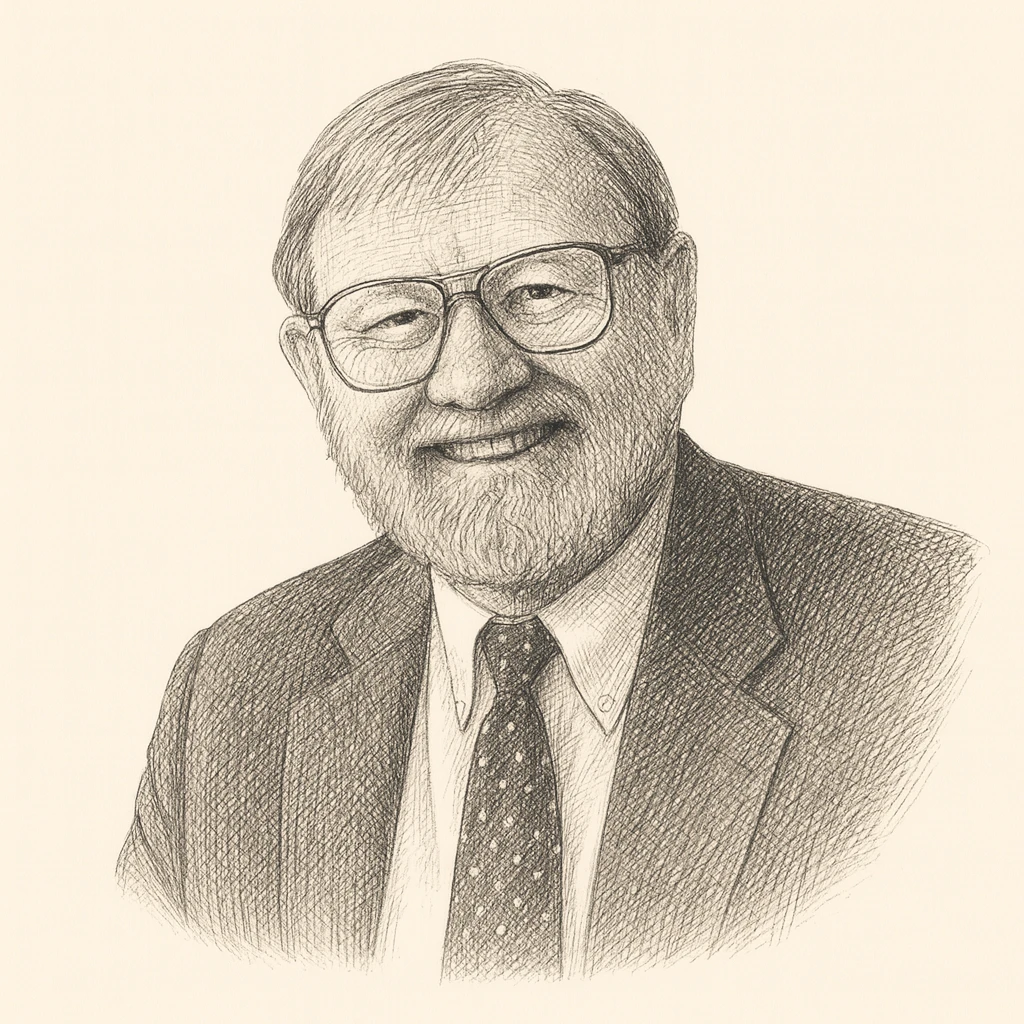
Mancur Olson was born on January 22, 1932, in Grand Forks, North Dakota, to a farming family of Norwegian immigrants, and grew up on a farm near Buxton. He graduated from North Dakota Agricultural College in 1954, studied at University College, Oxford, as a Rhodes Scholar, and earned his Ph.D. in economics at Harvard in 1963. He taught at Princeton, served from 1967 to 1969 as a deputy assistant secretary in the Department of Health, Education, and Welfare, and joined the University of Maryland in 1969, where he remained for the rest of his career.
Harvard University Press published his dissertation in 1965 as The Logic of Collective Action. The book asked why people who share an interest so often fail to organize around it. In a large group each member receives the benefit of any collective gain whether or not he helped pay for it, so each has reason to ride free on the efforts of others. Large organizations that do endure, Olson argued, usually survive by supplying something else, which he called the by-product theory: they sell goods or services to members and use the proceeds to lobby. His example was the Illinois Farm Bureau, which lobbied for farm subsidies while offering farmers low-cost auto insurance.
The Rise and Decline of Nations (1982) applied the argument to the economic history of the decades after the Second World War. Over long periods of stability, Olson held, societies accumulate lobbying groups, which he called distributional coalitions, that pursue narrow gains and slow the growth of the whole economy. Countries where those groups had been swept away should recover faster; in his words, "countries whose distributional coalitions have been emasculated or abolished by totalitarian government or foreign occupation should grow relatively quickly after a free and stable legal order is established." He served as president of the Southern Economic Association in 1981 and 1982.
In his later work Olson turned to the economies of communist countries and to economic development. In 1990 he led the creation of the IRIS Center at Maryland to apply research on institutions to development problems. His last book, Power and Prosperity: Outgrowing Communist and Capitalist Dictatorships, appeared after his death. It contrasts the roving bandit, who expects a short tenure and so takes heavily, with the stationary bandit, an autocrat who expects to rule for a long time and so has a stake in how much his subjects produce. Olson died of a heart attack in College Park, Maryland, on February 19, 1998.
Mancur Olson is associated with Cosmopolitan. See the archetype