
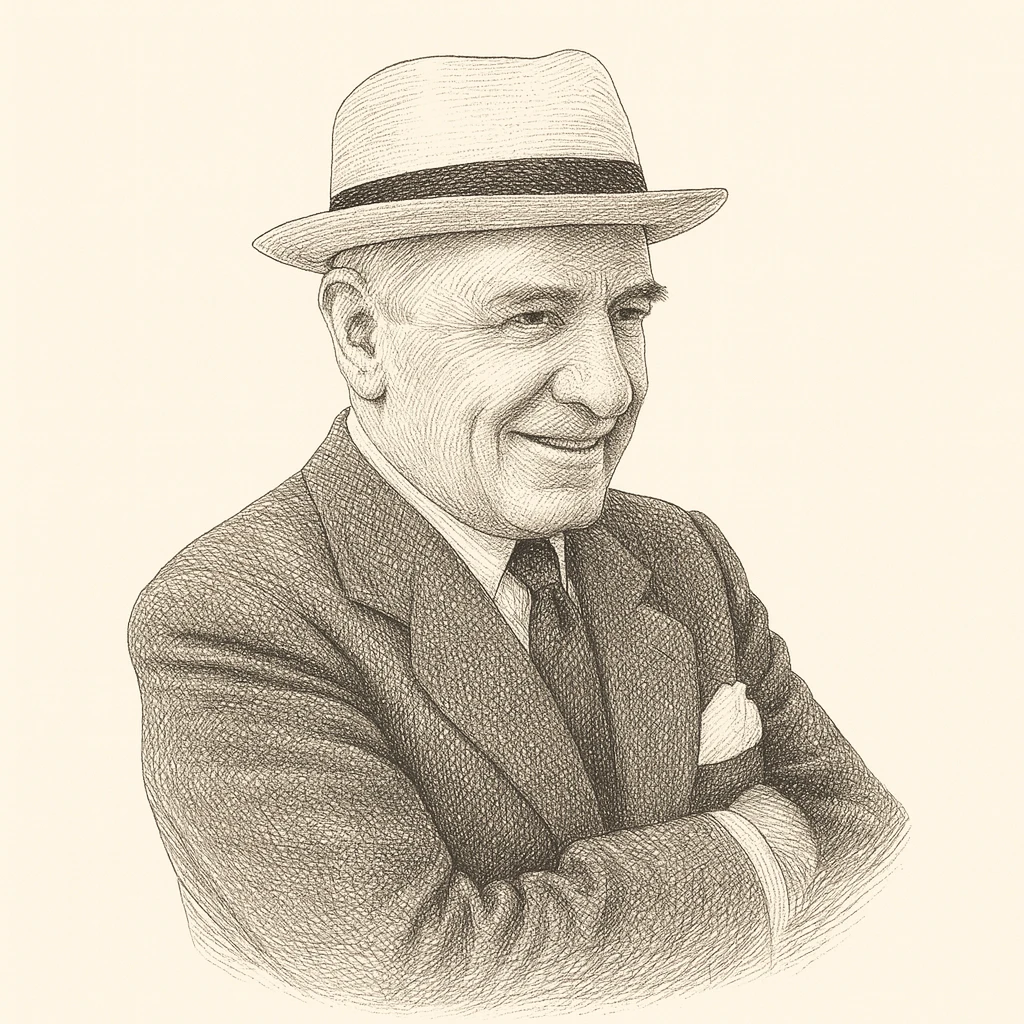
José Ortega y Gasset was born in 1883 in Madrid, into a family deeply embedded in the cultural life of the Spanish capital — his father was editor of El Imparcial, one of the major liberal newspapers of the Restoration period, and his maternal grandfather had founded the paper. He grew up with the assumption that intellectual engagement with public life was the natural vocation of a man of culture, and the combination of philosophical rigor with public intellectual purpose that characterized his work throughout his life was shaped by this formation as much as by his subsequent studies.
He was educated at the University of Deusto and then the University of Madrid, and then went to Germany — to Leipzig, Berlin, and Marburg — for graduate work, immersing himself in the Neo-Kantian philosophy of Hermann Cohen and Paul Natorp. The German years were decisive: they gave him a philosophical training of genuine rigor and introduced him to the philosophical questions that would organize his subsequent work — the nature of human life as distinct from biological existence, the relationship between the individual and her circumstances, the question of what reason could achieve in a domain as particular and historical as human life. He was one of the first Spanish philosophers to engage seriously with German academic philosophy, and his work had the density and precision of someone who had absorbed the tradition whole rather than merely gesturing at it.
He returned to Spain, took the chair in metaphysics at the University of Madrid in 1910, and immediately threw himself into the double role — philosopher and public intellectual — that he would maintain for the rest of his life. He founded the Revista de Occidente in 1923, which became the most important philosophical and cultural journal in the Spanish-speaking world, and wrote for newspapers throughout his career with the unusual combination of conceptual rigor and accessible style that was his signature. His essays on philosophy, art, history, sport, and politics reached audiences far larger than academic philosophy normally commanded.
The Revolt of the Masses (1930) was the work that made him internationally famous. It was published first as newspaper articles and then as a book, and it offered a diagnosis of European civilization's crisis that was neither Marxist nor conservative but distinctively his own. His central distinction was between the "select minority" — not an aristocracy of birth but a category of people who make demands on themselves, who hold themselves to high standards, who take on obligations — and the "mass man" — not a class in the economic sense but a psychological type, the person who feels special without having done anything to earn distinction, who demands the benefits of civilization without accepting any of its obligations, who treats civilization's achievements as natural endowments rather than fragile human constructions requiring constant effort.
The revolt of the masses was not a class uprising — it was the entry of the mass man into positions of social and political authority that had previously been held by select minorities. Mass man in power was characterized by the combination of self-satisfaction with intellectual closure: he felt no need to justify his opinions by reference to anything outside himself, took his own preferences as the standard of value, and regarded those who challenged his opinions not as potential teachers but as enemies. Ortega identified this type with the political extremism of both the Bolshevik right and the fascist left — though he was in some tension about the terminology — and with the liberal democrat who had abandoned any standard beyond the preferences of the majority.
His political situation was complicated by the Spanish Civil War. He opposed both the Republic and the Nationalist rebellion, finding neither capable of the "liberal" Spain he had spent his life trying to build, and went into voluntary exile in 1936, spending years in Argentina, Portugal, and France. He returned to Spain in 1945 and lived there, with some diplomatic difficulty, until his death in 1955. He was never fully reconciled with the Franco regime, which found his liberalism suspect, and never fully embraced by the democratic opposition, which found his aristocratic intellectual sensibility incompatible with democratic politics.
His later work, particularly History as a System (1935) and Man and People (1957), developed his account of "vital reason" — the argument that human life could not be understood through the natural sciences, which studied things, but required a form of reason adequate to its historical and circumstantial character. This was his most systematic philosophical contribution, developing the implications of the claim that human beings were not things with a fixed nature but projects that had to choose and realize themselves through their circumstances. It influenced the existentialist tradition even where Sartre and Heidegger did not acknowledge the debt.
José Ortega y Gasset is associated with National Conservative. See the archetype