
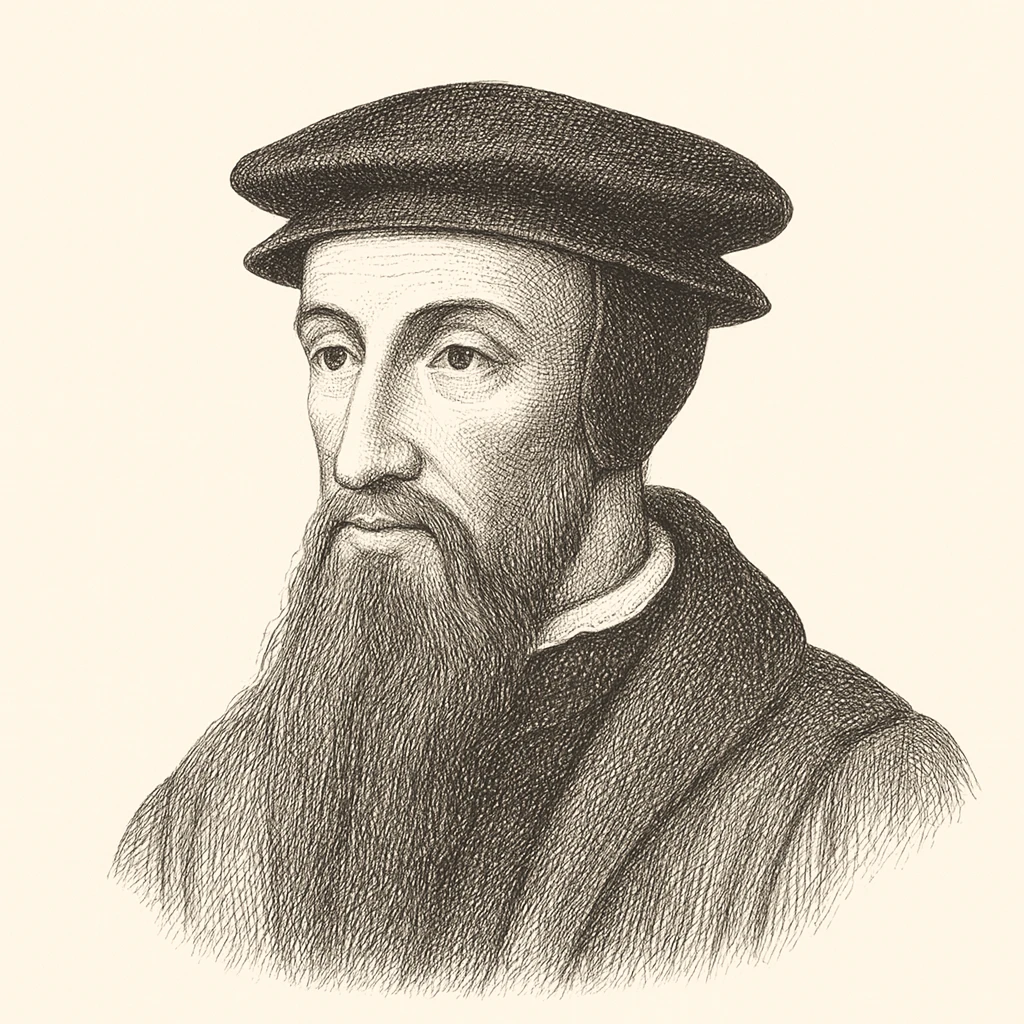
John Calvin was the most politically consequential of the Protestant Reformers, not because he held political office but because the theological framework he developed in Geneva shaped the political imagination of whole civilizations that followed. The Puritans who settled New England, the Scottish covenanters, the Dutch Republic, the French Huguenots, and eventually large parts of the American founding tradition all worked within Calvinist frameworks, often without realizing it. Max Weber's famous argument in The Protestant Ethic was specifically about Calvinist Protestantism, not Lutheranism, because Calvin had made disciplined worldly activity a religious calling in ways that reshaped both economic and political life wherever his theology took hold.
Calvin was born in 1509 in Noyon, France, trained in law and the humanities at the University of Paris, and was swept up in the Protestant Reformation as a young man. He fled France during the Catholic crackdown on Protestants, settled eventually in Geneva, and by 1541 had become the dominant intellectual and moral force in a city that was trying to remake itself as a Protestant commonwealth. He spent the rest of his life there, preaching, writing, organizing the Genevan church, supervising the education of ministers who would fan out across Europe, and producing the theological works that would shape Protestant thought for centuries.
His masterwork, the Institutes of the Christian Religion (1536, expanded repeatedly until 1559), was the most systematic work of Protestant theology produced in the Reformation era. It ran to over 1,500 pages in its final form and worked through the entire Christian theological system from a Protestant standpoint. But embedded within the theology was a political vision with enormous consequences. Calvin argued that God established two kingdoms — the spiritual kingdom of the church and the temporal kingdom of civil government — and that both had legitimate authority in their own spheres. Political authority was ordained by God for the preservation of order and the promotion of justice, and Christians owed it obedience as a religious duty. But political authority was not absolute. When civil rulers commanded what God forbade, Christians had a duty to obey God rather than men. And Calvin argued that inferior magistrates (lesser officials) had not only the right but the obligation to resist tyrannical superior rulers when those rulers violated divine law.
This doctrine of resistance was politically explosive. It gave Calvinist political communities a theological justification for rebellion against unjust authority that Lutheran and Catholic traditions had mostly denied. Calvin himself was cautious about applying it, but his successors — particularly Theodore Beza and later the Scottish covenanters — extended the framework into a full-blown theory of legitimate resistance. This shaped the French Wars of Religion, the Dutch revolt against Spain, the English Civil War, the Glorious Revolution, and eventually the American Revolution. When Thomas Jefferson cited the right of resistance in the Declaration of Independence, he was drawing on a tradition whose theological foundations had been laid by Calvin two centuries earlier.
Calvin's other major political contribution was his doctrine of vocation. Traditional medieval Christianity had distinguished sharply between sacred callings (priest, monk, nun) and secular work, treating the former as holy and the latter as at best morally neutral. Calvin dismantled this distinction. Every legitimate work, he argued, could be a calling from God if it served one's neighbor and the common good. The merchant, the farmer, the craftsman, the magistrate were all doing God's work when they performed their vocations faithfully. This theological reframing of ordinary work as religious calling transformed Protestant attitudes toward economic activity, civic engagement, and the dignity of everyday labor. Max Weber argued that this was the cultural engine of modern capitalism. Whether that specific thesis is right, the broader point is indisputable: Calvinism made disciplined worldly activity holy, and this reshaping of the religious meaning of ordinary life had political and economic consequences that are still with us.
Calvin died in 1564 at fifty-four, exhausted by overwork and chronic illness, having spent the final years of his life refining the Institutes and training the ministers who would carry Calvinism across Europe and eventually across the Atlantic. His legacy is contested in ways Calvin himself would have found difficult. The Geneva he built was theocratic by modern standards, with strict moral discipline enforced by civil authority. His handling of the heretic Michael Servetus, who was burned at the stake in Geneva in 1553 with Calvin's approval, has darkened his reputation permanently. But his contributions to the development of political resistance theory, constitutional government, and the moral dignity of civic life shaped the modern world in ways that make him essential to any serious understanding of Western political thought.
John Calvin is associated with Religious Conservative. See the archetype