
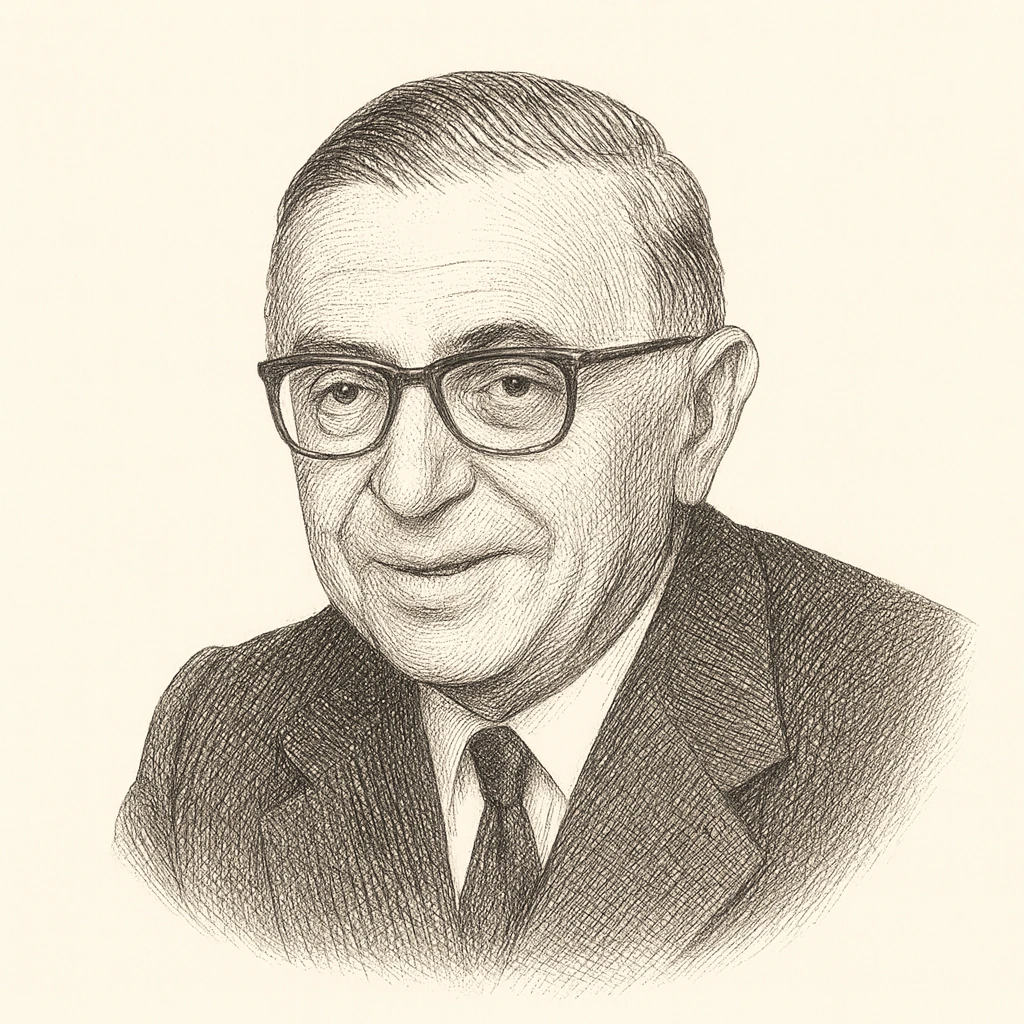
Jean-Paul Sartre was born in Paris in 1905 and studied philosophy at the École Normale Supérieure. Serving as an army meteorologist, he was captured by the Germans in 1940 and held for just under a year. His treatise Being and Nothingness (1943) and a lecture given at the end of 1945, published as Existentialism Is a Humanism, made him the best-known voice of existentialism. Its founding claim was that man "first of all exists, encounters himself, surges up in the world – and defines himself afterwards." With no fixed human nature to fall back on, each person answers for what he makes of himself, and blaming circumstance or temperament is what Sartre called bad faith.
After the Liberation he founded and co-edited the review Les Temps modernes and argued in What Is Literature? (1948) that writing is a form of engagement. He never joined the French Communist Party. In 1952 he published The Communists and Peace, whose aim he gave as "to declare my agreement with the Communists on precise limited subjects, arguing on the basis of my principles and not theirs." The same years brought a public break with Albert Camus after Les Temps modernes reviewed Camus's The Rebel in 1951–52. The alignment with the party ended over Hungary: on November 9, 1956, he said, "I condemn the Soviet invasion wholeheartedly and without any reservation."
Anticolonialism then took much of his energy. He supported the Jeanson network, which gave material aid to the Algerian independence movement, and wrote the preface to Frantz Fanon's The Wretched of the Earth (1961). When there were calls to prosecute him for civil disobedience, President Charles de Gaulle is reported to have replied that you don't arrest Voltaire. The Critique of Dialectical Reason (1960) tried to join existentialism to historical materialism, describing how scarcity and "seriality" keep people apart and how a "group in fusion" briefly overcomes that separation. In 1964 he declined the Nobel Prize in Literature, as he had declined other honors. He later took part in the Russell Tribunal on war crimes in Vietnam and condemned the Soviet invasion of Czechoslovakia.
After May 1968 he moved toward the young far left. In April 1970, after the previous directors of La Cause du peuple, the paper of the Maoist Gauche prolétarienne, had been arrested, he became its editor-in-chief; he said he took the title "in the name of freedom of the press." His 1972 preface to a book on French Maoists began with the words "I am not a Maoist." In 1977 he said he was no longer a Marxist. He died in Paris on April 15, 1980, and estimates of the crowd at his funeral procession range from 50,000 to 100,000.
Jean-Paul Sartre is associated with Progressive Activist. See the archetype