
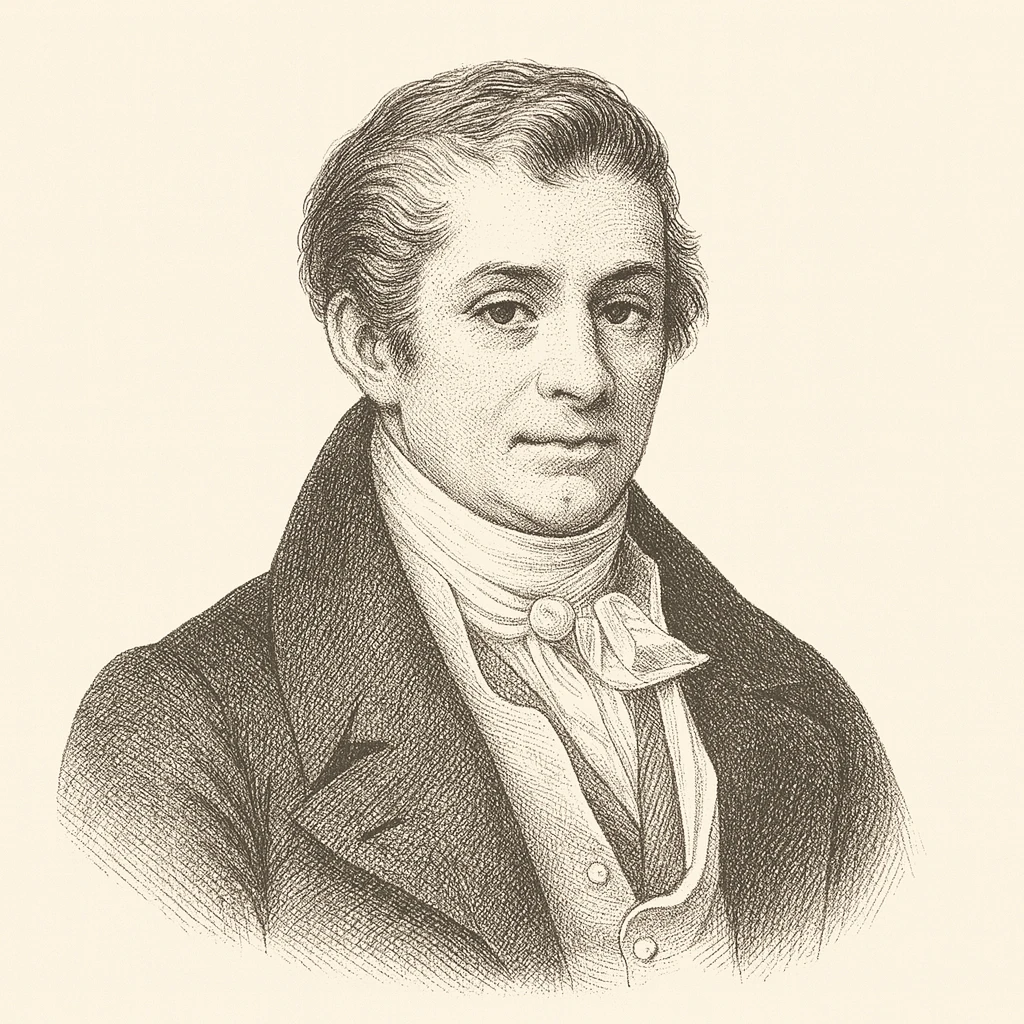
Jean-Baptiste Say was born in Lyon on January 5, 1767, into a Protestant merchant family whose forebears had left Nîmes for Geneva in the late seventeenth century, when the French state ended its toleration of Protestants. As a young man he was sent to London to learn commerce and English, and while working for a life insurance company he first read Adam Smith's Wealth of Nations. From 1794 to 1799 he edited La Décade philosophique, littéraire, et politique, writing on political economy for its pages.
In 1799 Say was appointed to the Tribunate, one of the legislative bodies of Napoleon's Consulate, and in 1803 he published his Traité d'économie politique, translated as A Treatise on Political Economy. Napoleon suggested a new edition that would more openly support his government's unpopular fiscal policies. Say refused, and that refusal, together with his steady opposition to government spending in the finance committee, led to his dismissal. He went into business instead, founding a cotton-spinning mill at Auchy in the Pas-de-Calais that employed between 400 and 500 people before he sold it in 1813. A second edition of the Treatise appeared in 1814.
The Treatise made Say the leading expositor of Smith's economics in Europe and America, and it served as a textbook in England and the United States. He did not follow Smith everywhere. He rejected the labor theory of value in favor of one grounded in utility, and he gave the entrepreneur a defined place in economic analysis, describing him as the intermediary between the scientist who creates knowledge and the worker who applies it in production. He argued for free markets and competition and against Napoleon's interventionist economic policy.
His name survives in Say's law of markets: over time, production itself generates the purchasing power to buy other goods, so a general glut cannot persist. The slogan usually attached to it, that supply creates its own demand, was not his wording. His stronger claim, that overproduction could not occur even in the short run, drew objections from his friend Thomas Malthus and, a century later, from John Maynard Keynes. Say first taught in 1815 and was the first to give public courses in political economy in France. He became a professor at the Conservatoire des Arts et Métiers in 1819 and later held the chair of political economy at the Collège de France. His Cours complet d'économie politique pratique appeared in 1828 and 1829. He died in Paris on November 15, 1832.
Jean-Baptiste Say is associated with Classical Liberal. See the archetype