
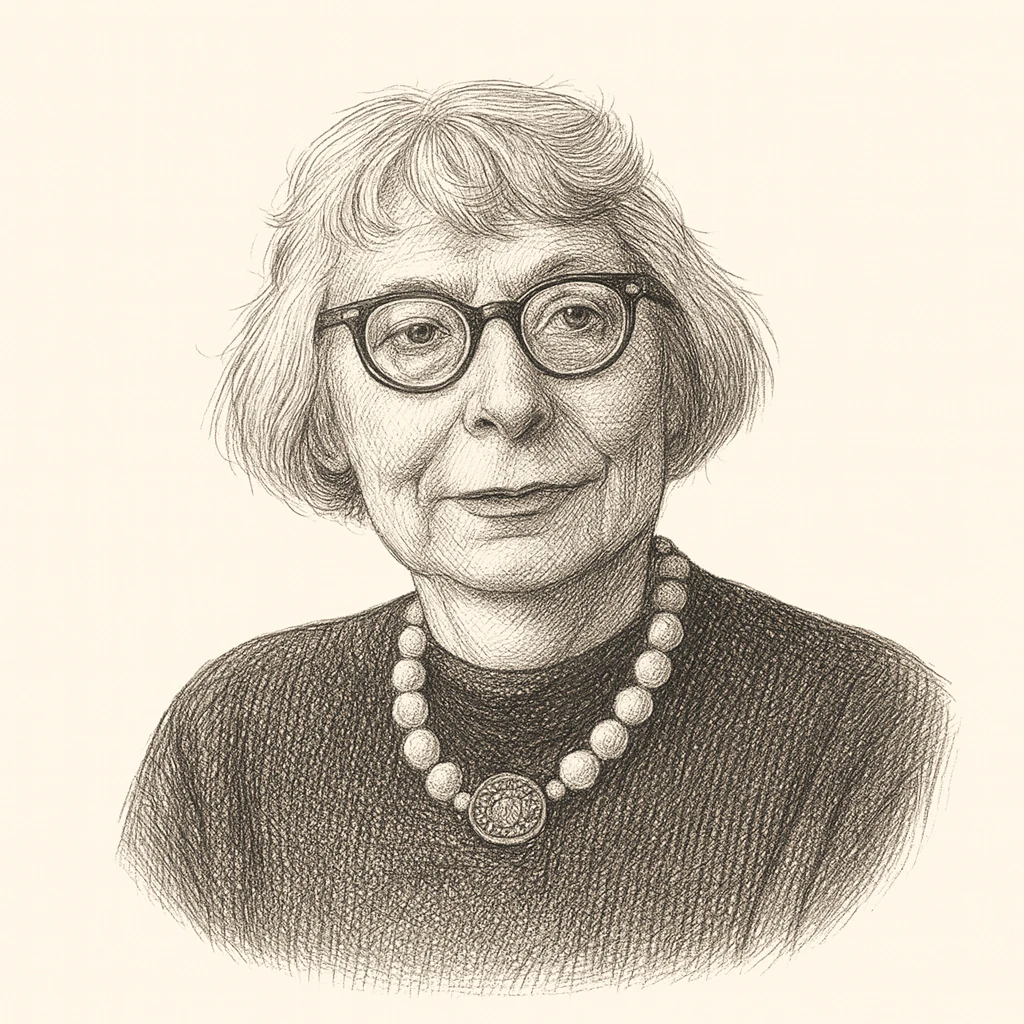
Jane Jacobs was born Jane Butzner in Scranton, Pennsylvania, on May 4, 1916, and moved to New York in the mid-1930s. She worked as a stenographer and freelance writer, and in 1952 became an associate editor at Architectural Forum, covering school and hospital buildings and then planning and rebuilding. That work led to The Death and Life of Great American Cities, published by Random House in 1961.
The book begins, "This book is an attack on current city planning and rebuilding." Against the clearance projects of urban renewal and the planners' separation of uses, Jacobs argued from what she observed on working streets. A street that can handle strangers safely, she wrote, needs "eyes upon the street, eyes belonging to those we might call the natural proprietors of the street," with buildings that face it. To "generate exuberant diversity in a city's streets and districts," she named four conditions as indispensable: districts serving more than one primary function, short blocks, a close mix of buildings of varying age and condition including a good share of old ones, and a dense concentration of people. "The necessity for these four conditions is the most important point this book has to make," she wrote. Her case put the knowledge of residents and the order of ordinary street life ahead of master plans drawn from above.
She practiced the argument in Greenwich Village. In 1958 she helped form the Joint Emergency Committee to Close Washington Square Park to Traffic, with Eleanor Roosevelt, Margaret Mead and Lewis Mumford among its figures, against Parks Commissioner Robert Moses's plan for a roadway through the park; after a trial closure, the park was never reopened to cars. In the early 1960s she and her neighbors kept urban renewal out of the West Village, and from 1962 she led opposition to Moses's proposed Lower Manhattan Expressway. In April 1968 she disrupted a public meeting on the project and was arrested.
Opposed to the Vietnam War, she moved her family to Toronto at the end of the 1960s and joined the successful fight against the Spadina Expressway there. Her later books carried her method from streets to economies and states: The Economy of Cities (1969), Canadian Cities and Sovereignty Association (1980) on Quebec, Cities and the Wealth of Nations (1984), Systems of Survival, a dialogue on the moral foundations of commerce and politics, and The Nature of Economies (2000). Her last book, Dark Age Ahead (2004), described several values she believed were under threat in the United States and Canada. She died in Toronto in April 2006, at 89.
Jane Jacobs is associated with Independent Localist. See the archetype