
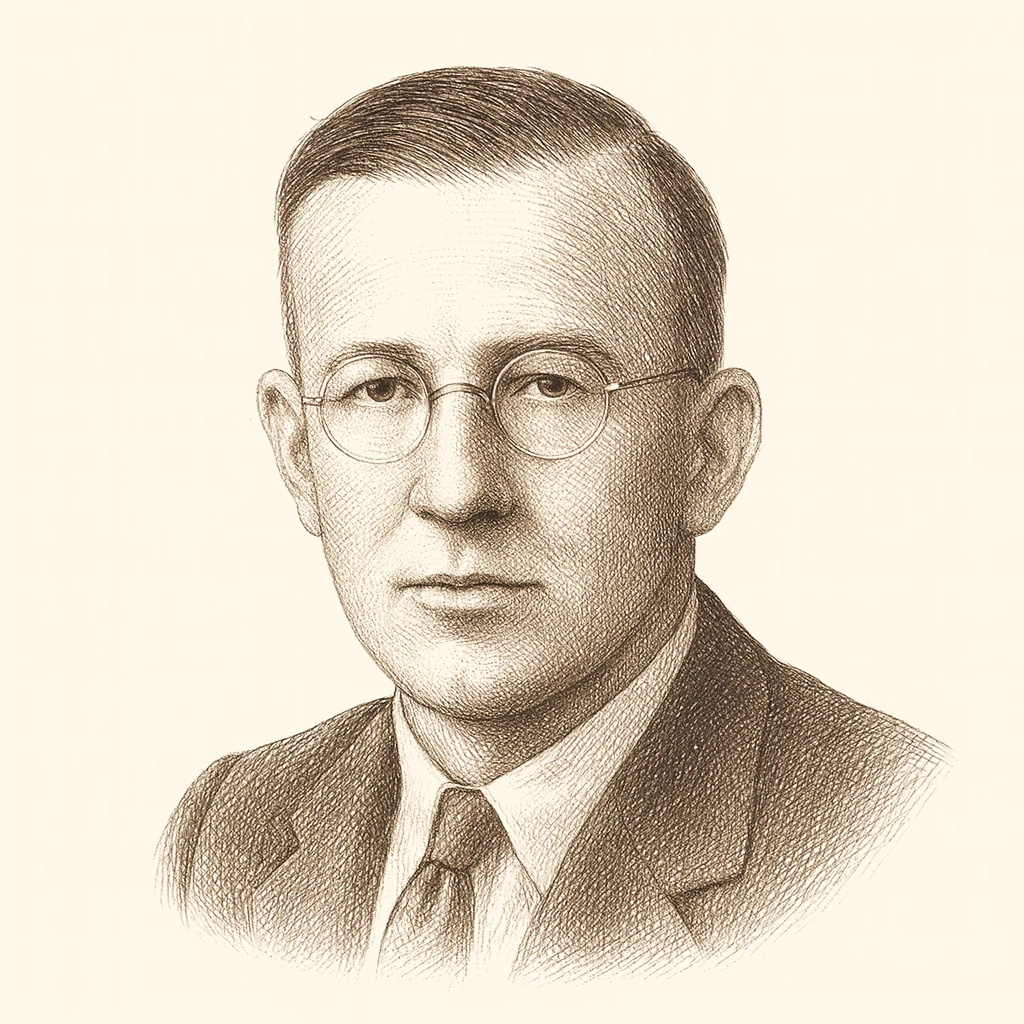
James Burnham was born in 1905 in Chicago, the son of a British-born railroad executive, and educated at Princeton and then at Balliol College, Oxford, on a fellowship — an elite formation that gave him the easy confidence of someone who had been prepared for intellectual authority from birth. He returned to the United States, took a position teaching philosophy at New York University, and was drawn into the radical politics of the 1930s through the characteristic route of that decade: the Depression, the apparent collapse of capitalism, and the Communist Party's claim to have the historical solution. But Burnham was drawn not to the Party itself but to the Trotskyist opposition — the group organized around Leon Trotsky's critique of Stalinism as a bureaucratic betrayal of the revolution. He became one of the leaders of the American Socialist Workers Party, the Trotskyist organization, and traveled to Mexico in 1937 to participate in the commission investigating Stalin's charges against Trotsky — a trip that brought him into direct personal contact with the exiled revolutionary.
The relationship with Trotsky was intellectually productive and ultimately explosive. Burnham was drawn to Trotsky's analysis of Stalinism as a bureaucratic degeneration of the workers' state, but he was developing doubts about the underlying Marxist framework that Trotsky regarded as inviolable. The debate within the Socialist Workers Party in 1939-40, over whether the Soviet Union should still be defended despite its invasion of Finland and its pact with Hitler, crystallized the disagreement. Burnham argued that the Soviet Union was neither a workers' state nor a degenerated workers' state but something new — a collectivist bureaucratic society governed not by the working class but by a new class of managers and administrators. Trotsky insisted this was heresy. Burnham resigned from the Party in 1940.
The Managerial Revolution (1941) was the theoretical synthesis he had been developing through the dispute. Its central argument was that capitalism and socialism, as classically conceived, were both being displaced by a new form of society in which power was held neither by owners of capital nor by the working class but by a new class of managers — technical administrators, corporate executives, state planners, military officers — who controlled the large organizations on which modern industrial society depended. He saw this managerial revolution proceeding simultaneously in New Deal America, Fascist Germany, and Stalinist Russia. The ideological packaging differed; the structural reality was the same. A new ruling class was consolidating power through organizational control rather than property ownership, and the old categories of capitalism versus socialism were becoming obsolete.
The book was read closely and seriously by George Orwell, who engaged with it in three extended essays written between 1944 and 1946. Orwell thought Burnham was wrong about the irreversibility of the managerial revolution but right about its dynamics. The Inner Party of Oceania in Nineteen Eighty-Four — the elite that controls society through organizational power rather than ownership, that has made the perpetuation of its own power the explicit aim of the system, that maintains its rule through the control of information rather than through traditional property relations — owes a recognizable intellectual debt to Burnham's analysis, filtered through Orwell's very different political commitments and moral imagination.
By 1945 Burnham had completed the journey from Trotskyism to anti-Communist conservatism that his analysis of the managerial revolution had made logically available. The same analysis that explained Stalinism as a new form of ruling-class domination could explain why the Soviet Union was an expansionist power rather than a country that had simply made socialism work badly — it had different rulers, not different structural imperatives. The Struggle for the World (1947) and The Coming Defeat of Communism (1950) were his strategic arguments for the Cold War: that the West faced an ideological enemy that intended global domination and that the appropriate response was active opposition rather than accommodation, containment rather than coexistence.
Suicide of the West (1964) was his most culturally influential work. Its argument was that liberalism — understood as a comprehensive worldview rather than merely a political system — was a form of civilizational self-dissolution, a collection of attitudes about guilt, self-criticism, and the obligations of power that systematically weakened the West's capacity to defend itself. The liberal guilt that prevented clear thinking about Soviet aggression, the liberal universalism that made it impossible to privilege one's own civilization over others, the liberal sentimentality about negotiation and compromise with ideological enemies — these were not accidental features of liberalism but expressions of its deepest commitments, and they made liberal civilization incapable of the unsentimental exercise of power that survival required. The phrase "suicide of the West" has traveled through conservative rhetoric ever since, detached from its original Cold War context and applied to every subsequent conservative anxiety about cultural decline.
He joined the founding editorial board of National Review in 1955 and remained a contributing editor for the rest of his career, providing the conservative movement with a strategic realism and an analysis of elite power that complemented Buckley's cultural conservatism and the neoconservatives' democratic idealism. He received the Presidential Medal of Freedom from Ronald Reagan in 1983. He died in 1987.
James Burnham is associated with Techno-Authoritarian. See the archetype